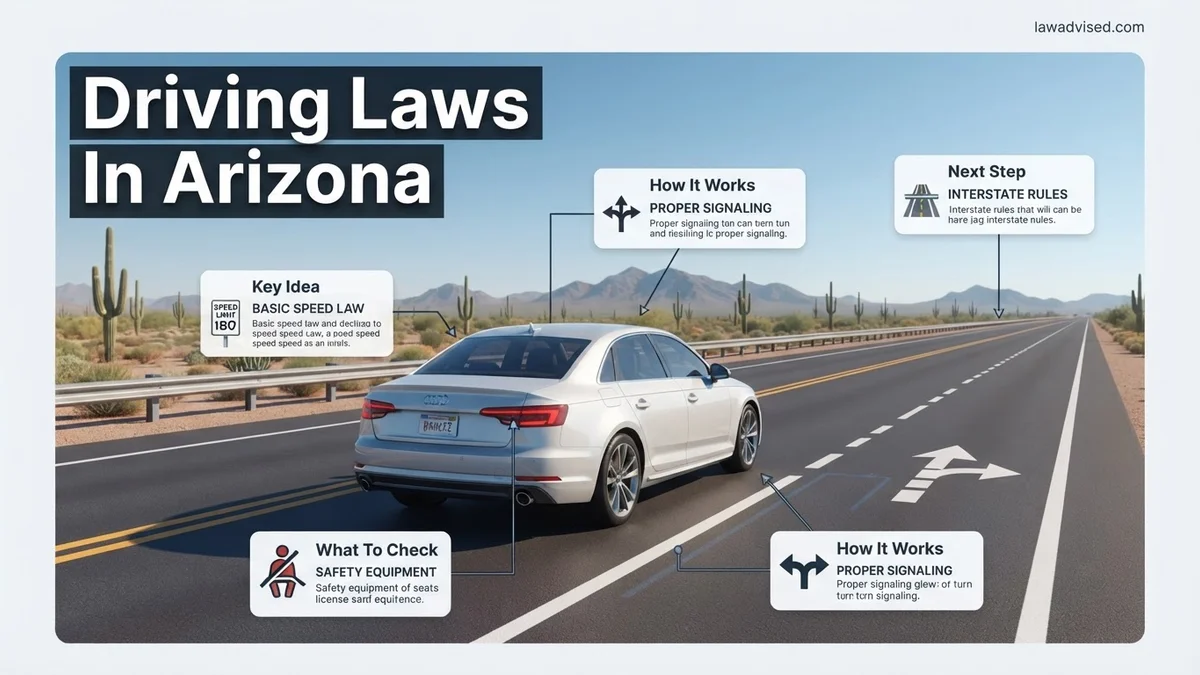
Driving Laws in Arizona 2027 Expert Guide to Rules & Fines
Navigating the roads safely requires staying up to date with driving laws in Arizona, including strict hands-free device bans and zero-tolerance policies. Ignorance of these regulations can lead to heavy fines, license points, or serious legal trouble. Review this guide to ensure full compliance on state highways and local streets.
Navigating Arizona roadways in 2027 requires strict adherence to updated state statutes, particularly regarding mobile device usage, automated enforcement, and strict right-of-way rules. If you drive in Phoenix, Tucson, or across state highways without understanding these specific local regulations, you risk facing severe financial penalties, point accumulations on your motor vehicle record, and heightened accident liabilities.
State enforcement agencies prioritize proactive compliance to lower accident rates across desert corridors and urban grids. Knowing the exact legal thresholds—from hands-free device restrictions to automated red-light enforcement triggers—keeps you safe from costly citations and protects your driving privileges.
Key Takeaways
- Arizona strictly bans holding or using any cell phone while driving.
- The standard Blood Alcohol Concentration (BAC) limit for adult drivers is 0.08%.
- Drivers must move over or slow down for stopped emergency and utility vehicles.
- Red-light cameras are active in several municipalities and issue automated citations.
- Left-turning drivers must yield the right-of-way to oncoming through traffic.
What Causes Traffic Violations and Accidents Under Arizona Driving Laws
The vast majority of traffic citations and collisions in Arizona stem from specific behavioral infractions that state troopers and local police heavily target. Recognizing these high-risk areas helps you avoid expensive tickets.
Distracted Driving and the Strict Hands-Free Ban
Arizona enforces a strict hands-free driving law that prohibits holding or supporting a mobile device with any part of your body while operating a vehicle. You cannot read, write, send texts, or browse social media behind the wheel. First-time offenses carry fines ranging from seventy-five to two hundred and fifty dollars, while repeat violations escalate quickly.
- Holding a smartphone to make calls while driving is completely illegal.
- Checking GPS maps on a handheld device while stopped at a red light constitutes a violation.
- Using built-in vehicle dashboard systems or voice-activated commands remains fully permitted.
Red-Light Cameras and Speeding Thresholds
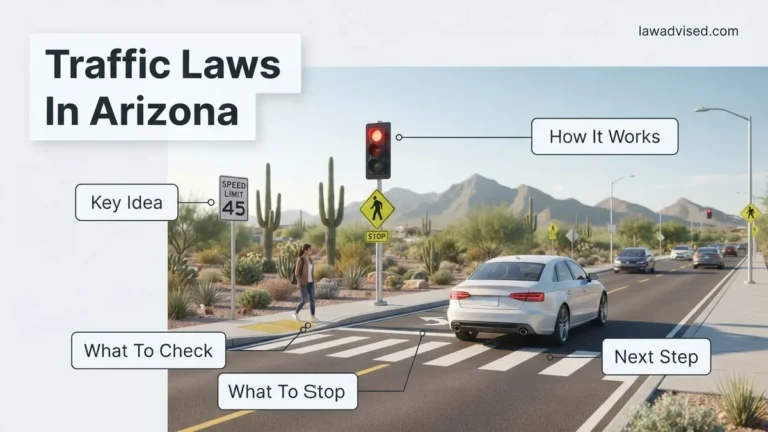
Automated photo enforcement systems operate actively across numerous intersections in the Phoenix metropolitan area. These cameras capture license plates the exact millisecond a vehicle enters an intersection after the signal turns red, or when drivers exceed posted limits by more than ten miles per hour.
- Intersection cameras issue automated citations directly to the registered vehicle owner.
- Fines for automated red-light violations frequently exceed three hundred dollars.
- Ignoring a photo enforcement summons ultimately results in a physical process server visit and extra fees.
How to Fix Dangerous Driving Habits and Comply With Arizona Statutes
Adapting your daily commute to align with Arizona Revised Statutes prevents unexpected legal trouble. Implementing specific behavioral changes ensures total compliance with unique local rules.
Mastering the Arizona Move-Over Law
Arizona statutes mandate that you must move over one lane—when safe to do so—whenever you approach any stationary vehicle displaying flashing lights on the side of the highway. This rule applies far beyond police cruisers to tow trucks, maintenance vehicles, and passenger cars with hazard lights active.
- Switch lanes completely if traffic permits on multi-lane highways.
- Reduce your vehicle speed to at least twenty miles per hour below the posted limit if changing lanes is unsafe.
- Failure to yield or move over can result in civil traffic violations and hefty fines.
The Legal Reality of Zipper Merging
Heavy construction zones across Arizona in 2027 make understanding the zipper merge essential for traffic flow and safety. State transportation departments actively encourage drivers to use both lanes all the way up to the merge point before taking turns blending together.
- Do not block merging traffic prematurely out of frustration or perceived etiquette.
- Alternate yielding vehicle by vehicle at the designated lane reduction point.
- Complying with zipper merge guidelines reduces overall highway congestion by up to forty percent.
Step-by-Step Compliance Guide for Hands-Free Laws and Speed Limits
Navigating Arizona roadways in 2027 requires strict adherence to updated technological mandates and velocity thresholds. According to the Arizona Department of Transportation (ADOT), enforcement regarding device usage and highway speeds has intensified to reduce preventable collisions statewide.
Mastering the Hands-Free Mandate
The state’s expanded distracted driving legislation prohibits holding or supporting any standalone electronic device while operating a motor vehicle. Drivers must integrate fully integrated Bluetooth systems or single-touch dashboard mounts. Law enforcement agencies utilize elevated patrol vantage points to spot violations instantly.
Adhering to Absolute and Absolute Speed Limits
Speed regulations rely strictly on absolute limits unless weather or road conditions dictate a safer, reduced pace. State highway patrols enforce a zero-tolerance buffer for excessive acceleration in urban corridors. Drivers must verify posted signage continuously, as municipal speed thresholds fluctuate frequently near active school zones and construction sites.
- Synchronize mobile devices to vehicle audio systems before shifting out of park.
- Mount navigation hardware securely to the dashboard or center console out of the primary airbag deployment zone.
- Calibrate cruise control systems to match the exact posted maximum limit on interstate highways.
- Scan the roadway ahead continuously for variable electronic advisory speed signs.
What If It Still Doesn’t Work and You Receive a Traffic Citation
Receiving an unexpected traffic ticket in Arizona can disrupt daily routines, but established legal procedures provide a clear path forward. If roadside arguments fail or automated speed cameras issue an infraction notice by mail, drivers must address the citation promptly to avoid escalating penalties, license suspension, or bench warrants.
Actionable Resolution Steps
Drivers facing active citations must evaluate their legal options carefully within the mandated timeframe printed on the violation notice. Resolving the matter efficiently minimizes financial impact and prevents demerit points from accumulating on the official driving record maintained by the Motor Vehicle Division (MVD).
- Review the citation details thoroughly for administrative errors, incorrect vehicle descriptions, or inaccurate timestamp data.
- Contact the designated municipal or justice court before the specified appearance deadline to verify total fine amounts, which typically range from $250 to $500 depending on the severity of the infraction.
- Enroll in an approved Arizona Defensive Driving School program if eligible, which completely dismisses qualifying civil traffic violations and prevents insurance rate spikes.
- Retain a qualified traffic defense attorney for complex contested hearings, with professional legal representation fees generally starting around $350 to $750 for standard misdemeanor infractions.
Conclusion
Staying fully compliant with Arizona driving laws protects both your financial wellbeing and personal safety on the highway. According to verified research and expert sources from the Governor’s Office of Highway Safety, proactive adherence to hands-free mandates and speed limits significantly reduces fatal collisions. Your immediate next step is to review your vehicle’s technology setup and verify that your current insurance policies meet or exceed state minimum liability requirements for 2027.
❓ Frequently Asked Questions
What are the penalties for violating Arizona’s hands-free cell phone law?
First-time violations carry fines ranging from $75 to $250. Subsequent offenses carry higher fines and can result in points added to your driver’s license record.
How does the Arizona Move Over Law work?
Drivers approaching stationary emergency vehicles, tow trucks, or maintenance vehicles with flashing lights must move over one lane if safe, or slow down significantly if changing lanes is impossible.
Are red-light cameras legal and enforceable in Arizona?
Yes, automated photo enforcement cameras are legal in jurisdictions like Phoenix and Scottsdale. Citations captured by these cameras are mailed to the registered owner of the vehicle.
What are the rules regarding school buses in Arizona?
Drivers traveling in both directions on undivided highways must come to a complete stop when a school bus displays flashing red lights and a stop sign arm until the signal is deactivated.
What should I do if I am involved in a minor traffic accident in Arizona?
Drivers must immediately stop their vehicles at the scene, exchange insurance and license information with the other parties involved, and report the accident if there are injuries or significant property damage.
Does Arizona use the zipper merge method in construction zones?
Yes, Arizona Department of Transportation encourages the zipper merge, where drivers use both lanes until reaching the merge point and take turns merging in an alternating fashion.

Ismail Hossain is the founder of Law Advised. He is an Divorce, Separation, marriage lawyer. Follow him.