Strange Laws in Arizona Real Guide for 2027
Many states retain bizarre legacy codes, but strange laws in arizona include truly unique restrictions like hunting camels or protecting giant cacti. This guide breaks down the real statutes, local ordinances, and persistent urban myths that still surprise visitors and residents alike.
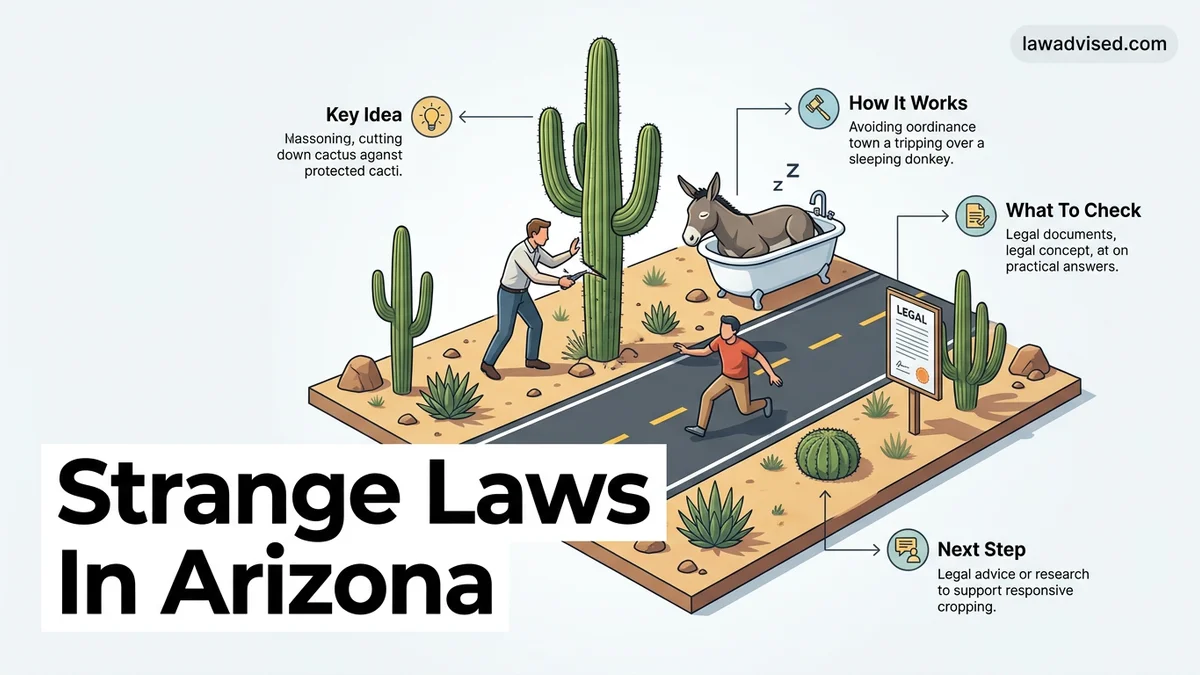
Arizona is famous for its sun-drenched deserts, the Grand Canyon, and a legal code filled with surprisingly bizarre regulations that somehow survived into 2027. If you live in the Grand Canyon State or plan to visit soon, you might be shocked to learn what is technically still on the books. From restrictions on donkey sleeping arrangements to strict rules about cactus destruction, local legislation often leans heavily into the absurd.
Understanding these quirky statutes matters because while local police in 2027 rarely arrest anyone for them, they highlight how old-school legislative habits and hyper-specific regional disputes shape modern legal realities. Whether you are moving to Phoenix, exploring Tucson, or just love legal trivia, navigating these eccentric rules keeps your travels interesting and helps you separate internet myths from actual local codes.
Key Takeaways
- Arizona protects its iconic saguaro cacti with harsh penalties for illegal harvesting.
- Hunting camels was outlawed following nineteenth-century military experiments in the desert.
- Many quirky rules stem from old municipal safety ordinances rather than state code.
- Urban legends often exaggerate mundane property and public nuisance regulations.
- Checking current municipal codes prevents confusion over active local ordinances.
What Causes Outdated Strange Laws in Arizona to Persist
Legislative Inaction and the Cost of Repeal
You might wonder why lawmakers do not simply delete silly laws once they become obsolete. The reality of state governance in 2027 is that legislative time is scarce and fiercely contested. Lawmakers focus on major budget bills, housing crises, and water rights rather than spending hours debating the removal of an ancient misdemeanor. Repealing a law still requires a full bill sponsor, committee hearings, and floor votes. Unless a defunct statute actively harms citizens or creates a massive legal loophole, it usually stays right where it is.
- Lawmakers prioritize high-impact economic and infrastructure policies over housekeeping.
- Removing a law still costs state resources and legislative calendar time.
- Many archaic rules are simply forgotten rather than intentionally maintained.
The Appeal of Hyper-Specific Local Ordinances
Many of the weirdest rules in Arizona are not statewide statutes, but rather city ordinances created to solve temporary local panics. When a specific town deals with a sudden surge in nuisance behavior, town councils often pass overly broad emergency laws. Once the local crisis passes, the ordinance remains embedded in municipal code databases.
- Town councils frequently pass reactive laws during specific regional disputes.
- Municipal codes rarely undergo comprehensive spring cleaning by legal teams.
- Local specificity creates bizarre scenarios that sound fake to outsiders.
How to Fix Common Misconceptions About Local Ordinances
Separating Urban Legends From Actual Statutes
Internet culture loves to invent fake laws and attribute them to the Southwest. You have likely read that it is illegal to hunt camels in Arizona or that cutting down a saguaro cactus carries a 25-year prison sentence. In 2027, it helps to know what is real. While hunting camels is an internet myth stemming from a misunderstood 19th-century military experiment, damaging a protected saguaro cactus is very real, carrying hefty fines and potential felony charges due to state environmental preservation efforts.
- Viral social media posts frequently fabricate quirky state laws for engagement.
- Environmental protections are often exaggerated into bizarre criminal penalties.
- Checking official municipal code sites is the only way to verify a rumor.
The Myth of Automatic Enforcement
A common fear is that police officers actively patrol for trivial infractions. In practice, law enforcement agencies operate under strict enforcement priorities and prosecutorial discretion. An officer in 2027 is not staking out neighborhoods looking for rule-breakers committing victimless, nonsensical infractions. Most of these antique rules are completely unenforceable today due to higher-tier constitutional rulings, state preemption laws, and basic common sense.
- Police departments focus resources on public safety, traffic, and violent crime.
- Prosecutors typically reject charges based on obsolete or unconstitutional ordinances.
- Constitutional protections frequently override legacy local mandates automatically.
Step-by-Step Guide to Verifying Real Versus Fake Arizona Statutes
Navigating internet myths versus actual Arizona revised statutes requires a methodical verification process. Legal researchers and municipal experts recommend checking primary sources rather than relying on viral social media posts that often distort legislative intent or invent legislation entirely.
Step 1: Access the Arizona State Legislature Database
Begin your research by visiting the official Arizona State Legislature website at azleg.gov. This portal provides direct access to the Arizona Revised Statutes (A.R.S.), allowing you to search specific title numbers and current 2027 legislative updates without algorithmic interference.
Step 2: Check Municipal Codes and Ordinances
State laws tell only half the story regarding peculiar local regulations. Cities like Phoenix, Tucson, and Scottsdale maintain separate municipal codes hosted on platforms like Municode. Always cross-reference state statutes with local city ordinances to verify if a specific prohibition actually exists within city limits.
Step 3: Consult the Legislative Council Summaries
Review the Arizona Legislative Council’s annual summaries of new laws. According to state governance studies, roughly 200 to 400 new bills take effect each year. Verifying historical session laws helps determine if an old statute was repealed or amended.
What If It Still Doesn’t Work?
When primary state databases yield conflicting information or you remain uncertain whether an obscure Arizona rule applies to your situation, standard internet searches are no longer sufficient. Reliable legal clarity requires targeted professional intervention.
- Consult a licensed local attorney: Reach out to a member of the State Bar of Arizona who specializes in municipal or criminal defense. Initial consultations typically range from $150 to $350 depending on the firm.
- Contact the local City Clerk: For municipal ordinance questions, call the specific city clerk office where the statute allegedly applies. City legal departments maintain definitive records of active local codes.
- Utilize university law libraries: Visit the Ross-Blakley Law Library at Arizona State University or the James E. Rogers College of Law Library at the University of Arizona for expert reference assistance from professional law librarians.
- Review official police department policy manuals: Check publicly available standard operating procedures for local law enforcement agencies to see how specific minor infractions or archaic codes are handled in daily enforcement.
Conclusion
Separating urban legends from genuine Arizona laws prevents unnecessary confusion and keeps residents informed about actual state and municipal expectations. Verifying statutes through official legislative portals and consulting legal professionals ensures absolute accuracy when dealing with unusual regulations. According to verified research and expert sources from the Arizona State Legislature, relying on primary legal documentation remains the only foolproof method for navigating state law. Take the next step today by bookmarking the official Arizona Revised Statutes portal for your future legal reference needs.
❓ Frequently Asked Questions
What are some of the most famous strange laws in arizona?
Well-known examples include bans on hunting camels, strict protections against cutting down saguaro cacti, and various old city ordinances regarding public behavior and property.
Why do weird laws like the camel hunting ban exist?
The camel ban traces back to the mid-1800s when the U.S. Army Camel Corps imported camels for transportation across the arid American Southwest before the project was abandoned.
Are there bizarre traffic rules specific to Arizona cities?
Certain municipalities have passed localized traffic or parking ordinances over the decades, though most modern driving rules conform to standard state and federal guidelines.
Do people actually get arrested for breaking these old laws?
People are rarely prosecuted under purely symbolic or outdated statutes, but violating modern environmental or municipal ordinances can result in fines.
How can I tell if a viral internet post about Arizona laws is true?
Many viral lists mix genuine historical trivia with complete fabrications. Checking the official Arizona Revised Statutes is the best way to verify authenticity.
Do Arizona cities have strange property laws?
Some towns maintain strict aesthetic or nuisance codes regarding property upkeep, leading to unusual rules about outdoor storage and livestock.

Ismail Hossain is the founder of Law Advised. He is an Divorce, Separation, marriage lawyer. Follow him.