Motorcycle Laws in Arizona 2027 Expert Legal Guide
Navigating motorcycle laws in Arizona requires understanding specific state statutes regarding safety gear, lane filtering, and licensing. Riders must strictly follow regulations on helmets for minors, eye protection, and mandatory equipment to ensure road legality.
Arizona stands as one of the premier states for year-round motorcycle riding, but its legal landscape demands strict adherence. If you ride on Grand Canyon State roads in 2027, you must know the exact rules governing safety equipment, licensing, and traffic flow. Failing to comply can lead to hefty fines, insurance complications, and severe legal liabilities if an accident occurs.
The rules in Arizona are specific, particularly regarding head protection and the state’s famous lane-filtering allowances. Navigating these statutes correctly protects you from traffic citations and ensures you keep your riding privileges intact.
Key Takeaways
- Riders and passengers under 18 must wear a DOT-approved helmet at all times.
- Lane filtering is legal under specific traffic conditions outlined in House Bill 2250.
- All operators need a valid driver license with a motorcycle endorsement (Class M).
- Mandatory equipment includes proper exhaust systems, handlebars, and functioning mirrors.
- Eye protection is legally required unless the motorcycle features a protective windshield.
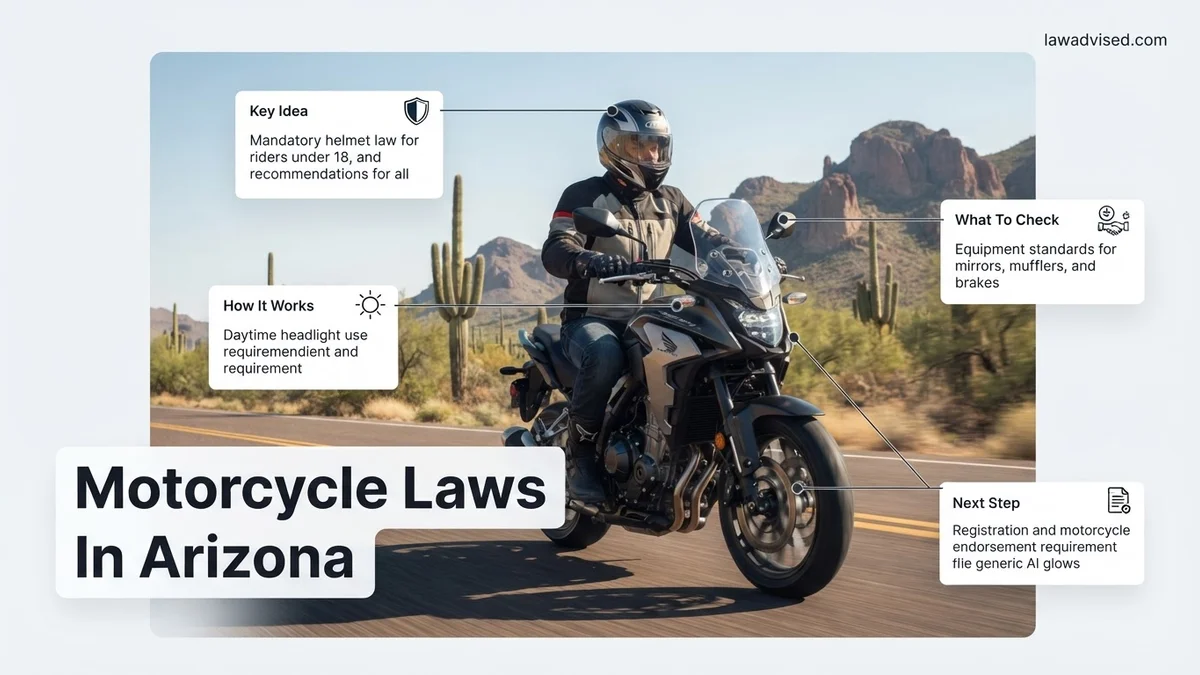
What Causes Confusion Regarding Arizona Motorcycle Regulations
The Gray Areas of Helmet and Eye Protection Mandates
Many riders stumble over Arizona’s tiered helmet laws. If you are under the age of 18, state law strictly mandates that you wear a DOT-approved helmet at all times. For riders 18 and older, the law does not require a helmet. However, this creates a false sense of security regarding other gear.
Eye protection remains mandatory for all riders, regardless of age, unless your motorcycle features a functional windshield. If a police officer pulls you over and your sunglasses or goggles do not meet safety standards, you face a citation. Relying on assumptions about adult exemptions frequently lands riders in trouble.
Misunderstandings Surrounding Lane Filtering Rules
Arizona made history by legalizing lane filtering, but riders constantly confuse it with illegal lane splitting. House Bill 2250 set strict boundaries that you cannot cross without breaking the law. Filtering is only permitted under specific conditions:
- Traffic must be completely stopped or moving at 10 miles per hour or less.
- You cannot exceed a speed of 15 miles per hour while filtering.
- The maneuver must occur on roads with a speed limit of 45 miles per hour or higher.
- You must operate in the same direction and within adjacent lanes headed the same way.
Riders often assume they can weave through highway traffic at 30 miles per hour during a slowdown. That crosses the line from legal filtering into reckless driving.
How to Fix Compliance Issues With Safety Gear and Licensing
Securing the Proper Endorsement and Core Equipment
Fixing compliance issues starts with your driver license. Operating a motorcycle in Arizona requires a valid Class M endorsement or a motorcycle-only license. To get this, you must pass a written knowledge test and a skills test, though passing an approved Motorcycle Safety Foundation (MSF) course often waives the on-bike test.
Your bike must also match state equipment statutes to avoid equipment fix-it tickets. Make sure your setup includes:
- At least one rearview mirror mounted on the handlebars.
- Working turn signals, brake lights, and a rear license plate light.
- An exhaust system equipped with a muffler to prevent excessive noise.
- Secure passenger footpegs and a designated seat if you carry a rider.
Proactive Steps for 2027 Legal Riding
Enforcement standards tighten as traffic volumes increase across Phoenix and Tucson. Police officers actively look for illegal handlebar heights—which cannot rise above your shoulders—and missing safety components. Review your motorcycle setup before every long trip. Keeping your paperwork current and your bike physically compliant guarantees you avoid roadside hassles and ride with total peace of mind.
What If Lane Filtering Rules and Equipment Requirements Still Aren’t Met
Navigating Arizona roadways requires strict adherence to equipment mandates and filtering protocols. When riders fail to meet these statutory standards, legal and financial repercussions quickly follow. Understanding compliance failures protects both your driving record and your personal injury rights in 2027.
Penalties for Non-Compliance with Equipment Mandates
Operating a motorcycle without federally compliant helmets for riders under 18, lacking proper eye protection, or missing required rearview mirrors results in civil traffic violations. Fines typically range from $150 to $250 for a first offense. Furthermore, law enforcement can issue repair orders for missing turn signals or inadequate exhaust systems. Failure to correct these mechanical deficiencies within designated timeframes leads to vehicle registration holds.
Legal Liabilities Stemming from Unlawful Lane Filtering
Arizona law permits lane filtering under specific conditions, including traffic speeds under 20 mph and roads with speed limits of 45 mph or greater. Violating these operational boundaries strips the rider of statutory protections. If a collision occurs while filtering illegally, insurance adjusters and courts frequently assign partial or total fault to the motorcyclist. According to verified traffic safety research, comparative negligence laws in Arizona can completely bar a rider from recovering damages if they are found more than 50 percent at fault for the accident.
What If It Still Doesn’t Work?
If initial attempts to resolve a traffic citation or insurance dispute regarding Arizona motorcycle laws fail, riders must escalate their approach. Follow these precise fallback steps to protect your legal standing:
- Consult a specialized motorcycle attorney: Reach out to a legal professional who focuses specifically on Arizona traffic and personal injury law to evaluate your citation or accident report.
- Request an administrative hearing: If facing point accumulations or license suspensions due to alleged violations, formally contest the action through the Arizona Department of Transportation within the statutory 15-day window.
- Commission an independent vehicle inspection: Hire a certified mechanic to document that your motorcycle equipment meets state standards, which typically costs between $100 and $250.
- Gather supplementary digital evidence: Retrieve and preserve helmet-cam or dash-cam footage demonstrating compliance with lane filtering speeds and environmental conditions at the time of the incident.
Conclusion
Mastering Arizona motorcycle laws involves strict compliance with equipment standards, protective gear mandates, and precise lane-filtering protocols. Failing to meet these legal thresholds exposes riders to costly fines and severe liability risks during accidents. According to verified research and expert legal sources, proactive education and immediate post-incident legal intervention remain the most effective defenses on the road. Take the next actionable step by scheduling a comprehensive compliance check for your motorcycle and reviewing your current insurance policy limits today.
❓ Frequently Asked Questions
What are the exact rules for lane filtering in Arizona?
Lane filtering is permitted on roads with a speed limit of 45 mph or higher when vehicles are completely stopped. The motorcycle must not exceed 15 mph while filtering.
What is the minimum insurance requirement for motorcycles in Arizona?
Arizona law mandates liability insurance with minimum limits of $25,000 for bodily injury per person, $50,000 per accident, and $15,000 for property damage.
Can I carry a passenger on my motorcycle in Arizona?
Yes, provided the motorcycle is factory-equipped with designated passenger footpegs and a proper passenger seat. Passengers must also follow the under-18 helmet rule.
Are handlebar height modifications restricted in Arizona?
Yes, handlebars cannot be positioned higher than the shoulder height of the operator when seated properly in the saddle.
What happens if I am caught riding without a motorcycle endorsement?
Operating a motorcycle without a proper Class M endorsement is considered a civil traffic violation and carries statutory fines.
Are aftermarket exhaust pipes legal if they are loud?
Arizona requires motorcycles to have an adequate muffler system to prevent excessive or unusual noise. Completely straight pipes or modified exhausts lacking baffling may result in a citation.

Ismail Hossain is the founder of Law Advised. He is an Divorce, Separation, marriage lawyer. Follow him.