Gun Laws in Arizona in Car 2027 Expert Legal Guide
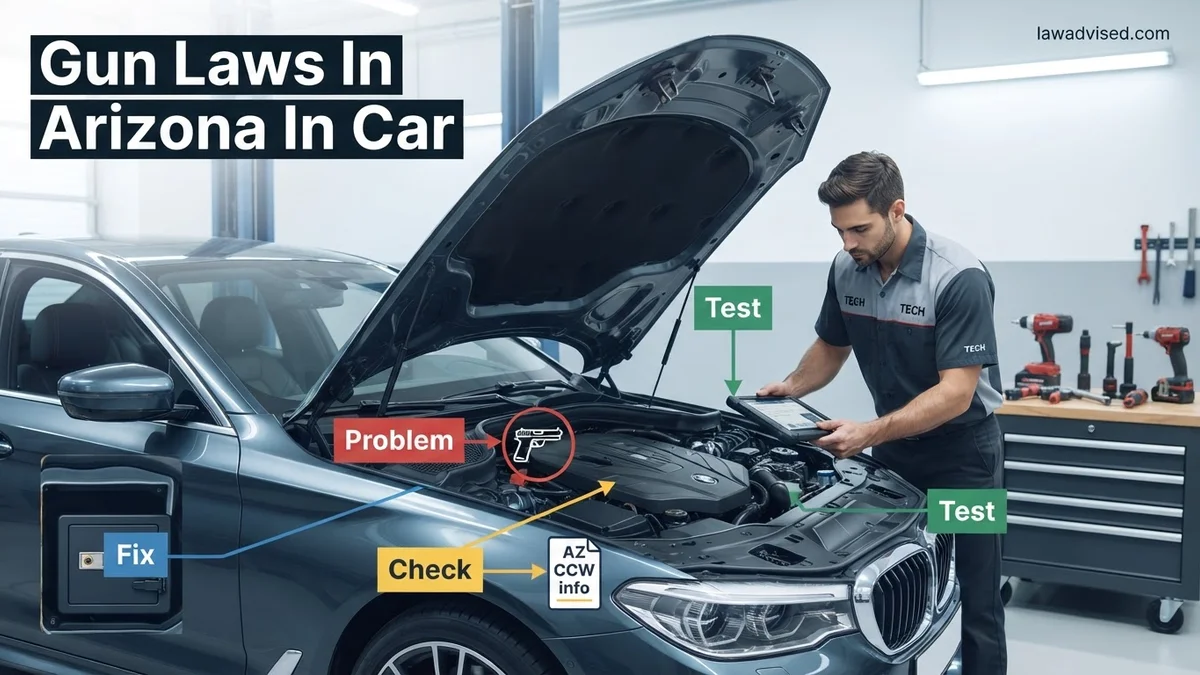
Navigating gun laws in Arizona in a car requires understanding the state’s constitutional carry provisions and storage rules. Adults aged 21 and older can legally keep a loaded firearm anywhere in their vehicle without a permit.
If you are at least 21 years old, Arizona law allows you to keep a loaded firearm anywhere inside your vehicle—including the glove box, center console, or sitting openly on the seat—without needing a concealed carry permit. This is part of the state’s robust permitless carry framework, which treats your vehicle as an extension of your home.
Knowing these vehicle carry rules keeps you legally compliant during routine traffic stops and helps you avoid misunderstandings with law enforcement. Whether you are commuting through Phoenix or road-tripping across rural desert highways, navigating Arizona’s 2027 firearm statutes requires clear knowledge of where your gun can go and who is legally allowed to put it there.
Key Takeaways
- Adults 21 and older can carry loaded firearms openly or concealed in vehicles without a permit.
- Firearms can be stored in the glove box, center console, on the seat, or in a holster.
- Individuals aged 18 to 20 face different restrictions and generally must keep firearms openly visible.
- Arizona law does not require you to voluntarily inform law enforcement officers during a traffic stop.
- Possessing firearms is strictly prohibited on school grounds and certain federal or tribal lands.
What Causes Confusion With Gun Laws in Arizona in Car
The Myth of the Visible Requirement
Many drivers mistakenly believe that a firearm inside a vehicle in Arizona must remain in plain sight, such as resting on the dashboard or passenger seat. This misconception often stems from old-school advice or confusion with laws from other states. In Arizona, your weapon does not need to be visible to anyone looking into your car.
-
Common vehicle storage locations include:
- Locked or unlocked center consoles
- Glove compartments
- Underneath the driver or passenger seat
- In a holster on your body or secured in a bag
Permitless Carry Versus CCW Permit Rules
Another major point of confusion involves how Arizona treats residents versus visitors, and the role of the Concealed Weapons Permit (CCW). Because Arizona is a constitutional carry state, any legal adult who is at least 21 can carry concealed in a vehicle. However, having an Arizona CCW permit still offers distinct legal advantages as of 2027, such as reciprocity in other states and expedited gun purchases. Drivers frequently wonder if they need a permit to cross tribal lands or school zones, which introduce specific federal and tribal nuances that override standard state vehicle laws.
How to Safely Transport Firearms in Your Vehicle Step-by-Step
Choosing Your Vehicle Storage Location
Deciding where to place your firearm in your car depends on your priority: immediate self-defense accessibility or secure out-of-sight storage. If you want quick access, a holster mounted under the steering column or a center console vault works best. If you prefer to minimize distraction, a glove box or dedicated lockbox secured to the vehicle frame keeps the firearm out of reach of passengers or potential thieves.
-
Steps for proper in-car firearm placement:
- Assess your comfort level with accessibility versus security.
- Select a designated compartment that prevents the firearm from sliding around during sudden stops.
- Ensure the weapon has a proper trigger guard or holster coverage if stored loose in a console or glove box.
- Verify that all passengers, especially minors, cannot casually access the firearm if you leave the vehicle unattended.
Interacting Safely During Traffic Stops
Arizona law does not explicitly require you to inform a law enforcement officer that you have a firearm in your vehicle during a routine traffic stop unless the officer specifically asks. Even so, prioritizing safety and communication changes how the interaction unfolds. Keep your hands visible on the steering wheel, and inform the officer calmly where your license, registration, and firearm are located if you choose to disclose its presence.
-
Best practices during a police encounter:
- Keep your hands on the steering wheel when the officer approaches.
- Do not reach into the glove box or console—where guns and paperwork are often kept—without telling the officer first.
- Answer questions regarding weapons honestly and clearly.
- Remember that officers have the temporary authority to secure a firearm for their safety during the duration of the stop.
What to Do During Traffic Stops and Police Interactions
Navigating a traffic stop while carrying a firearm in a vehicle requires strict adherence to legal protocols and officer safety procedures. Arizona law does not impose a mandatory duty to immediately inform law enforcement that you are carrying a weapon unless explicitly asked by the officer. However, legal experts and law enforcement agencies strongly recommend clear communication to prevent misunderstandings.
Step-by-Step Protocol for Drivers
- Keep your hands visible: Place both hands on the steering wheel immediately when the officer approaches your vehicle.
- Turn on interior lights: If the traffic stop occurs at night, activate your dome light so the interior is fully illuminated.
- Inform the officer politely: Clearly state that you have a firearm in the vehicle, specify its exact location, and ask the officer how they would like you to proceed.
- Avoid reaching for the weapon: Never touch, reach for, or adjust the firearm unless the officer explicitly instructs you to do so.
- Comply with lawful orders: Follow all instructions regarding the temporary handling or securing of the firearm for the duration of the stop.
According to safety studies published by the Arizona Department of Public Safety, proactive and calm communication significantly reduces tension during vehicle contacts. Failing to follow basic officer instructions or making furtive movements toward a weapon can escalate a routine traffic stop into a felony detainment.
What If You Are Under 21 or Crossing State Lines
Arizona permits constitutional carry for individuals aged 21 and older. However, strict statutory limitations apply if the vehicle occupant is between the ages of 18 and 20, or if the travel extends beyond state boundaries into neighboring jurisdictions.
Statutory Rules for Adults Aged 18 to 20
- Open carry requirement: Residents aged 18 to 20 may legally carry a firearm in a vehicle only if it remains in plain view. Concealed carry inside a vehicle is prohibited for this age demographic.
- Concealed Carry Permit exception: An 18- to 20-year-old who holds a valid Arizona Concealed Weapons Permit may legally carry concealed inside a vehicle.
- Federal firearm purchases: Federal law prohibits licensed dealers from selling handguns to individuals under 21, though private transfers within state lines may be legal depending on local ordinances.
Interstate Travel Considerations
Transporting a firearm across state lines from Arizona into California, Nevada, Utah, or New Mexico introduces entirely different legal frameworks. Federal law under 18 U.S.C. Section 926A protects interstate transport of firearms, provided the weapon is unloaded, stored in a locked container separate from ammunition, and inaccessible from the passenger compartment. However, destination state laws apply immediately upon arrival. According to legal analysts tracking 2027 firearm regulations, motorists must verify reciprocity agreements before entering neighboring states to avoid severe felony charges.
What If It Still Doesn’t Work?
If legal ambiguity persists regarding your specific vehicle carry scenario, standard troubleshooting steps may not suffice. Take the following actions to ensure full compliance with Arizona law:
- Review the most recent Arizona Revised Statutes (A.R.S. Title 13, Chapter 31) for updated 2027 legislative modifications.
- Consult a certified firearms instructor or legal professional specializing in Second Amendment law for personalized guidance.
- Obtain an Arizona Concealed Weapons Permit to eliminate ambiguity regarding concealed versus open vehicle carry.
- Expect professional legal consultation fees to range from $250 to $500 per hour depending on the complexity of your case.
- Contact local law enforcement non-emergency lines to clarify municipal ordinances that may apply stricter rules than state statutes.
Conclusion
Understanding Arizona vehicle firearm laws protects your constitutional rights while ensuring public safety on the road. Whether relying on constitutional carry or a valid permit, responsible gun owners must prioritize secure storage and compliance during traffic stops. According to verified research and expert legal sources, staying informed on age restrictions and interstate transport laws remains the best defense against inadvertent violations. Take the next step by reviewing current state statutes or enrolling in an accredited training course to keep your driving and carrying practices fully compliant.
❓ Frequently Asked Questions
What are the core vehicle carry rules for adults over 21 in Arizona?
Under Arizona’s constitutional carry laws, any person legally eligible to possess a firearm who is at least 21 years old may carry a loaded or unloaded firearm anywhere inside a vehicle. The weapon does not need to be locked in a case, stored in the trunk, or kept out of sight.
How do vehicle gun laws apply to adults aged 18 to 20?
While federal and state laws permit adults aged 18 to 20 to own and transport firearms, they do not qualify for permitless concealed carry in vehicles. For this age group, any firearm kept inside a vehicle must remain in plain view, such as resting in a holster or on the seat, rather than hidden in a glove box or console.
Is a Concealed Weapons Permit (CCW) still useful in Arizona?
Yes, holding an Arizona CCW permit provides several benefits, including reciprocity with numerous other states, exemption from background check requirements when purchasing firearms from licensed dealers, and the ability to carry in certain locations like restaurants that serve alcohol (unless posted otherwise).
Are there specific requirements for where the firearm must be placed?
Arizona law does not mandate a specific location for storing a firearm in a private vehicle. You can place the weapon on the dashboard, passenger seat, floorboard, center console, or glove box, provided you meet the age requirement for concealed storage.
What should I do if I am pulled over by the police while carrying a gun in my car?
During a traffic stop, keep your hands visible on the steering wheel and follow the officer’s instructions. While you are not legally required to announce that you have a firearm unless asked, it is often wise to calmly inform the officer if they ask to search the vehicle or if you need to reach near the firearm.
Can I cross state lines into Arizona with a loaded gun in my car?
Yes, interstate travelers passing through Arizona must abide by Arizona’s transport laws once inside the state borders. However, you must ensure you comply with the departure state’s laws and any intervening states you travel through before reaching Arizona.

Ismail Hossain is the founder of Law Advised. He is an Divorce, Separation, marriage lawyer. Follow him.