Odd Laws in Arizona Real Weird Statutes and Guide for 2027
Many outdated and bizarre statutes still fill the books, leaving residents and visitors wondering about the truth behind these bizarre rules. This guide to odd laws in Arizona separates real historical statutes from viral internet myths. You will discover the actual context behind the Grand Canyon State’s strangest regulations.
Arizona is home to some of the strangest legal statutes in the United States. Even as we head through 2027, the Grand Canyon State retains a quirky legislative history filled with bizarre rules governing everything from livestock theft to hunting camels. While you will not find police officers actively patrolling for cactus-choppers, these weird laws remain legally on the books or deeply embedded in local folklore.
Understanding these unusual regulations matters practically for your everyday life and travels. It helps you separate internet myths from actual municipal codes. When you know what is real and what is pure fiction, you can navigate local humor and legal history with confidence.
Key Takeaways
- Arizona features numerous strange historical statutes and municipal ordinances.
- Many popular internet rules about Arizona are actually urban legends.
- Outdated laws often reflect the specific social concerns of their era.
- Local city councils historically passed unique bans to solve hyper-local problems.
- Most bizarre ordinances are no longer actively enforced by modern police.
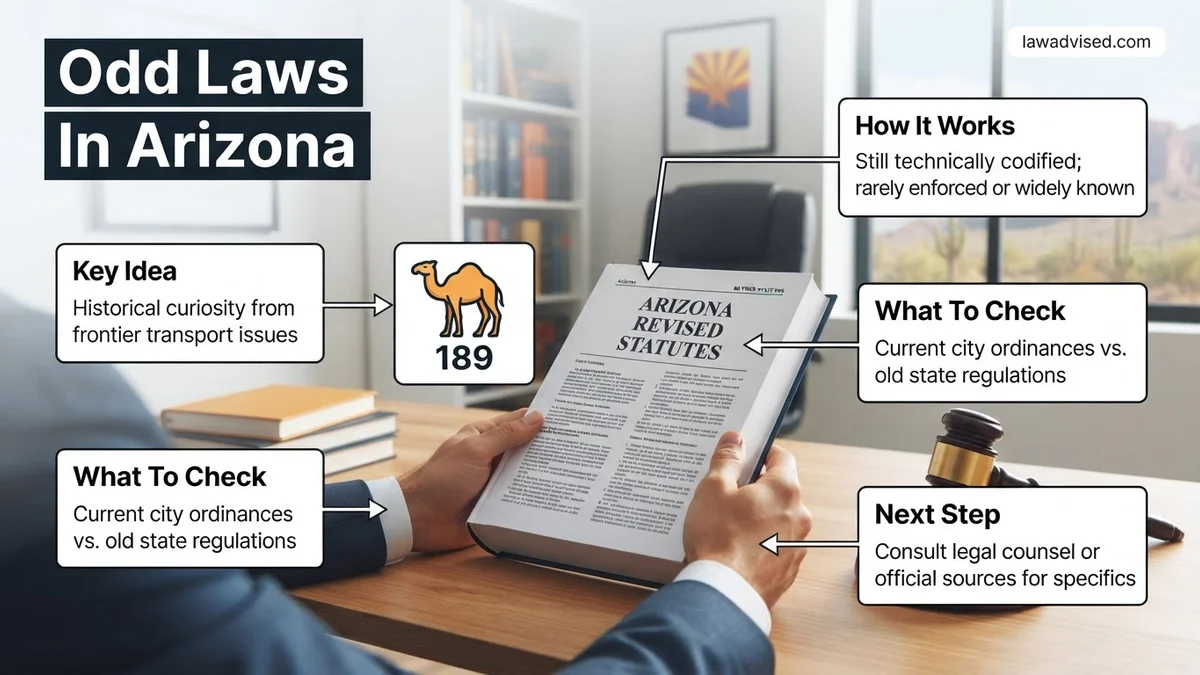
What Causes the Existence of Outdated and Strange Legal Statutes
Old laws do not simply disappear when society changes. Legislative bodies must actively repeal statutes, and harmless historical relics rarely make the priority list for busy lawmakers in Phoenix. You might wonder how absurd rules survive for generations.
The Legislative Inertia Problem
Most weird laws survive simply because lawmakers focus on modern budgetary and criminal justice priorities. Repealing a statute prohibiting hunting camels requires just as much bureaucratic paperwork as passing a major infrastructure bill. Therefore, minor oddities get left behind indefinitely.
- Legislators prioritize 2027 fiscal budgets over cleaning up historical text.
- Outdated laws often become dormant rather than explicitly contested in courts.
- Many bizarre rules originate from hyper-specific 19th-century territorial crises.
Specific Historical Contexts of Arizona Territory
Arizona entered the Union in 1912, inheriting a mix of wild west survival rules and Victorian-era sensibilities. When cattle rustling, mining disputes, and extreme desert heat dominated daily survival, lawmakers drafted aggressive local ordinances. These old statutes addressed hyper-specific problems of the era, such as protecting specific livestock breeds or managing imported working animals like camels.
How to Identify Real Odd Laws in Arizona from Urban Legends
The internet loves spreading fabricated legal myths about the Grand Canyon State. You have likely seen viral posts claiming it is illegal to refuse someone a glass of water or that cutting down a saguaro cactus carries a 25-year prison sentence. As you research local statutes in 2027, knowing how to verify these claims keeps you from spreading misinformation.
Checking Official State Statutes and Municipal Codes
To determine if a weird law is real, you need to check primary legal sources rather than relying on viral listicles. Real laws have specific code numbers and identifiable legislative histories.
- Search the Arizona Revised Statutes database for state-level criminal or civil code.
- Check local city codes for Phoenix, Tucson, or Scottsdale regarding municipal ordinances.
- Look for explicit penalty clauses, which real laws almost always include.
Red Flags That Indicate an Internet Myth
Fake legal trivia usually follows a predictable formula designed for maximum social media shock value. If you spot certain patterns, you are likely looking at an urban legend rather than an enforceable Arizona statute.
- The rule targets impossibly niche scenarios, such as walking a specific type of pet on Tuesdays.
- There is no official citation or statute number provided in the claim.
- The penalty sounds excessively harsh or cartoonish for the minor infraction described.
Step-by-Step Guide to Researching Historical Arizona Legislation
Investigating the validity and history of unusual Arizona statutes requires navigating official state legal archives. According to the Arizona Legislative Council, proper legislative tracking ensures citizens distinguish between active modern codes and obsolete urban legends. Follow this verified framework to research state statutes accurately in 2027.
Step 1: Access the Arizona Revised Statutes (A.R.S.) Online
- Navigate to the official Arizona Legislature website (azleg.gov) to access the current state database.
- Locate the “Laws” tab and click on the “Arizona Revised Statutes” search portal.
- Enter specific keywords or Title numbers related to the municipal or state statute in question.
Step 2: Cross-Reference Municipal Codes
- Determine whether the odd law originates from state level or a specific municipality like Phoenix, Tucson, or Mesa.
- Visit the online municipal code repositories, such as Municode or American Legal Publishing, which host active city ordinances.
- Review the historical annotation notes beneath the statute text to check for recent repeals or amendments.
What If It Still Doesn’t Make Sense Why These Laws Were Passed
Sometimes legislative texts lack clear modern context, leaving researchers confused about the original intent behind a statute. When official legal codes offer no clear rationale, specialized investigative methods can bridge the gap between historical text and modern understanding.
Troubleshooting Historical Legislative Intent
- Consult the Arizona State Library, Archives and Public Records division to review original legislative committee minutes and sponsor statements.
- Contact the State Bar of Arizona public resources desk to request historical legal briefs or law review articles analyzing the statute.
- Engage a local legislative historian or researcher to perform deep-dive archival retrieval; professional research fees typically range from $75 to $200 per hour depending on archive complexity.
- Consult a licensed Arizona attorney specializing in administrative or municipal law if you require a formal legal opinion on an active statute’s enforcement likelihood.
Conclusion
Navigating quirky Arizona statutes reveals a fascinating intersection of pioneer history, rapid modernization, and municipal regulation. While many viral odd laws turn out to be internet myths or long-repealed ordinances, verifying current legal codes protects citizens from misinformation. According to verified research and expert sources from the Arizona Legislative Council, always cross-reference local municipal codes with the official state database to confirm a law’s true status. Take the next step today by visiting the official Arizona State Legislature portal to audit your local municipal codes.
❓ Frequently Asked Questions
What is the most famous odd law in Arizona?
One of the most frequently cited urban legends claims it is illegal to cut down a cactus, which is actually heavily regulated to protect native saguaros.
Did Arizona really ban donkey mistreatment in bathtubs?
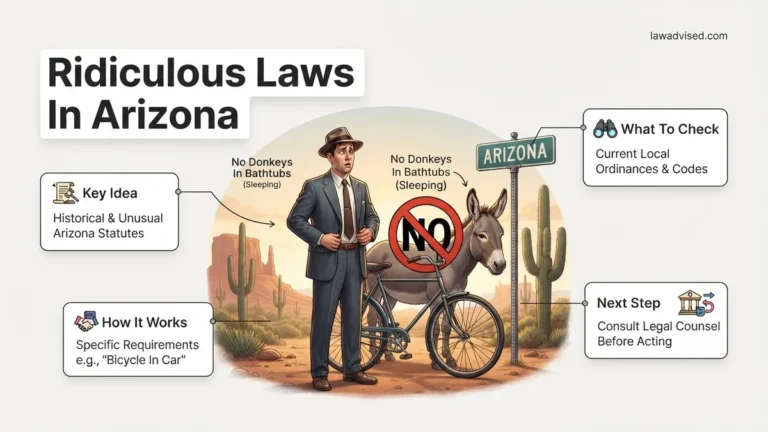
A persistent rumor claims a specific town banned putting donkeys in bathtubs, though historical records show this is likely a misattributed local prank.
How do old laws get removed from the books?
Legislatures periodically pass cleanup bills to repeal obsolete, unconstitutional, or unenforceable statutes from state and local codes.
Do other states have equally bizarre laws compared to Arizona?
Yes, nearly every U.S. state features quirky historical ordinances born from unique regional histories and past cultural norms.
Are property owners liable if they break an obscure local ordinance?
While technically possible, prosecutors rarely pursue charges for obsolete statutes that lack modern public safety relevance.
Where do internet lists of weird laws usually come from?
Most viral lists originate from secondary aggregation sites that repeat unverified anecdotes without checking official legislative records.

Ismail Hossain is the founder of Law Advised. He is an Divorce, Separation, marriage lawyer. Follow him.