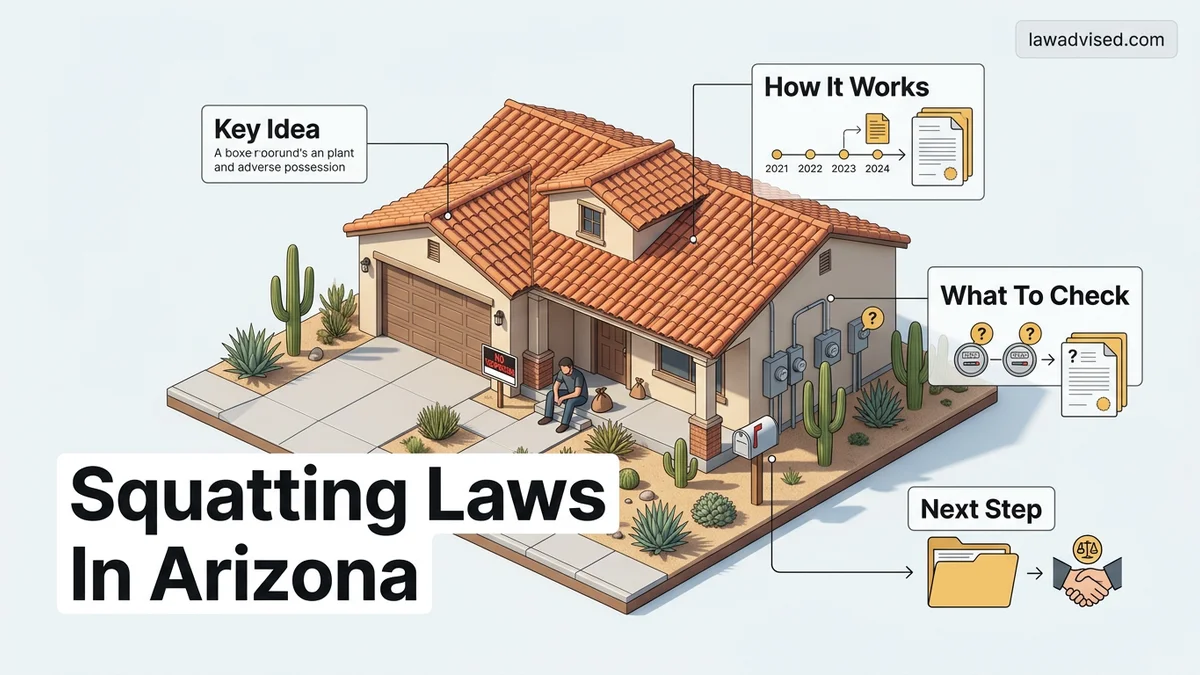
Squatting Laws in Arizona 2027 Step-by-Step Guide
Navigating unauthorized occupants requires knowing that squatting laws in Arizona strictly distinguish between criminal trespassers and civil squatters. Property owners must follow specific legal procedures, utilizing recent legislation designed to expedite the removal of illegal occupants.
Arizona property owners dealing with unauthorized occupants have powerful legal remedies available in 2027, thanks to aggressive state legislation designed to bypass lengthy traditional eviction court battles. If someone breaks into or refuses to leave your residential property, you are not necessarily forced to endure a months-long court process.
Understanding the exact legal distinction between a trespasser and a holdover tenant is critical for Arizona homeowners. Utilizing the state’s expedited removal statutes allows you to reclaim your real estate quickly, provided you follow the precise procedural steps required by local law enforcement and the courts.
Key Takeaways
- Squatters are civil matters, whereas trespassers are criminal offenders handled immediately by law enforcement.
- Arizona’s expedited removal laws allow homeowners to fast-track the removal of illegal occupants.
- Adverse possession claims require strict timeframes, often ranging from 2 to 10 years depending on the case.
- Holdover tenants are not squatters and must go through traditional landlord-tenant eviction proceedings.
- Property owners can prevent squatting by securing vacant properties and routinely inspecting real estate.
What Causes Unauthorized Occupancy and Squatting Disputes in Arizona
Vacant Investment Properties and Second Homes
Vacant homes in the Valley of the Sun or seasonal properties in northern Arizona are prime targets for unauthorized occupants. When real estate sits empty for months, opportunistic individuals look for signs of neglect, such as piled-up mail or overgrown landscaping. Criminals often forge fake lease agreements or change the locks, attempting to mask a clear trespassing case as a civil landlord-tenant dispute.
The Danger of Problematic Guest Overstays
Many Arizona squatting disputes actually start as permitted guests, friends, or romantic partners who simply refuse to leave when asked. If you allow someone to stay long enough to establish residency or receive mail at the address, they may trigger tenant protections. This complicates your ability to remove them instantly, shifting the situation from a quick police matter to a legal removal proceeding.
How to Fix a Squatter Situation Using Step-by-Step Arizona Legal Procedures
Utilizing Arizona’s Expedited Law Enforcement Removal Process
Arizona property owners can leverage homeowner-friendly legislation that allows law enforcement to remove unauthorized occupants immediately under specific conditions. To use this fast-track method in 2027, you must submit a formal affidavit to the local sheriff or police department.
- You must prove you are the legal owner or authorized agent of the property.
- You must state under penalty of perjury that the occupant is unlawfully present and has no legal lease.
- You must confirm the occupant is not a current or former tenant in a valid rental dispute.
Filing an Unlawful Detainer or Ejection Action in Court
If law enforcement declines to remove the occupant on the spot, you must take formal legal action through the Arizona justice courts. Navigating this judicial path requires strict adherence to statutory timelines and notice requirements.
- Serve a formal written demand or notice to vacate to the occupant.
- File a forcible detainer or ejectment lawsuit at the local precinct if they fail to exit.
- Attend the court hearing to present your deed, tax records, and proof of unlawful entry.
- Obtain a Writ of Restitution, which commands the county sheriff to physically remove the occupants and their belongings.
How to Prevent Future Squatter Invasions on Your Arizona Property
Preventing unauthorized occupants is far easier and less costly than navigating the 2027 legal eviction process. Property security experts recommend a multi-layered approach to deter potential trespassers before they can establish residency.
Secure All Entry Points
- Install heavy-duty deadbolt locks on every exterior door and secure all sliding glass doors with auxiliary blocking bars.
- Cover all ground-floor windows with shatter-resistant security film or physical wooden boards if the property remains vacant long-term.
- Seal pet doors, mail slots, and basement access points that unauthorized individuals might use to gain entry.
Deploy Modern Surveillance Technology
- Set up cellular-connected security cameras that stream live video feeds directly to your smartphone and trigger motion-activated floodlights.
- Install smart doorbell systems to monitor daily front porch activity and verify when individuals approach the perimeter.
- Post visible signage warning that the premises are under 24-hour video surveillance and protected by a local private security firm.
Maintain Regular Property Presence
- Hire a property management company or local landscape service to visit the site at least twice per week.
- Collect accumulated junk mail, flyers, and packages immediately so the property never appears abandoned to opportunistic outsiders.
- Use automatic indoor light timers to create the realistic illusion that someone occupies the home during evening hours.
What If It Still Doesn’t Work?
If the expedited police removal process stalls or the occupant presents falsified documents that confuse law enforcement, property owners must pivot immediately to judicial remedies. Real estate litigation attorneys advise following these fallback steps to regain control.
- File an Emergency Forcible Detainer Action: Submit a formal complaint at the local Arizona justice court to secure a judicial hearing within three to six business days.
- Retain a Real Estate Litigation Attorney: Hire specialized legal counsel familiar with Arizona property code updates to navigate complex court filings and counter fraudulent leases.
- Budget for Legal and Eviction Costs: Prepare for unexpected expenses ranging from $1,500 to $4,000 for attorney retainers, court filing fees, and professional sheriff lockout services.
- Utilize Licensed Private Security: Engage bonded security personnel to secure the perimeter legally the exact moment the court grants possession and the sheriff executes the writ.
Conclusion
Dealing with squatters in Arizona requires a swift, legally compliant response to avoid prolonged property loss and mounting financial damages. By leveraging updated 2027 expedited removal statutes, rigorous documentation, and proactive physical security measures, owners can successfully reclaim their real estate investments. According to verified research and expert sources from the Arizona Association of Realtors, taking immediate action within the first 24 hours of unauthorized entry remains the most critical step to prevent protracted legal battles. Your next action step is to consult a licensed Arizona real estate attorney to review your property security compliance today.
❓ Frequently Asked Questions
What is the primary difference between a trespasser and a squatter in Arizona?
A trespasser breaks into a property and commits a criminal offense, allowing police to remove them immediately. A squatter typically enters under false pretenses or establishes occupancy over time, creating a civil property dispute that requires formal legal eviction or specific removal procedures.
How do Arizona’s expedited removal laws work for homeowners?
Homeowners can submit a formal affidavit to local law enforcement requesting the immediate removal of an unauthorized occupant. If the occupant cannot prove a legal right to be there, law enforcement can assist in evicting them without a lengthy court battle.
What are the exact requirements for a squatter to claim adverse possession in Arizona?
To successfully claim adverse possession, the squatter must occupy the property openly, notoriously, exclusively, continuously, and hostilely for the statutory period of 10 years. They must also often pay property taxes during that duration.
Can I legally shut off utilities to force a squatter out?
No, shutting off utilities, changing locks, or removing a squatter’s personal property yourself is considered a self-help eviction. This is illegal in Arizona and can result in the property owner facing civil penalties or lawsuits from the squatter.
How should I handle a tenant who refuses to leave after their lease ends?
A tenant who overstays a lease is a holdover tenant, not a squatter. You must follow the standard Arizona Residential Landlord and Tenant Act by serving proper written notice and filing a formal forcible detainer action in court.
What practical steps can I take to secure vacant property against squatters?
Regularly inspect your vacant properties, install reliable security camera systems, ensure all doors and windows have heavy-duty locks, and post clear no-trespassing signs to deter unauthorized entry.

Ismail Hossain is the founder of Law Advised. He is an Divorce, Separation, marriage lawyer. Follow him.