Seatbelt Laws in Arizona Real Guide for 2027
Navigating seatbelt laws in Arizona requires knowing both adult and child restraint mandates to ensure compliance and avoid fines. Arizona enforces primary enforcement for minor passengers, allowing police to stop vehicles solely for child restraint violations, while adult rules vary by seating position. Understanding these specific legal thresholds protects your passengers and prevents costly traffic citations.
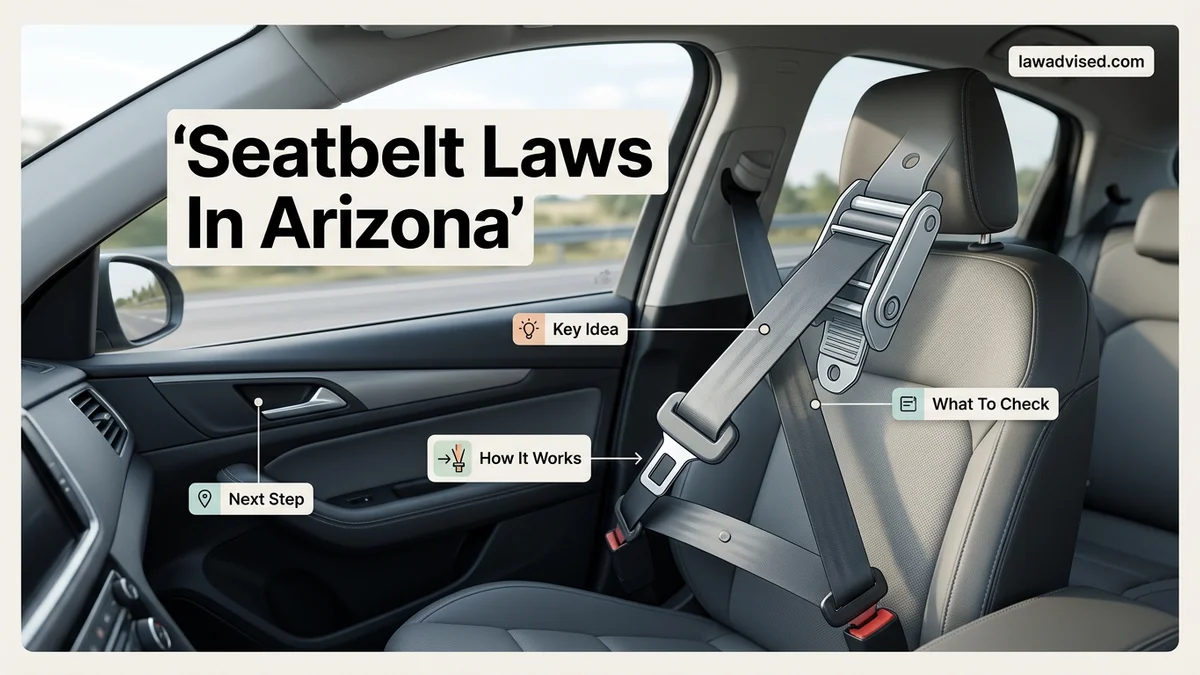
Arizona law requires all front-seat occupants and all minor passengers under the age of 16 to wear a properly adjusted and fastened seatbelt at all times in a moving vehicle. As of 2027, enforcement standards remain strictly categorized by seating position and age, meaning that a lack of compliance can immediately trigger a traffic stop for certain passengers.
Understanding these specific legal thresholds protects you from unexpected fines and ensures your vehicle meets all state safety standards. Whether you are driving down a local Phoenix street or cruising on Interstate 10, knowing the exact enforcement rules keeps your passengers legal and safe.
Key Takeaways
- Drivers and front-seat passengers must wear seatbelts at all times in Arizona.
- Children under eight years old must use a proper child safety or booster seat.
- Arizona utilizes secondary enforcement for adult passengers aged 16 and older.
- Fines for seatbelt violations are generally modest but vary by municipality.
- Specific exemptions apply for medical conditions, postal workers, and older vehicles.
What Causes Confusion With Seatbelt Laws in Arizona
Primary Versus Secondary Enforcement Rules
The biggest source of confusion for drivers in Arizona is how law enforcement officers pull vehicles over for seatbelt infractions. Arizona utilizes a hybrid system of primary and secondary enforcement based on the age of the occupant.
- Minors under 16: Enforcement is primary. If an officer spots a child or teenager unrestrained in the back or front seat, they can pull you over immediately without any other traffic violation taking place.
- Adults 16 and older: Enforcement is secondary in the front seat. An officer cannot pull you over solely for failing to wear a seatbelt; you must first be stopped for another infraction like speeding or a broken taillight, after which you can be ticketed for the belt violation.
The Backseat Adult Exemption Loophole
Many drivers incorrectly assume that all adult passengers must wear seatbelts regardless of where they sit. Under Arizona Revised Statutes, adult passengers aged 16 and older sitting in the rear passenger seats are not legally required to wear a seatbelt. However, relying on this exemption is dangerous during a collision, and rideshare drivers should always mandate rear belts for liability reasons.
How to Fix Compliance Risks and Follow Adult Requirements
Specific Fine Structures and Penalties
Violating Arizona seatbelt laws carries predictable financial penalties that can scale up depending on who is unrestrained in your vehicle. Staying compliant protects your driving record and your wallet in 2027.
- Adult Front-Seat Fines: A standard civil traffic violation for an unrestrained adult in the front seat typically results in a base fine of 10 dollars plus local surcharges, bringing the total closer to 25 or 30 dollars.
- Child Safety Violations: Failing to secure a minor properly carries stiffer penalties and can sometimes result in mandatory traffic safety courses or higher fines exceeding 50 dollars for repeat offenses.
Medical and Occupational Exemptions
You might qualify for a legal exemption if you meet specific medical or job-related criteria. Drivers or passengers with a written verification from a licensed physician stating that wearing a seatbelt is impractical due to a medical condition are exempt from the law. Similarly, United States Postal Service rural letter carriers and certain utility delivery drivers who make frequent stops are exempt while actively servicing their routes at low speeds.
How to Apply Child Safety and Booster Seat Rules
Arizona child safety restraint laws enforce stricter requirements than standard adult seatbelt regulations. According to the Arizona Governor’s Office of Highway Safety, every child under the age of eight must be secured in a proper child safety seat or booster seat while traveling in a vehicle.
Parents and caregivers must follow specific developmental guidelines to ensure absolute compliance with state statutes in 2027. Failure to adhere to these mandates results in standard traffic citations and increased safety risks during collisions.
Rear-Facing and Forward-Facing Car Seats
Infants and toddlers must remain in rear-facing child safety seats until they reach the maximum height or weight limit specified by the car seat manufacturer. Once children outgrow rear-facing seats, they transition to forward-facing seats equipped with a harness system. Experts at the National Highway Traffic Safety Administration recommend keeping children in harnesses as long as possible before moving to booster seats.
Booster Seat Requirements
Children who have outgrown forward-facing harness seats must use belt-positioning booster seats. Arizona law mandates booster seats for children who are under eight years old and under four feet and nine inches in tall. Complete the following steps to properly install and verify a booster seat:
- Place the booster seat securely in the back seat of the vehicle against the seatback.
- Position the child squarely in the booster seat with their back flat against the seat.
- Route the lap belt low across the child’s upper thighs, ensuring it rests flat across the hips rather than the soft abdomen.
- Adjust the shoulder belt so it crosses the center of the child’s chest and rests snugly across the collarbone, avoiding the neck and face.
What If It Still Doesn’t Work: Exemptions and Handling Fines
Drivers facing citations for seatbelt or child restraint violations in Arizona must understand applicable exemptions and fine structures. Certain medical, occupational, and vintage vehicle exemptions exist within state statutes. If standard compliance efforts or fine resolutions fail, drivers can pursue formal fallback procedures.
Review these critical recovery and troubleshooting steps if you receive a seatbelt infraction:
- Verify if your vehicle qualifies for an exemption, such as vehicles manufactured before 1972 that were not originally equipped with safety belts, or delivery personnel who make frequent stops at low speeds.
- Obtain a signed statement from a licensed physician if a medical or physical condition prevents the safe use of a seatbelt.
- Appear at the designated municipal court by the date listed on the citation to contest the ticket or present proof of corrected child restraint equipment.
- Consult with a qualified traffic defense attorney if the citation involves complex commercial vehicle regulations or disputed child safety infractions. Estimated legal consultation costs range from $150 to $350.
- Enroll in a state-approved defensive driving school if eligible, which typically costs between $150 and $250 in total fees, to dismiss the point assessment from your driving record.
Conclusion
Navigating Arizona seatbelt laws requires strict adherence to adult mandatory buckle-up statutes and comprehensive child safety restraint mandates. Securing all occupants properly prevents severe injuries and costly traffic citations. According to verified research and expert sources from the Arizona Department of Transportation, consistent seatbelt use reduces the risk of fatal injury by 45 percent for front-seat occupants. Take action today by inspecting all vehicle seatbelts and child safety seats to ensure they meet current 2027 state standards.
❓ Frequently Asked Questions
What are the exact adult seatbelt requirements in Arizona?
Under Arizona law, the driver and any front-seat passenger of a motor vehicle manufactured with safety belts must wear them at all times. Failure to do so by the driver or front-seat passenger can result in a traffic citation.
How does primary versus secondary enforcement apply to seatbelts?
Arizona operates under secondary enforcement for adult occupants, meaning law enforcement cannot pull over a vehicle solely because an adult is not wearing a seatbelt. However, for child passengers, enforcement is primary, allowing police to stop a vehicle immediately if a child is unrestrained.
What are the specific child safety seat laws by age and height?
Children who are under eight years of age and under 4 feet 9 inches tall must be secured in a child safety seat or booster seat that matches federal standards. Once a child exceeds either age eight or a height of 4 feet 9 inches, standard seatbelts may be used.
What exemptions exist under Arizona seatbelt legislation?
Exemptions include individuals with a certified medical condition preventing seatbelt use, rural letter carriers delivering mail, vehicles manufactured before safety belts were legally required, and emergency response personnel.
Can I be ticketed for passengers not wearing seatbelts?
Drivers are legally responsible for ensuring that all minor passengers under the age of 16 are properly restrained. If a minor is unbelted, the driver receives the citation.
Do out-of-state drivers have to follow Arizona seatbelt rules?
Yes, any driver operating a motor vehicle within the state of Arizona must comply with local traffic and safety restraint laws regardless of where their vehicle is registered.

Ismail Hossain is the founder of Law Advised. He is an Divorce, Separation, marriage lawyer. Follow him.