Bike Laws in Arizona 2027 Expert Guide to Rules & Rights
Understanding bike laws in Arizona is essential for cyclists sharing the road with motor vehicles. Arizona law grants bicycles the same rights and responsibilities as cars, meaning riders must follow standard traffic signals while knowing specific equipment and positioning mandates.
In Arizona, bicycles are legally classified as vehicles. This means you carry the same rights and responsibilities on public roads as someone driving a car, truck, or motorcycle. You must obey standard traffic control devices, signal your turns, and ride with the flow of traffic, while simultaneously receiving the protection of vehicular access to public roadways.
Navigating these statutes requires knowing how state regulations apply to your daily commute or weekend ride. Whether you are rolling through downtown Phoenix or cruising suburban bike lanes in 2027, staying compliant protects you from fines and keeps you legally protected in the event of an accident.
Key Takeaways
- Bicycles are legally defined as vehicles under Arizona traffic statutes.
- Cyclists must ride as far right as practicable, with specific exceptions.
- Front and rear lights are legally required during hours of darkness.
- Arizona does not have a statewide mandatory helmet law for adults.
- Local municipalities may enforce ordinances that differ from state law.
What Causes Confusion Regarding Bike Laws in Arizona — Legal Status and Definitions
The Driver Equivalent: Vehicular Status
Arizona Revised Statutes (ARS) Title 28 treats cyclists as operators of vehicles. As a rider, you possess every right to occupy a standard travel lane. Drivers must afford you the same respect and space given to motor vehicles. You cannot be arbitrarily pushed off paved surfaces simply because a driver wants to pass.
Classifications of Electric Bicycles
Modern infrastructure rules draw strict lines regarding e-bikes. Arizona categorizes electric bicycles into three distinct tiers based on motor assistance and top speed capabilities:
- Class 1: Pedal-assist only, with a motor that cuts off at 20 mph.
- Class 2: Throttle-assisted, operating up to 20 mph without pedaling.
- Class 3: Pedal-assist only, reaching speeds up to 28 mph.
Standard e-bike laws generally permit Class 1 and Class 2 models on multi-use paths, though local municipalities retain authority to restrict Class 3 usage on specific pedestrian trails.
How to Fix Riding Compliance — Step-by-Step Rules of the Road and Positioning
Lane Positioning and the As Far Right Rule
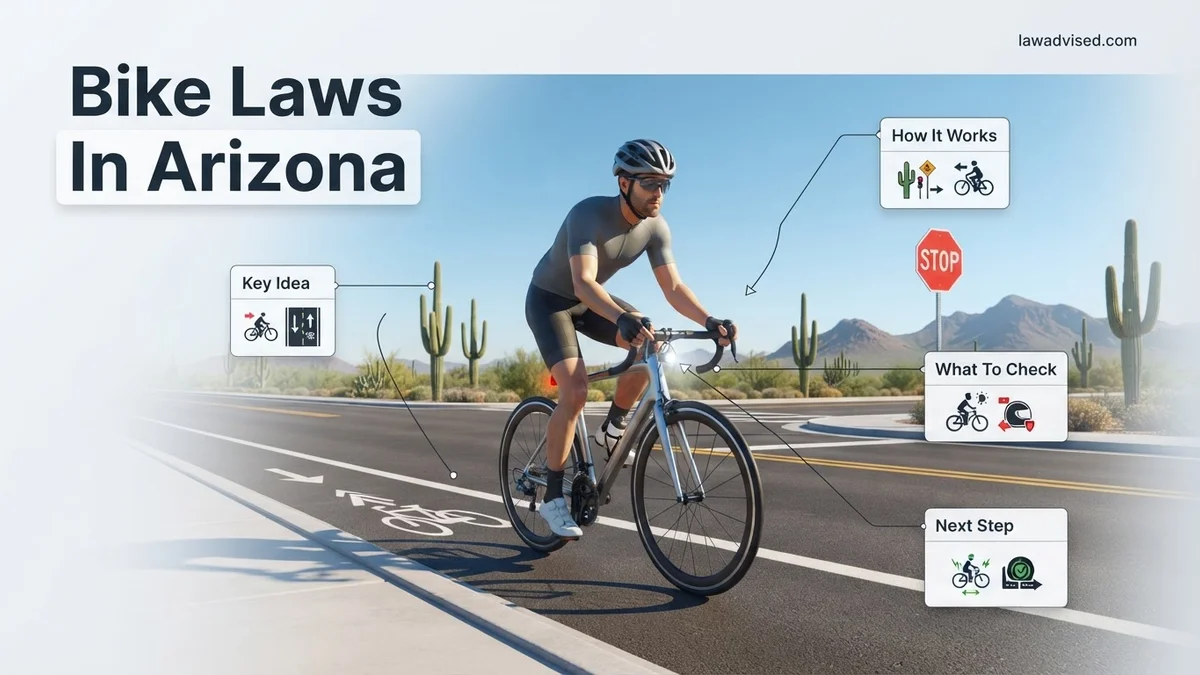
You must ride as near to the right side of the roadway as practicable under ARS 28-815. However, riders frequently misinterpret this rule as requiring you to hug the gutter. The law provides critical exceptions allowing you to take the full lane:
- When overtaking and passing another vehicle or bicycle.
- When preparing for a left turn at an intersection or into a private driveway.
- When avoiding hazardous conditions such as debris, drainage grates, potholes, or parked car doors.
- When the travel lane is too narrow to safely share side-by-side with a passing motor vehicle.
Navigating Intersections and the Three-Foot Passing Law
When riding through intersections, you must use standard hand signals continuously during the 100 feet before a turn, unless your hands are needed to control the bike. Additionally, motorists passing you from behind must maintain a minimum safe distance of three feet. Drivers are legally required to move over into an adjacent lane when possible to execute this clearance safely.
How to Equip Your Bicycle — Mandatory Safety Gear and Lighting Regulations
Equipping your bicycle properly is not just a matter of convenience; it is a strict legal requirement under Arizona state statutes. Navigating the roads of Phoenix or Tucson in 2027 requires adherence to specific equipment mandates designed to maximize visibility and rider safety.
Essential Lighting and Reflectors
State law dictates exact specifications for operating a bicycle after dark. Riders must equip their bikes with a front white light visible from a distance of at least 500 feet. Additionally, a rear red reflector or a solid or flashing red light visible from 500 feet is mandatory. According to traffic safety experts, relying solely on reflectors is insufficient for modern high-speed corridors, making high-lumen LED lights an absolute necessity for compliance and safety.
Braking Systems and Audible Warnings
Every bicycle operated on Arizona roadways must feature a functional braking system. This system must be capable of making the braked wheel skid on dry, level, clean pavement. Furthermore, while state law does not mandate a bell or horn, local municipalities strongly encourage them. Riders must always yield the right-of-way and provide an audible warning before passing pedestrians on shared-use paths.
What If Local Ordinances Differ — Navigating Municipal Rules Across Arizona Cities
While Arizona Revised Statutes provide a baseline framework for statewide cycling, individual cities retain the authority to enact stricter local ordinances. A rule that applies perfectly in unincorporated Maricopa County might conflict with specific municipal codes inside city limits.
Sidewalk Riding Restrictions
Sidewalk riding laws vary wildly across the Grand Canyon State. For example, Tucson generally permits adult bicycling on sidewalks outside of specific downtown commercial zones. Conversely, parts of Phoenix and Scottsdale restrict sidewalk riding for adults entirely unless designated as an official multi-use path. Cyclists must check municipal codes before setting out to avoid unexpected fines.
E-Bike Classifications on Multi-Use Trails
Local authorities also regulate electric bicycles differently based on their class. Cities like Tempe and Flagstaff align closely with state definitions for Class 1, 2, and 3 e-bikes. However, specific regional parks and local open-space preserves may ban Class 2 throttle-controlled models entirely. Always inspect trail-head signage for localized e-bike restrictions.
What If It Still Doesn’t Work?
Cyclists who encounter legal disputes, receive contested traffic citations, or face recurring municipal ordinance confusion should take immediate, structured action to protect their rights.
- Document the Scene and Equipment: Photograph your bicycle’s lighting, braking systems, and overall setup immediately if stopped by law enforcement to prove compliance with state equipment statutes.
- Consult Municipal Codes Directly: Review the specific city code rather than relying on state generalizations, as local ordinances supersede state law where permitted.
- Seek Professional Legal Counsel: Contact a bicycle-specific traffic attorney or local advocacy group like the Arizona Bicycle Association if you receive an unfair citation. Legal consultation fees for traffic infractions typically range from $150 to $400 depending on the court jurisdiction.
- Engage Local Advocacy Groups: Reach out to regional cycling coalitions for expert guidance on navigating complex municipal infrastructure disputes or contested right-of-way accidents.
Conclusion
Mastering Arizona bike laws ensures a safer, legally compliant ride across every municipality in 2027. By understanding state statutes, local ordinances, and mandatory equipment standards, cyclists can protect themselves on the road. According to verified research and expert transportation sources, informed riders experience significantly fewer collisions and traffic disputes. Take the next step today by inspecting your bicycle’s lighting and reviewing your specific city’s sidewalk and e-bike ordinances before your next ride.
❓ Frequently Asked Questions
What are the rules for passing a bicyclist in Arizona?
Motorists must give cyclists at least three feet of clearance when passing them on the road. If three feet is not possible, drivers must slow down safely and pass only when clear.
Do bicyclists have to stop at stop signs and red lights in Arizona?
Yes, cyclists are required to obey all traffic control devices, including coming to a complete stop at red lights and stop signs, as Arizona has not adopted the Idaho Stop statewide.
Can you get a DUI on a bicycle in Arizona?
Yes, Arizona’s Driving Under the Influence (DUI) laws apply to any vehicle, and because bicycles are legally classified as vehicles, riding while impaired can result in a DUI charge.
What hand signals must cyclists use in Arizona?
Cyclists should use hand signals to indicate turns and stops: left arm straight out for a left turn, left arm bent upward or right arm straight out for a right turn, and left arm bent downward to signal a stop.
Are brakes required on bicycles in Arizona?
State law requires every bicycle to be equipped with a brake that enables the operator to make the braked wheels skid on dry, level, clean pavement.
How do local city ordinances affect Arizona bike laws?
While state law provides a baseline, local cities like Phoenix, Tucson, and Scottsdale may enact specific ordinances regarding sidewalk riding in business districts or parking restrictions.

Ismail Hossain is the founder of Law Advised. He is an Divorce, Separation, marriage lawyer. Follow him.