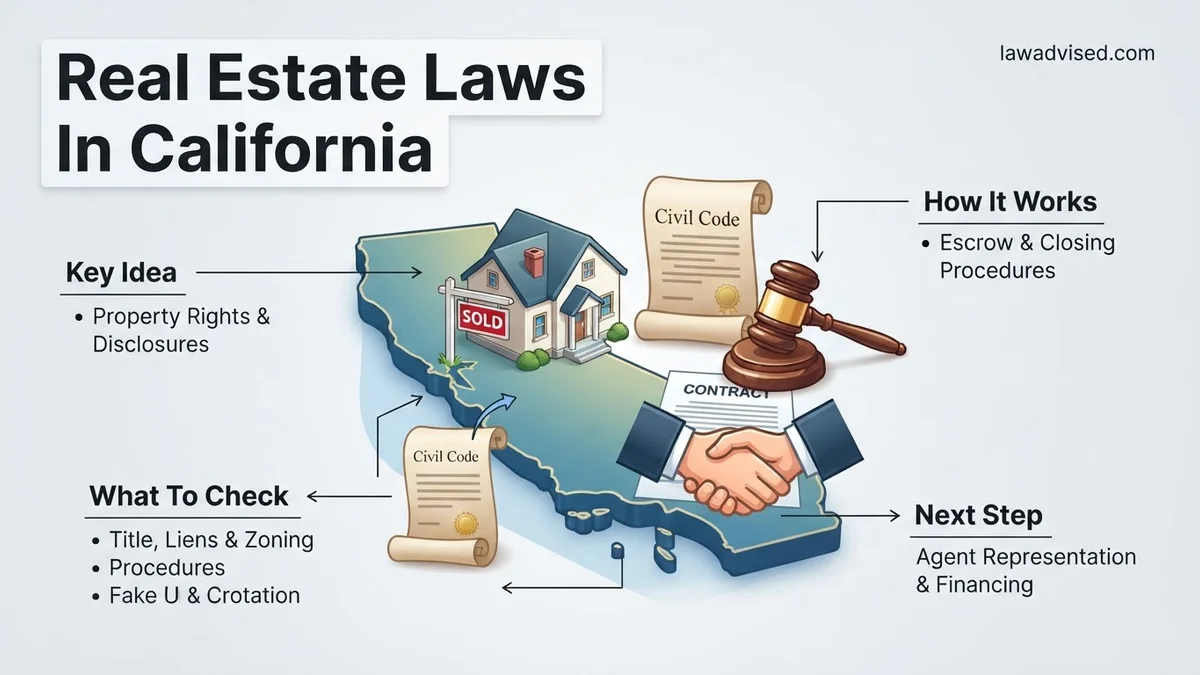
Real Estate Laws in California Expert 2027 Guide & Rules
Navigating real estate laws in california requires strict adherence to mandatory property disclosures, state-wide rent control caps, and local zoning ordinances. Compliance with these legal regulations protects both buyers and sellers from costly litigation during property transactions. Understanding these statutes is essential for successful property management and contract execution across the state.
California real estate laws in 2027 demand absolute precision from buyers, sellers, landlords, and agents. Navigating the Golden State market means complying with strict mandatory disclosure statutes, Tenant Protection Act caps, and localized zoning rules that change by the municipality.
Failing to follow these legal regulations can lead to costly escrow cancellations, post-closing lawsuits, or severe penalties. Whether you are managing a multi-family rental property or closing a residential purchase, understanding the core legal statutes protects your financial interests and ensures your transactions hold up under strict state scrutiny.
Key Takeaways
- Mandatory disclosure forms must be provided to buyers within statutory timeframes.
- California Tenant Protection Act caps annual rent increases for qualifying properties.
- Security deposit limits are strictly regulated based on furnished or unfurnished status.
- All agency relationships must be formally disclosed in writing prior to transactions.
- Local municipal ordinances often add stricter rules to state property laws.
What Causes Compliance Failures and Legal Disputes in California Real Estate
Most legal disputes in California real estate stem from missed disclosure deadlines or misunderstood landlord-tenant statutes. When parties bypass mandatory paperwork or fail to document property conditions accurately, the door opens for litigation.
Failure to Deliver Comprehensive Property Disclosures
The Transfer Disclosure Statement (TDS) and the Natural Hazard Disclosure (NHD) are non-negotiable pillars of California transactions. Sellers often stumble by attempting to hide minor defects or failing to disclose structural modifications made without permits. In 2027, updated climate risk requirements mean you must also disclose specific wildfire and flood zone vulnerabilities.
- Omitting past water damage or roof leaks that were later repaired.
- Failing to provide the Local Option Real Estate Transfer Disclosure Statement when required by the city.
- Ignoring new 2027 energy efficiency disclosures mandated for older residential structures.
Misinterpreting Tenant Protection and Rent Control Statutes
Landlord-tenant disputes usually arise from improper lease terminations or violations of the California Tenant Protection Act of 2019, which saw updated enforcement guidelines leading into 2027. If you raise rent beyond the state-mandated caps—typically tied to the Consumer Price Index plus 5%, capped at 10%—you face severe statutory damages.
- Serving improper eviction notices without offering required relocation assistance.
- Withholding security deposits beyond the strict 21-day window after tenant vacates.
- Failing to provide mandatory just-cause eviction reasons for tenants residing in a unit for 12 months or more.
How to Fix Transaction Errors and Meet Mandatory Disclosure Statutes
Correcting real estate transaction errors requires a proactive, systematic approach. Waiting until a buyer’s inspection contingency period expires to fix paperwork mistakes will derail your closing timeline and risk your earnest money deposit.
Auditing and Amending Transaction Documents Immediately
If you discover an omission in your Real Estate Transfer Disclosure Statement, you must issue an amended disclosure immediately. California law grants buyers a statutory right to rescind the purchase contract within three days of receiving a delivered amendment or five days if delivered by mail.
- Conduct a dual-party audit of the Agent Visual Inspection Disclosure (AVID) before finalizing escrow paperwork.
- Ensure all supplementary disclosures, including Mello-Roos tax assessments and lead-based paint warnings, are signed and dated by all principals.
- Work with a licensed real estate attorney to draft legally binding addenda if unexpected property defects emerge during escrow.
Standardizing Property Management and Lease Compliance
To eliminate landlord-tenant disputes in 2027, you must standardize your leasing framework to align with current state and local ordinances. Automated property management software helps track rent caps and notice periods automatically.
- Implement standardized lease agreements that explicitly state local rent stabilization rules that override state minimums.
- Schedule routine, documented property inspections while respecting the mandatory 24-hour written notice rule for entry.
- Keep meticulous digital records of all tenant communications, repair requests, and security deposit itemized deductions for at least four years.
Step-by-Step Guide to Managing Landlord-Tenant Regulations Legally
Navigating California landlord-tenant laws in 2027 requires meticulous attention to statutory timelines and state-mandated documentation. According to the California Apartment Association, procedural missteps during lease enforcement account for over 40 percent of contested housing disputes statewide.
Step 1: Verify State Rent Caps and Exemption Status
Before issuing any lease modification or rent increase notice, landlords must determine if the property falls under the California Tenant Protection Act of 2019 (AB 1482) or stricter local ordinances. Single-family homes and newer constructions are often exempt, provided explicit written exemption notices were given to the tenant at lease inception.
Step 2: Adhere to Mandatory Notice Periods
California Civil Code strictly regulates the delivery timeline for tenancy actions. For rent increases exceeding 10 percent, landlords must provide a 90-day written notice. Standard notices for lease termination or cure-or-quit infractions require strict adherence to 3, 30, or 60-day windows depending on the length of tenancy and local municipal codes.
Step 3: Process Security Deposits Within Statutory Limits
Under 2027 state statutes, residential security deposits are capped at a maximum of one month’s rent for both unfurnished and furnished properties. Landlords must return the itemized deposit and remaining funds within 21 calendar days following tenant vacating, accompanied by mandatory receipts for any documented cleaning or repair deductions exceeding $125.
What If Compliance Issues Persist and Broker Mediation Fails
When internal compliance measures and initial broker mediation fail to resolve a California real estate dispute, property owners and investors must escalate the matter strategically. Persistent regulatory violations or contractual breaches require formal intervention to mitigate legal liability.
- Engage a Real Estate Litigation Attorney: Retain specialized legal counsel holding active credentials with the California State Bar. Legal representation fees typically range from $350 to $650 per hour depending on geographic market complexity.
- File a Formal Complaint with the DRE: Submit a verified consumer complaint to the California Department of Real Estate (DRE) if licensed brokers or agents breached fiduciary duties. The DRE investigation process usually initiates within 14 to 30 business days.
- Initiate Binding Arbitration or Superior Court Action: Review purchase agreements or lease clauses for mandatory arbitration provisions. Alternatively, file an unlawful detainer or civil lawsuit in the local California Superior Court, where filing fees average $240 to $450.
- Consult Specialized Title or Escrow Experts: For property title disputes or escrow discrepancies, involve a licensed title insurance officer. Comprehensive title research services generally cost between $500 and $1,500.
Conclusion
Mastering California real estate laws demands proactive compliance with shifting rent caps, disclosure mandates, and strict procedural timelines. When disputes arise, structured escalation protocols protect both financial investments and legal standing. According to verified research and expert sources from the California Department of Real Estate, maintaining meticulous written records remains the single most effective defense against costly litigation. Take action today by auditing your current lease agreements and disclosures against updated 2027 statutory requirements.
❓ Frequently Asked Questions
What are the primary components of the California Transfer Disclosure Statement?
The TDS requires sellers to disclose structural defects, environmental hazards, past alterations, and neighborhood nuisances of which they are aware. Failure to accurately complete this document can result in severe liability for damages.
How do local rent control ordinances interact with California state law?
Local ordinances can provide stricter rent control and eviction protections than the state Tenant Protection Act. Landlords must always adhere to the standard that is most restrictive on rent increases.
What happens if a seller fails to provide a Natural Hazard Disclosure?
Buyers retain the right to terminate the purchase contract prior to closing without penalty. If discovered after closing, the buyer may sue for actual damages incurred due to the omission.
What are the legal requirements for earnest money deposits in California?
Earnest money must be placed into a neutral escrow account or broker trust account within three business days of acceptance. Disputes over deposits require formal mediation or court resolution before release.
Are property owners required to disclose registered sex offenders nearby?
Sellers do not have to investigate the neighborhood, but they must provide the statutory Megan’s Law database notice in the purchase contract directing buyers to check registry info.
What legal steps are required to evict a tenant in California?
Landlords must establish a valid ‘just cause’ reason under state law, serve proper written notice (such as 30 or 60 days), and file an unlawful detainer lawsuit if the tenant fails to vacate.

Ismail Hossain is the founder of Law Advised. He is an Divorce, Separation, marriage lawyer. Follow him.