Folding Knife Laws in California 2027 Expert Legal Guide
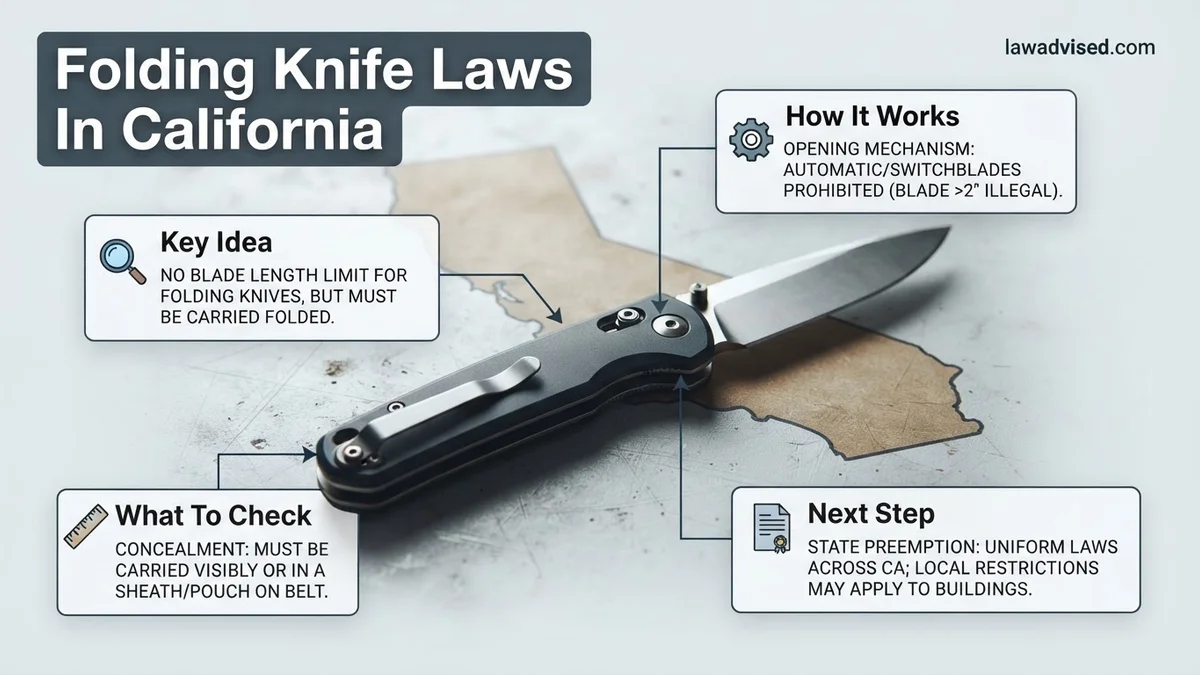
Navigating folding knife laws in California requires understanding strict rules regarding concealed versus open carry. Under California Penal Code, locking folding knives carried concealed can legally be classified as concealed daggers, creating major legal risks for everyday carriers.
Carrying a folding knife in Penal Code Section 21510″>California in 2027 requires careful attention to how your knife locks and how you carry it. Under California Penal Code, any folding knife equipped with a locking mechanism is legally classified as a concealed dagger when carried concealed on your person. This means standard locking folders are strictly illegal to carry hidden in your pocket, waistband, or under a jacket.
To stay legal, your folding knife must either remain entirely visible or be a non-locking slipjoint design. Grasping these specific distinctions prevents accidental felony charges, as local law enforcement and prosecutors strictly enforce these statutory definitions across the state.
Key Takeaways
- Non-locking folding knives can generally be carried concealed without length limits in California.
- Locking folding knives carried in a pocket or pouch are legally considered concealed daggers.
- Open carry of any folded pocket knife is legal statewide as long as it is fully visible.
- Switchblades with blades 2 inches or longer are completely illegal to carry or own.
- Knives are strictly prohibited in schools, government buildings, and public events.
What Causes Legal Trouble with Folding Knife Laws in California
The Hidden Danger of Locking Folding Knives
Most everyday carry (EDC) folding knives feature a locking mechanism, such as a liner lock, frame lock, or back lock. While these mechanisms prevent the blade from accidentally closing on your fingers during heavy use, California law treats them very harshly. If a locking folder is carried in a way that is hidden from public view, you are technically carrying a concealed dagger.
- Concealed Carry Violation: Slipping a locking folder entirely inside your pocket makes it a concealed weapon.
- Felony Classification: Carrying a concealed dagger is a wobbler offense in California, meaning it can be charged as a felony.
- Intent is Irrelevant: Having the knife for opening boxes or camping does not excuse a concealed carry violation.
Prohibited Blade Lengths and Knife Types
Beyond carry methods, certain types of folding knives are completely banned in California regardless of how you carry them. Switchblades—defined as knives containing a blade that opens automatically by hand pressure applied to a button, spring, or other device in the handle—are illegal if the blade is 2 inches or longer. Ballistic knives and butterfly knives (balisongs) also face absolute bans.
- Switchblades: Banned entirely if the blade measures 2 inches or more in length.
- Automatic Openers: Pocket knives deploying via gravity, centrifugal force, or spring assist with a 2-inch or greater blade risk classification as illegal switchblades.
- Exotic Designs: Belt-buckle knives, lipstick knives, and cane swords are strictly prohibited statewide.
How to Fix Your Carry Method to Comply with California Knife Statutes
Open Carry Requirements for Locking Folders
If you prefer carrying a locking folding knife, you must ensure it is completely unconcealed. California does not have statewide open carry restrictions for legal non-switchblade folding knives, provided they are worn openly in a sheath on your belt or clipped visibly to the outside of your pocket. Complete visibility is your primary defense against unlawful concealment charges.
- Pocket Clip Visibility: The entire knife clip and a portion of the handle must remain fully visible outside the pocket fabric.
- Sheath Placement: Belt sheaths must be worn openly on the hip or waist, never covered by an untucked shirt, jacket, or sweater.
- Local Ordinances: Check city and county codes, as some municipalities enforce stricter open carry bans in public buildings, parks, or specific zones.
Transitioning to Non-Locking Folding Knives
The safest legal workaround for 2027 pocket carry is switching to a non-locking folding knife, commonly known as a slipjoint. Because slipjoint knives rely on backspring tension rather than a mechanical lock, they do not legally qualify as daggers under California law. Consequently, you can carry a non-locking folding knife completely concealed in your pocket without violating state statutes.
- Slipjoint Exemption: Non-locking folders are exempt from the concealed dagger statute, allowing deep pocket carry.
- Traditional Options: Classic pocket knives like Swiss Army knives and traditional stockmans remain fully compliant.
- Modern Slipjoints: Many modern manufacturers now produce heavy-duty non-locking folders designed specifically for strict legal jurisdictions like California.
Step-by-Step Guide to Identifying Legal Versus Illegal Folding Knives
Navigating California knife statutes in 2027 requires a systematic evaluation of your everyday carry tool. Manufacturers often market folding knives globally without accounting for California’s specific restrictions. Legal experts recommend a strict verification process before carrying any folder in public.
Step 1: Check the Deployment Mechanism
You must evaluate how the blade opens from the closed position. Under California Penal Code 17235, switchblades and automatic knives are illegal to carry concealed.
- Inspect the knife for hidden springs, buttons, or gravity-assist mechanisms that snap the blade open automatically.
- Verify that the blade requires manual thumb pressure, a thumb stud, or a flipper tab against friction to deploy.
- Confirm the folder lacks any centrifugal or gravity-assisted locking release that allows the blade to swing freely into place.
Step 2: Measure Overall Dimensions and Blade Configuration
Pocket knife size limitations vary drastically depending on how and where you carry the tool.
- Measure the blade length from the tip to the forward-most point of the handle frame.
- Ensure non-locked folding pocket knives remain under municipal size limits if local ordinances apply.
- Verify that the blade does not feature double-edged dagger characteristics or disguised features like lipstick tubes or belt buckles.
What If Local Ordinances and Prohibited Zones Still Restrict Your Carry
Even if your folding knife complies with state-level California statutes in 2027, local municipal codes and specific zone restrictions can create legal pitfalls. Cities like Los Angeles, San Francisco, and Sacramento maintain stricter municipal codes regarding blade lengths and public carrying. Furthermore, state and federal properties enforce zero-tolerance bans regardless of blade classification.
If you encounter overlapping restrictions or face ambiguous local regulations, apply these fallback steps:
- Review municipal codes for the specific city or county you plan to visit, as local ordinances supersede state leniency for non-concealed folding pocket knives.
- Secure your folding knife inside a locked container within your vehicle trunk rather than the glove box or center console during transit through sensitive zones.
- Avoid carrying any knife, regardless of legal folding status, into prohibited zones such as schools, government buildings, courthouses, and public airports.
- Consult a criminal defense attorney specializing in California weapons laws if you face disputed charges or require formal legal interpretation. Professional legal consultations typically range from $250 to $500 per hour.
Conclusion
Understanding California folding knife laws in 2027 prevents costly legal penalties and ensures your everyday carry remains fully compliant with state and municipal codes. By carefully verifying your blade deployment mechanism, measuring overall dimensions, and respecting sensitive public zones, you eliminate unnecessary legal risks. According to verified research and expert legal sources, reviewing local municipal ordinances before transit remains the single most effective safeguard. Take the next step today by auditing your current collection against California Penal Code definitions and swapping out any non-compliant automatic or concealed-style folders.
❓ Frequently Asked Questions
What makes a folding knife illegal to carry concealed in California?
Any folding knife that locks into place is legally considered a dagger when locked and carried in a concealed manner, such as inside a pocket or under a jacket. To be legally carried concealed without restriction, the folding knife must be non-locking.
Does California have state preemption for knife laws?
Unlike firearms, California does not have complete statewide preemption for knife laws. This means individual cities and counties can enforce stricter local ordinances regarding blade lengths or carry restrictions.
How can I legally carry a locking folding knife?
To legally carry a locking folding knife in California, it must be carried openly in a sheath worn on the waistband rather than concealed in a pocket or under clothing. Open carry ensures the weapon is fully visible to law enforcement.
Are assisted-opening knives legal under California law?
Assisted-opening knives that require manual pressure on a thumb stud or flipper against a spring mechanism are generally legal to carry, provided they do not meet the legal definition of a switchblade.
What are the penalties for violating California knife laws?
Carrying a concealed dagger or prohibited blade is typically charged as a misdemeanor, which can result in fines and up to a year in county jail. Subsequent or aggravated offenses can escalate to felonies.
Can tourists or out-of-state visitors bring folding knives into California?
Visitors must comply with the exact same state laws regarding locking mechanisms and concealed carry. Ignorance of California’s unique dagger classification for locking folders does not exempt anyone from prosecution.

Ismail Hossain is the founder of Law Advised. He is an Divorce, Separation, marriage lawyer. Follow him.