Fixed Blade Laws in California 2027 A Step-by-Step Guide
Navigating fixed blade laws in california requires understanding the strict distinction between open carry and concealed carry. Under California Penal Code 21310, carrying a concealed ‘dirk or dagger’ is a felony, making proper open carry in a waist sheath legally essential.
Carrying a fixed-blade knife in California comes with strict legal boundaries under California Penal Code 21310. While owning a fixed blade at home is generally legal, carrying one in public requires strict adherence to open carry rules. You cannot slip a fixed-blade knife into your pocket, waistband, or backpack without running into serious legal trouble.
As of 2027, law enforcement agencies across California continue to heavily enforce restrictions on concealed fixed blades, classifying many of them as illegal “dirks or daggers.” Understanding the distinction between legal open carry and unlawful concealment protects you from unexpected misdemeanor or felony charges during a routine police encounter.
Key Takeaways
- Fixed blades must be worn openly in a sheath suspended from the waist.
- Concealing any fixed blade defined as a ‘dirk or dagger’ is a felony.
- California law defines a dirk or dagger as any stabbing weapon ready for use.
- Local cities and counties may enforce stricter ordinances regarding knife carry.
- All knives are strictly prohibited in schools, government buildings, and airports.
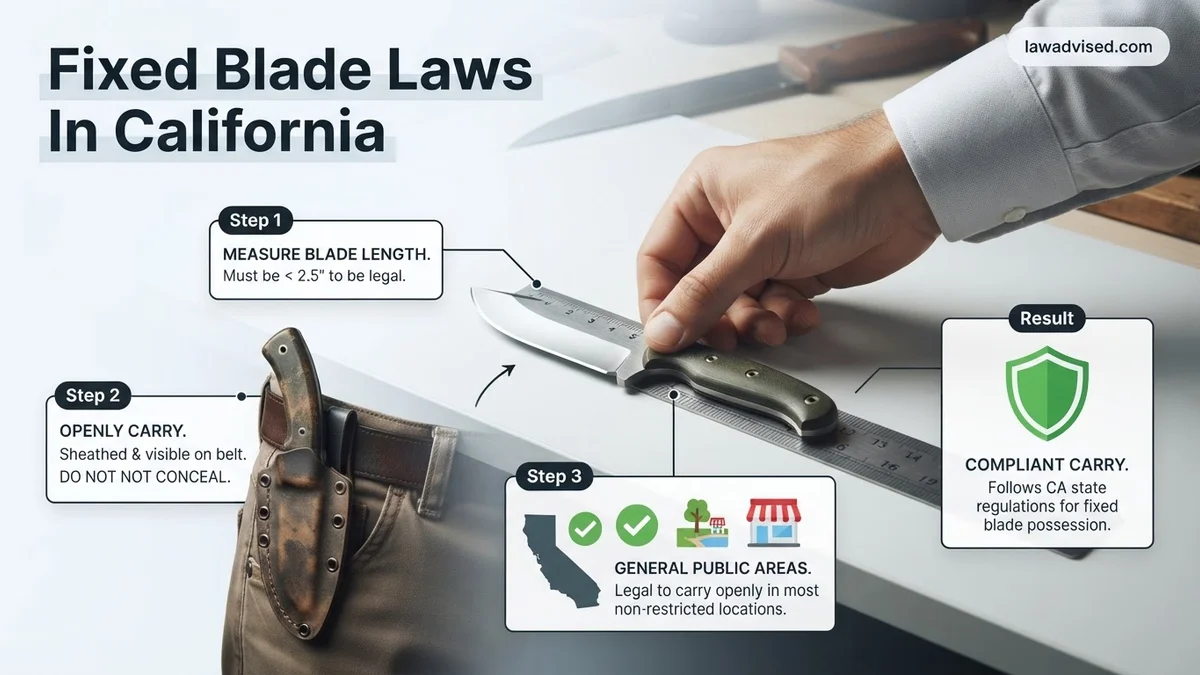
What Causes Legal Violations of Fixed Blade Laws in California
Concealing a Dirk or Dagger Without Authorization
The most common cause of legal violations is carrying a fixed blade where it is hidden from public view. California law defines a dirk or dagger as any knife or other instrument primarily designed, constructed, or altered to be a stabbing weapon that is capable of ready use as a stabbing weapon. Because nearly all fixed-blade knives meet this broad legal definition, hiding them triggers immediate statutory violations.
If you tuck a fixed-blade hunting knife into your jacket pocket or drop a tactical boot knife under your pant leg, you are technically committing a crime. Penal Code 21310 makes carrying a concealed dirk or dagger a wobbler offense. Prosecutors can charge this violation as either a misdemeanor or a felony depending on your prior criminal record and the circumstances of the stop.
Violating Municipal Ordinances and Sensitive Locations
Another major source of legal trouble involves local city or county ordinances that impose stricter bans than state law. Even if you follow state guidelines, local jurisdictions may ban all fixed blades—regardless of carry method—in specific public areas.
- School grounds, universities, and childcare facilities maintain zero-tolerance knife policies.
- Government buildings, courthouses, and public meetings strictly prohibit any form of fixed-blade carry.
- Local parks or transit systems may enforce independent bans that override standard state allowances.
Fixed Blade Laws in California Made Easy: Your Essential Action Plan
Navigating California knife laws can be notoriously tricky due to vague statutes and strict local ordinances. Whether you are an avid outdoorsman, a tactical gear enthusiast, or just someone who wants to carry a tool safely, understanding what is legal and what is prohibited is vital to avoiding steep fines or criminal charges. This comprehensive guide will walk you through the exact process of assessing, carrying, and utilizing fixed blade knives legally within the Golden State.
Step 1: Understand the Core Definition of a Fixed Blade in California
What you need: A ruler, a tape measure, and your specific knife.
Instructions: Before you do anything else, you must understand how California penal code classifies a fixed blade knife. Unlike folding knives, which are regulated heavily based on whether they lock or are considered “switchblades,” fixed blades have a solid, unchanging silhouette. Under California law, a fixed blade knife is generally legal to own and possess privately. However, the legal scrutiny shifts dramatically based entirely on how you carry the knife on your person in public spaces.
Pro Tip: Never assume that a knife sold legally in a California retail store means it is legal to carry openly or concealed in public.
Step 2: Differentiate Between Concealed and Open Carry Rules
What you need: Standard clothing layers and your chosen knife sheath.
Instructions: The golden rule of California fixed blade laws is all about visibility. Penal Code 21310 explicitly bans the carrying of a concealed dagger or stabbing instrument. Because almost any fixed blade can be legally argued as capable of stabbing, carrying any fixed blade completely hidden under a jacket, in an inside pocket, or beneath a shirt is a felony offense. Therefore, your fixed blade must be worn strictly in open carry. This means the knife and its entire sheath must be fully visible and suspended openly from your waist, belt, or gear.
Pro Tip: If your jacket accidentally blows in the wind and momentarily covers your openly carried sheath knife, you could technically be viewed as carrying concealed. Ensure your holster setup maintains absolute visibility.
Step 3: Analyze Length Restrictions and Classification Boundaries
What you need: A caliper or tape measure to check blade length.
Instructions: Surprisingly, California state law does not impose a maximum length limit on standard fixed blade knives (unlike some local ordinances that restrict folding knives to under 3 inches). You can legally carry a large hunting knife, a bowie knife, or a tactical combat knife. However, be extremely cautious of weapons classified as “dirks or daggers.” A dirk or dagger is defined as a knife or other instrument with a blade that is fitted or designed primarily for stabbing. If a fixed blade is categorized as a dirk or dagger, it must be carried openly in a sheath, never concealed.
Pro Tip: Carrying a machete openly for yard work or camping is generally permissible, but carrying a tactical dagger hidden in a boot is a felony.
Step 4: Scout Prohibited Locations Across the State
What you need: A map or itinerary of your daily destinations.
Instructions: Even if you are meticulously following open carry laws, California has absolute statewide prohibitions regarding specific sensitive locations. You can never bring a fixed blade knife—openly or otherwise—onto school grounds (K-12, colleges, and universities), government buildings, state or federal courthouses, polling places during elections, or secure areas of airports. Bringing any fixed blade into these zones will result in immediate arrest, regardless of your intended use or lawful open-carry status elsewhere.
Pro Tip: Always double-check your route if you are commuting through urban centers, as state parks and federal lands have nuanced jurisdiction boundaries.
Step 5: Research Local City and County Ordinances
What you need: Internet access to local municipal codes.
Instructions: State preemption laws in California do not entirely strip local municipalities of their power to regulate knives. While state law allows open carry of non-dirk/dagger fixed blades, specific cities (such as Los Angeles or San Francisco) have local ordinances that heavily restrict blade lengths or forbid carrying certain knives in public parks or during public assemblies. Before strapping a fixed blade to your belt for a hike or a walk downtown, pull up the municipal code of the specific city you will be visiting to ensure no stricter local bans apply.
Pro Tip: When in doubt, default to the strictest rule. Local law enforcement will often enforce municipal codes on the spot.
Step 6: Practice Responsible Transport in Vehicles
What you need: A vehicle glove box, center console, or designated trunk space.
Instructions: Transporting a fixed blade in a car requires careful attention. Because wearing a knife openly inside a confined vehicle can be interpreted as carrying a concealed weapon if you are seated over it, standard practice dictates how you stow it. The safest method is to keep the fixed blade securely packed inside your camping gear, stored in a locked container, or placed inside the trunk of your vehicle. Avoid keeping a sheath knife tucked between the driver’s seat and the center console where it is easily accessible and hidden from plain view.
Pro Tip: Treat your vehicle transport like firearm transport: out of reach, securely stowed, and ideally locked away when commuting.
✅ Final Checklist
- Is your fixed blade completely unobstructed and visible as an open-carry item?
- Have you verified that you are not entering any prohibited zones (schools, government buildings)?
- Have you checked local city and county municipal codes for stricter blade regulations?
- Is your knife securely stowed in the trunk or a locked container while driving?
Important Notes:
- Violating California concealed weapon laws regarding knives can result in felony charges. Always prioritize open, undeniable visibility of your gear.
- If you face legal ambiguity, local citations, or confusion regarding an arrest, seek counsel from a criminal defense attorney familiar with California weapon statutes.
- Time investment: 15-30 minutes of research per municipality. Cost: Free, saving you thousands in potential legal fees.
How to Step-by-Step Comply with Open and Concealed Carry Rules
Step 1: Ensure the Fixed Blade is Carried Openly
To stay legally compliant in California, your fixed-blade knife must be carried in plain sight. Open carry is the only legal way to transport most fixed-blade knives on your person in public spaces without a specialized permit.
Your knife must be worn openly in a sheath that is suspended from your waist. Tucking a knife into a belt without a proper sheath or carrying it loosely in your hand does not satisfy the legal requirement for open carry and can be viewed as brandishing or concealment.
Step 2: Eliminate Any Element of Concealment
You must audit your carrying setup to ensure no part of the fixed blade or its sheath is hidden by clothing, bags, or gear.
- Do not wear long jackets, hoodies, or shirts that drape over the knife and obscure it from view.
- Avoid mounting fixed-blade knives on tactical vests or chest rigs if they are covered by outer layers.
- Check that backpacks, fanny packs, or purses do not house your fixed blade, as enclosed storage constitutes unlawful concealment.
What If Local Ordinances and Preemption Laws Conflict
Navigating California knife laws requires understanding the friction between state statutes and municipal regulations. California Penal Code generally preempts local knife laws regarding folding knives, but the state legislature grants cities and counties broader authority over fixed blade knives. In 2027, this creates a complex patchwork of rules where a carry method compliant in unincorporated county territory violates city ordinances.
When state laws and local municipal codes appear to contradict one another, strict compliance with the most restrictive rule is legally required. Law enforcement officers enforce local ordinances unless a state statute explicitly overrides municipal authority. Carrying a fixed blade requires checking both California Penal Code Section 20200 and the specific municipal code of the city you are visiting.
How to Evaluate Local Municipal Codes for Fixed Blades
- Review the California Penal Code baseline definitions regarding concealed versus open carry of fixed blade knives.
- Visit the official online code repository for the specific municipality or county you plan to enter in 2027.
- Search the municipal code for keywords including knife, weapon, blade, and concealed.
- Contact the local police department or sheriff’s office non-emergency line to confirm current municipal enforcement policies on fixed blades.
How to Fix Common Misconceptions About Blade Lengths and Sheaths
A persistent myth surrounding California fixed blade laws is the existence of a strict statewide length limit, such as three or four inches. Verified legal analysis of California Penal Code confirms no statutory maximum length exists for carrying a fixed blade openly. The primary legal distinction relies entirely on the manner of carry—open versus concealed—rather than the physical dimensions of the steel.
Another dangerous misconception involves sheath requirements and concealment definitions. Tucking a fixed blade sheath inside a waistband or covering it with an untucked shirt legally constitutes a concealed weapon, transforming a lawful open-carry knife into a misdemeanor or felony depending on the blade type. Sheaths must remain fully visible and unobstructed to maintain compliance under 2027 legal standards.
Steps to Ensure Compliant Sheath and Carry Configuration
- Inspect your carrying rig to guarantee the entire knife and sheath remain visible from at least three sides during standard movement.
- Remove any clothing, jackets, or gear items that obscure the fixed blade from casual observation by the public or law enforcement.
- Verify that the retention system of the sheath securely locks the fixed blade in place during active physical movement.
- Consult updated 2027 legal commentary from recognized knife rights advocacy organizations to confirm your setup satisfies current judicial interpretations.
What If It Still Doesn’t Work?
If uncertainties regarding local ordinances, specific carry configurations, or legal definitions persist after independent review, rely on structured fallback procedures to maintain absolute compliance.
- Discontinue carrying the fixed blade immediately and store it securely inside a locked container within your vehicle’s trunk or a residence to eliminate legal exposure.
- Consult a licensed California attorney specializing in Second Amendment and weapons law for formal legal counsel tailored to your local jurisdiction. Professional legal consultations typically range from $250 to $500 per hour.
- Reach out to established knife rights defense organizations, such as Knife Rights, which maintain up-to-date databases of municipal litigation and statutory updates for 2027.
- Transition to carrying a folding pocket knife that complies with state preemption laws if municipal restrictions on fixed blades prove overly prohibitive in your area.
Conclusion
Navigating California fixed blade laws in 2027 demands strict adherence to open-carry mandates and local municipal codes. By ensuring your knife remains fully visible in an approved sheath and verifying city-specific ordinances, you eliminate unnecessary legal risks. According to verified research and expert legal sources, proactive compliance remains the most effective defense against accidental violations. As an actionable next step, review your local city municipal code today to verify that your current carry setup aligns with all applicable local statutes.
❓ Frequently Asked Questions
What exactly constitutes a concealed fixed blade in California?
A knife is considered concealed if it cannot be readily seen by an observer walking near you. This includes carrying a fixed blade inside a backpack, under a jacket, or inside a waistband without the handle fully exposed.
Why is Penal Code 21310 so important for knife owners?
Penal Code 21310 makes carrying a concealed dirk or dagger a wobbler offense, which prosecutors can charge as a felony. Understanding this statute prevents accidental felony convictions for everyday carriers.
How should a fixed-blade knife be worn for legal open carry?
To legally open carry a fixed blade, it must be in a sheath that is visibly worn outside of clothing, typically suspended from the waist so that the entire handle is clearly in plain view.
Do local municipalities have the power to ban open carry?
While California has state preemption laws regarding certain knife regulations, many local cities and counties enforce stricter ordinances prohibiting the open carry of fixed blades in public parks or downtown areas.
Can folding knives be classified as dirks or daggers?
Yes, a folding knife can be legally classified as a dirk or dagger if it is locked in the open position and meets the statutory definition of a ready-to-use stabbing weapon.
What steps should I take if stopped by law enforcement while carrying a knife?
Remain calm, keep your hands visible, and honestly inform the officer if you are carrying a knife. Ensure the knife remains plainly visible in its proper waist sheath to demonstrate compliance with open carry rules.

Ismail Hossain is the founder of Law Advised. He is an Divorce, Separation, marriage lawyer. Follow him.