What Does the IRS Do Guide to Federal Taxes for 2026
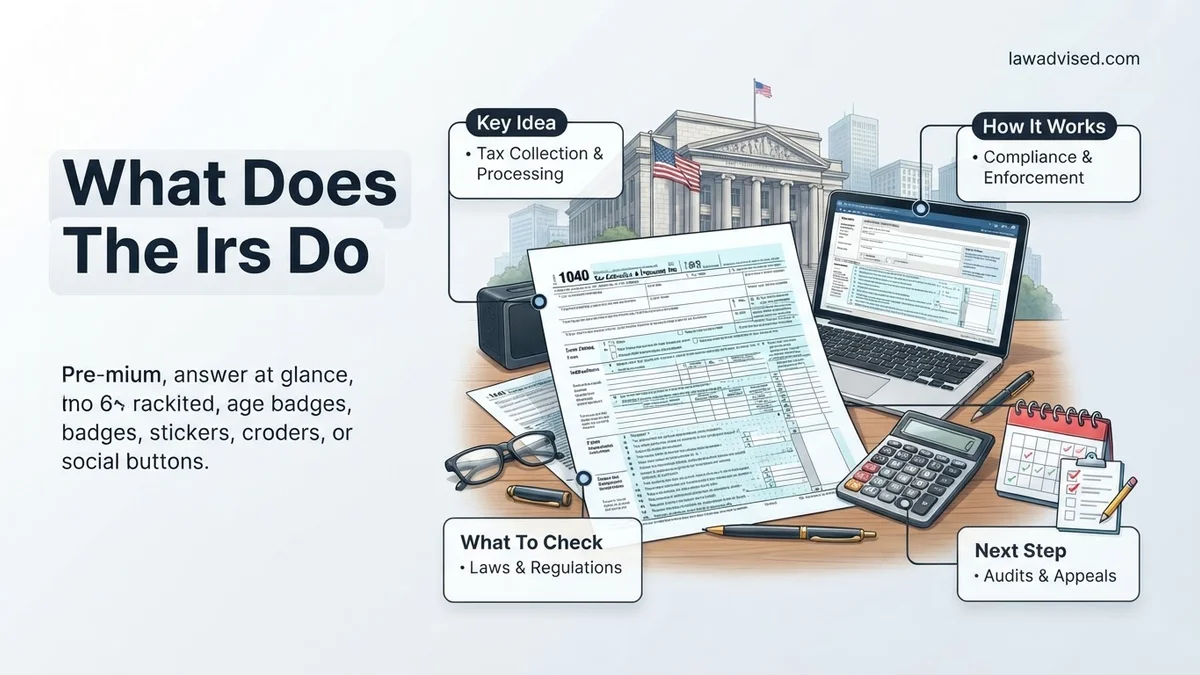
The Internal Revenue Service (IRS) is the federal agency responsible for administering and enforcing the internal revenue laws of the United States. Its primary missions include collecting federal taxes, processing tax returns, issuing financial refunds, and investigating tax evasion to fund government operations.
The Internal Revenue Service (IRS) is the federal agency responsible for administering and enforcing the nation’s tax laws. As the revenue collection arm of the United States government, the IRS collects trillions of dollars annually, processes hundreds of millions of tax returns, and ensures that individuals and corporations comply with the Internal Revenue Code. For the 2026 tax season, understanding this agency’s core mandate helps you navigate your obligations and see where federal funding originates.
Without the operational framework of the IRS, the federal government could not fund national defense, infrastructure projects, social security, and other critical public services. Knowing how the agency operates, what triggers compliance investigations, and how to handle official correspondence demystifies the federal tax system and protects your financial well-being.
Key Takeaways
- The IRS collects individual and corporate income taxes to fund federal government operations.
- Tax processing involves handling millions of returns and distributing financial refunds annually.
- Enforcement actions include conducting audits, investigating fraud, and penalizing tax evasion.
- The agency regulates tax-exempt organizations and charities to ensure compliance.
- Taxpayer assistance programs help citizens understand their filing obligations and rights.
What Causes IRS Audits and Tax Compliance Investigations
Common Triggers for Automated and Field Audits
The IRS uses sophisticated automated systems and risk-scoring algorithms to screen tax returns for discrepancies. When your reported income does not match the data submitted by employers, banks, or financial institutions via W-2 and 1099 forms, the system flags your return. Other common triggers include claiming unusually high charitable deductions relative to your income, reporting consistent business losses over multiple years, or claiming large unverified travel and entertainment expenses.
- Mismatched income reported on W-2 or 1099 forms versus your tax return
- Disproportionately large deductions compared to your stated income bracket
- High-risk filing categories, such as cash-intensive businesses or complex foreign accounts
- Random selection based on statistical norms for specific income thresholds
The Enforcement and Compliance Process
When the IRS launches an investigation, its primary goal is verifying tax compliance rather than immediately penalizing you. The agency conducts correspondence audits through the mail for simple document verification. For more complex financial records, they execute field audits where an agent reviews your books in person. If the IRS uncovers underreported taxes, you face back taxes, statutory interest, and accuracy-related penalties that typically add twenty percent to the understated tax amount.
How to File Correctly and Respond to IRS Notices
Best Practices for Accurate Tax Submission
Preventing an IRS investigation starts with submitting accurate, complete tax information. You must report all taxable income streams, including freelance earnings, digital asset transactions, and investment dividends. Utilizing approved electronic filing software significantly reduces mathematical errors that routinely trigger automated notices. Always double-check your Social Security numbers, employer identification numbers, and routing details before final transmission.
- Gather all official tax documents, including W-2s, 1099s, and 1098 forms, before you begin.
- Reconcile your records against what third-party payers report to the IRS.
- Use modern e-filing platforms that perform automated validation checks.
- Retain copies of your filed returns and supporting receipts for a minimum of three years.
Handling Official IRS Correspondence
Receiving a letter or notice from the IRS requires a prompt and structured response. Most notices address specific, easily resolved discrepancies, such as a math error or a missing schedule. Read the notice carefully to identify the specific tax year and issue in question. Never ignore a notice, as delaying your response escalates the matter into formal collection actions, tax liens, or levies on your bank accounts and wages.
- Verify the notice number (such as a CP2000 or LT11) to understand the exact issue.
- Gather the specific documents requested to support the items on your return.
- Respond by the stated deadline, using certified mail or the secure online IRS portal.
- Contact a qualified tax professional if the notice involves complex legal disputes or substantial tax liability.
What If Your Tax Return Still Gets Flagged by the IRS
Even with careful preparation, modern automated filters can still flag your 2026 federal tax return for manual review. According to Treasury Inspector General for Tax Administration (TIGTA) reports, millions of electronically filed returns undergo further scrutiny each year due to mismatched income reporting, identity verification flags, or mathematical discrepancies. When this happens, the agency typically issues a formal notice by mail detailing the exact nature of the discrepancy. Ignoring these notices generally leads to automated adjustments, additional penalties, and mounting interest charges.
Decoding IRS Notice Codes and Timelines
When the IRS flags your return, understanding the specific notice or letter number is critical for an efficient resolution. The agency assigns distinct codes—such as CP2000 for income mismatches or Letter 5071C for identity verification—which dictate your required next steps. According to Government Accountability Office (GAO) compliance guidelines, taxpayers usually have 30 to 60 days from the date printed on the notice to respond with supporting documentation. Failing to meet these strict statutory deadlines forfeits your right to appeal the proposed changes in tax liability.
To address a flagged return effectively, taxpayers should follow these procedural steps:
- Carefully read the specific IRS notice to identify the exact line items or documents in question.
- Gather original source documents, including W-2s, 1099s, and relevant receipt logs that support the figures on your 2026 return.
- Log into your secure IRS online account to check for digital updates and upload requested verification files directly.
- Submit your formal written response and documentation via certified mail with return receipt requested if physical submission is required.
- Monitor your account transcript weekly for transaction code updates indicating the agency has processed your response.
What If It Still Doesn’t Work?
If initial correspondence or online verification attempts fail to resolve your IRS dispute, more aggressive intervention is often required. Persistent processing delays, unreturned calls, or complex audit notices demand specialized intervention strategies to protect your financial standing. According to National Taxpayer Advocate reports, unresolved systemic errors can stall refunds for months without professional escalation.
If standard resolution pathways fail, taxpayers should consider these fallback steps:
- Engage a qualified credentialed tax professional—such as a Certified Public Accountant (CPA), Enrolled Agent (EA), or tax attorney—to negotiate directly with the agency on your behalf. Professional representation typically ranges from $200 to $500 per hour, or $1,500 to $4,000 for comprehensive audit defense.
- Request assistance through the Taxpayer Advocate Service (TAS), an independent organization within the IRS that helps taxpayers resolve severe financial hardships or systemic processing roadblocks at no cost.
- Contact your local congressional representative’s constituent services office to submit a formal congressional inquiry regarding prolonged, unexplained refund delays.
- File a formal appeal through the IRS Independent Office of Appeals if you disagree with the adjustments proposed by the automated examination division.
Conclusion
Navigating the complex functions of the IRS in 2026 requires strict adherence to filing deadlines, accurate income reporting, and prompt responses to automated compliance notices. Understanding how the agency processes returns and enforces federal tax law protects you from unexpected penalties and prolonged financial audits. According to verified research and expert sources from federal oversight agencies, proactive compliance remains the single most effective defense against costly tax disputes. Take your next actionable step today by logging into your official IRS online account to verify your current tax transcript and ensure all 2026 filings are fully processed.
❓ Frequently Asked Questions
What is the primary mission of the Internal Revenue Service?
The primary mission of the IRS is to provide America’s taxpayers top-quality service by helping them understand and meet their tax responsibilities and apply the law with integrity and fairness to all.
How does the IRS collect federal revenue?
The IRS collects revenue primarily through payroll withholdings, estimated quarterly tax payments, and annual tax returns filed by individuals and businesses.
What triggers an IRS tax audit?
Audits can be triggered by mathematical errors, discrepancies between reported income and third-party documents like W-2s or 1099s, unusually high deductions, or random selection.
Can the IRS seize property for unpaid taxes?
Yes, under federal law, the IRS has the authority to place liens on property or levy bank accounts and wages if a taxpayer refuses to pay established tax debts.
How long does the IRS have to audit a tax return?
Generally, the IRS has three years from the date a return is filed to audit it, though this window can be extended if there is substantial underreporting of income or fraud.
What should I do if I receive a notice in the mail from the IRS?
Read the notice carefully to understand the specific issue, gather any supporting documents requested, and respond by the stated deadline either online or through the mail.

Ismail Hossain is the founder of Law Advised. He is an Divorce, Separation, marriage lawyer. Follow him.