Federal Taxes Explained 2026 A Step-by-Step Guide
Navigating the US tax system can feel overwhelming, but federal taxes are built on a predictable progressive structure. This guide breaks down how tax brackets work, the path from gross income to taxable income, and the filing process.
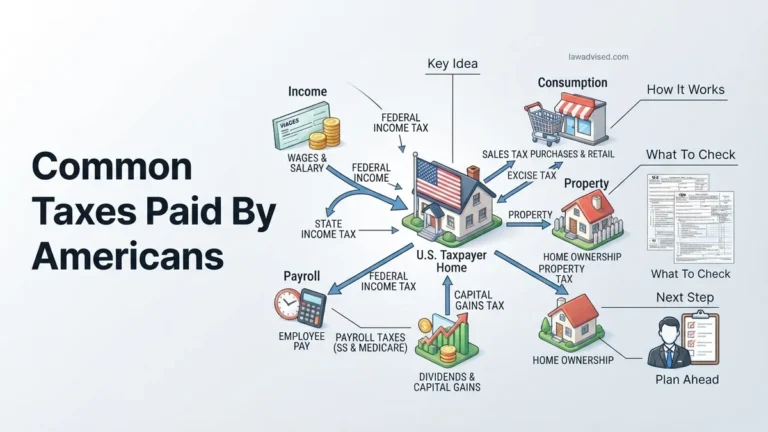
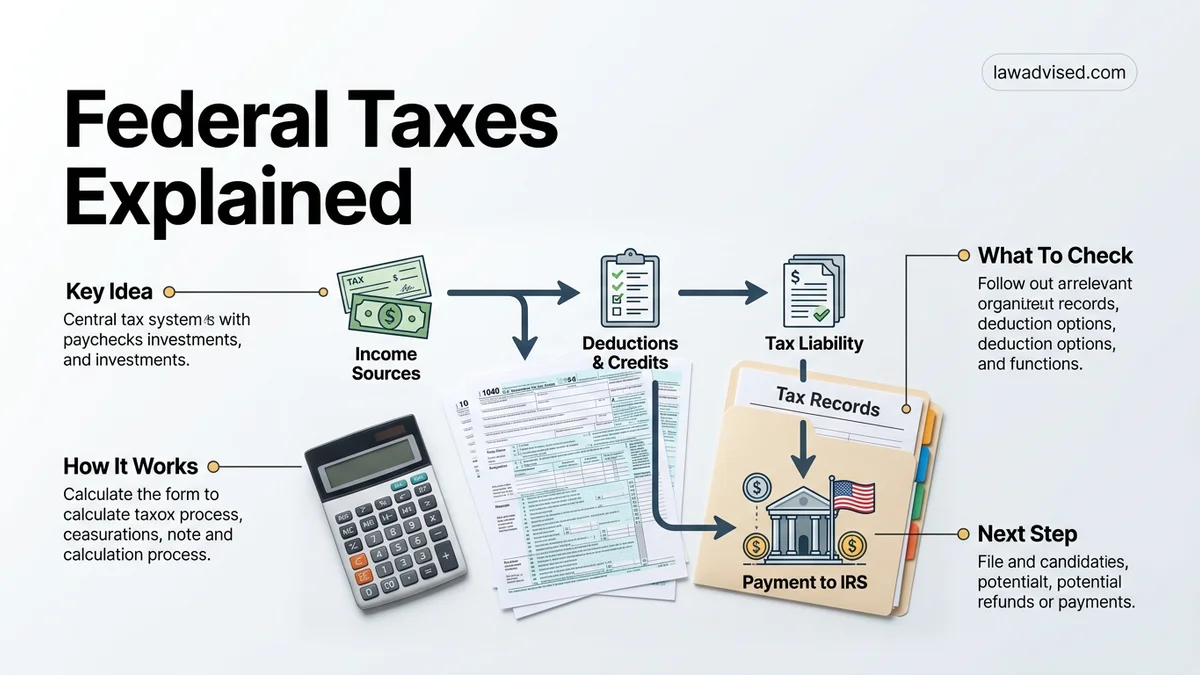
Federal taxes in the United States operate on a progressive marginal system where you pay different tax rates on different portions of your income, rather than a single flat percentage on everything you earn. The system collects revenue through automatic payroll withholding or quarterly estimated payments, which fund national infrastructure, defense, and federal programs.
Navigating this system is essential for your financial health in 2026. Knowing exactly how these mechanisms work prevents you from overpaying the IRS, helps you maximize your take-home pay, and ensures you avoid costly underpayment penalties when April approaches.
Key Takeaways
- Federal income taxes use a progressive bracket system where only income in higher brackets is taxed at higher rates.
- Your Adjusted Gross Income (AGI) is calculated by subtracting specific adjustments from your total gross income.
- Standard deductions lower your overall taxable income before final tax calculations are made.
- Employers withhold estimated tax amounts from paychecks throughout the year based on your W-4 form.
- Filing an annual tax return reconciles your withholdings, resulting in either a tax refund or a balance due.
What Causes Confusion With Federal Taxes and Brackets
The biggest misconception about federal income taxes is how tax brackets actually function. Many people fear getting a raise because they believe moving into a higher tax bracket means every dollar they earn will suddenly be taxed at that much higher rate.
The Myth of the Single Tax Bracket Rate
Your entire income is never taxed at your top marginal rate. Instead, the U.S. tax code divides your income into chunks, or brackets, and applies progressively higher rates only to the money that falls within each specific range.
- The first portion of your earnings gets taxed at the lowest rate.
- Each subsequent chunk of income is taxed at the corresponding higher bracket rate.
- Your highest bracket rate applies strictly to your last dollar earned, not your entire paycheck.
Marginal Rates Versus Effective Tax Rates
Your marginal rate is simply the tax rate applied to your very last dollar of income. Your effective tax rate is your total tax liability divided by your total income, which is always lower than your marginal rate. Understanding this distinction stops you from turning down promotions or extra hours out of fear of higher taxes.
How to Calculate Your Taxable Income Step-by-Step
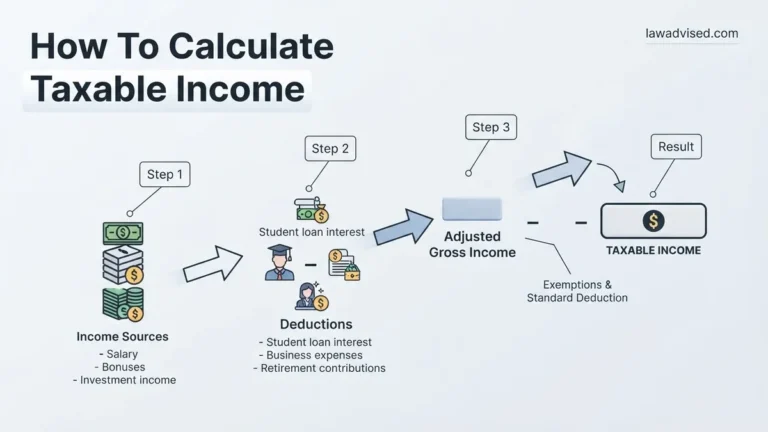
Before the IRS applies those progressive tax brackets to your earnings, you must determine your actual taxable income. The calculation starts with everything you make and strips away specific deductions until you reach the final number the government uses to calculate your tax bill.
From Gross Income to Adjusted Gross Income
Your financial journey with the IRS begins with your gross income, which includes your salary, bonuses, tips, investment dividends, and rental income. To move from gross income to adjusted gross income (AGI), you subtract specific adjustments known as “above-the-line” deductions.
- Traditional IRA or 401(k) retirement contributions.
- Student loan interest payments.
- Self-employed health insurance deductions and half of self-employment tax.
Reaching Your Final Taxable Income
Once you have your AGI, you must subtract either the standard deduction or your total itemized deductions to arrive at your final taxable income. For 2026, the standard deduction provides a baseline shield that protects a set amount of your earnings from federal income tax entirely. You only pay taxes on the dollars that remain after applying this final subtraction.
How to Fix Common Withholding Mistakes on Your Paycheck
Incorrect tax withholding can catch many workers off guard when the filing season arrives. According to recent IRS data, millions of taxpayers either overpay throughout the year or face unexpected liabilities due to outdated W-4 forms. Adjusting your withholding prevents these discrepancies and keeps your cash flow optimized for 2026.
Step-by-Step Correction Procedure
- Locate your current pay stub: Review your recent earnings statement to identify your current filing status and extra withholding amounts.
- Use the IRS Tax Withholding Estimator: Input your latest pay stubs, expected income, and deductions into the official online tool to calculate your ideal withholding rate.
- Complete a new Form W-4: Enter the precise adjustments recommended by the estimator to account for multiple jobs, dependents, or non-wage income.
- Submit the form to your employer: Deliver the updated W-4 to your human resources or payroll department for processing in the upcoming payroll cycle.
- Verify your next pay stub: Check your following paycheck to confirm that the employer successfully applied the requested changes.
What If Your Tax Return Results in a Bill Instead of a Refund
Discovering that you owe money to the federal government instead of receiving a refund can cause immediate stress. However, structured options exist to manage unexpected tax liabilities without severe financial penalties. The IRS provides formal mechanisms to resolve balances while minimizing interest and additional fees.
Managing an Unexpected Balance Due
- File your return on time: Submit your paperwork by the April 2026 deadline even if you cannot pay the full amount to avoid failure-to-file penalties.
- Explore a short-term payment plan: Request an extension of up to 180 days to pay the balance in full through the IRS online payment agreement portal.
- Set up an installment agreement: Apply for a monthly payment plan if you need more than 180 days, noting that setup fees range from $31 to $225 depending on your income level and application method.
- Request penalty abatement: Ask the IRS to waive penalties if you have a history of compliant tax filing and experienced a documented hardship.
What If It Still Doesn’t Work?
If automated tax tools and self-correction attempts fail to resolve complex filing errors or persistent notices from the IRS, alternative interventions are necessary. Implement these fallback steps to protect your financial standing:
- Gather all IRS correspondence: Compile every official notice, certified letter, and matching W-2 or 1099 form associated with the dispute.
- Consult a credentialed tax professional: Engage a Certified Public Accountant (CPA), Enrolled Agent (EA), or tax attorney. According to industry data, professional representation fees for resolving IRS notices typically range from $300 to $1,500 depending on complexity.
- Contact the Taxpayer Advocate Service: Reach out to this independent organization within the IRS if you face immediate economic hardship or systemic processing delays.
- Request a penalty reconsideration: Submit a formal written request alongside supporting documentation if automated systems incorrectly assessed additional taxes or interest.
Conclusion
Navigating federal taxes in 2026 requires diligence, accurate record-keeping, and proactive adjustments to your paycheck withholding. Addressing discrepancies early prevents costly penalties and reduces end-of-year stress. According to verified research and expert sources from financial analysts and tax authorities, utilizing official IRS calculators and consulting certified professionals remain the most reliable strategies for maintaining tax compliance. Take your next actionable step today by reviewing your latest pay stub and running the IRS Tax Withholding Estimator to secure your financial future.
❓ Frequently Asked Questions
Does moving into a higher tax bracket mean my entire income is taxed at that higher rate?
No, the US uses a marginal tax rate system. Only the portion of your income that falls within that specific higher bracket is taxed at the higher percentage, while the rest is taxed at lower rates.
What is the difference between the standard deduction and itemized deductions?
The standard deduction is a fixed dollar amount that reduces your taxable income, available to most taxpayers. Itemized deductions allow you to list specific deductible expenses, such as mortgage interest and medical bills, and you choose whichever method yields the larger deduction.
How does the IRS determine if I get a refund or owe money?
The IRS compares your total tax liability for the year against the total amount of taxes you already paid through paycheck withholding or estimated tax payments. If you paid more than you owe, you get a refund; if you paid less, you must pay the difference.
What information do I need before filing my federal tax return?
You will need your social security number, income documents like W-2s or 1099s, records of any deductions or credits you plan to claim, and your bank account information if you prefer direct deposit for your refund.
What happens if I cannot file or pay my federal taxes by the April deadline?
You can request an automatic six-month extension to file your return by the April deadline, but an extension to file is not an extension to pay. You should estimate and pay any expected tax liability to avoid penalties and interest.
What is the purpose of the W-4 form?
The W-4 form is filled out by employees and tells employers how much federal income tax to withhold from each paycheck. Adjusting your W-4 helps ensure your withholdings accurately match your actual tax liability.

Ismail Hossain is the founder of Law Advised. He is an Divorce, Separation, marriage lawyer. Follow him.