
How Taxes Work in the United States 2026 Step-by-Step Guide
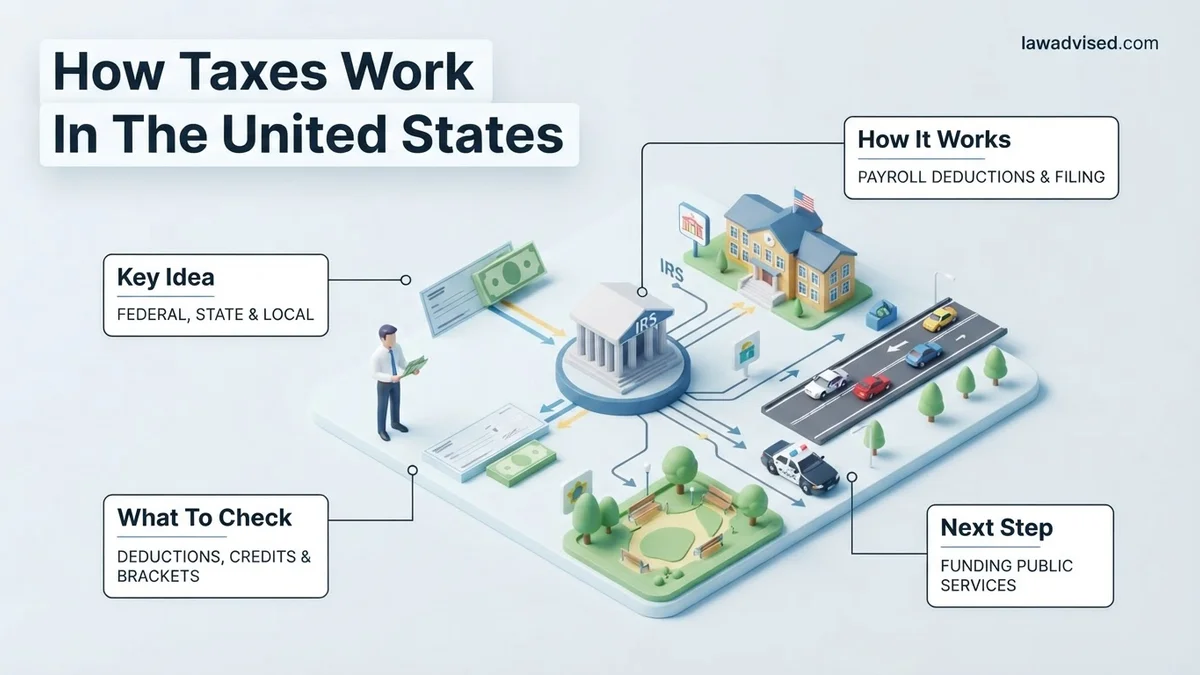
Understanding how taxes work in the United States requires navigating a multi-layered system of federal, state, and local collections. Taxes are primarily funded through regular payroll withholdings or self-employment payments, then reconciled annually using the marginal tax bracket system.
The United States tax system operates on a pay-as-you-go model where federal, state, and local governments collect revenue from individuals and businesses to fund public services. Every time you earn money through wages, investments, or self-employment, a portion of that income goes toward taxes. Understanding how this system works from start to finish is essential for keeping your finances on track and avoiding unexpected IRS bills.
Failing to understand the mechanics of the U.S. tax code often leads to overpaying or facing penalties. When you grasp how withholding, marginal brackets, and deductions function together, you take direct control of your financial life. This guide breaks down the complete lifecycle of U.S. taxes for 2026, giving you a clear roadmap from your first paycheck to the annual filing deadline.
Key Takeaways
- The U.S. uses a progressive tax system with marginal brackets, meaning only income above a threshold is taxed at higher rates.
- Federal income tax is automatically withheld from W-2 paychecks throughout the year based on your Form W-4.
- Independent contractors and freelancers must pay self-employment tax and make quarterly estimated tax payments.
- Filing an annual tax return reconciles what you paid via withholding against your actual tax liability, resulting in a refund or bill.
- Deductions lower your taxable income, while tax credits reduce your tax liability dollar-for-dollar.
What Causes Tax Confusion and How the U.S. System Operates
The Myth of the Marginal Tax Bracket
The single biggest misconception about U.S. taxes is how marginal brackets work. Many people worry that earning a little more money will push them into a higher tax bracket, causing every dollar they earned to be taxed at that much higher rate. That is completely false. The U.S. federal income tax system is progressive, meaning your income is taxed in slices, or brackets.
As you move up the income scale, only the money that falls within a specific bracket is taxed at that bracket’s rate. For example, if the first portion of your income is taxed at 10 percent and the next portion at 12 percent, crossing into the 22 percent bracket only applies the 22 percent rate to the dollars that sit in that highest tier. Your lower dollars remain taxed at the lower rates.
The Structure of Federal Tax Brackets
For the 2026 tax year, the IRS adjusts these bracket thresholds to account for inflation. Federal income tax brackets typically range from 10 percent up to 37 percent for the highest earners. Your final tax bill is simply the sum of the taxes calculated across each individual slice of your taxable income.
- Income is divided into tiered segments called brackets
- Each tier has a progressively higher tax rate
- Higher brackets never retroactively increase the tax rate on your lower-tier dollars
- State and local governments often apply their own separate tax brackets
How to Navigate Tax Brackets, Withholding, and the Filing Process Step-by-Step
Step 1: Earning and Withholding
The tax lifecycle begins the moment you earn money. If you are a W-2 employee, your employer automatically withholds federal, state, and local income taxes from your paycheck based on the Form W-4 you filled out. If you are a 1099 contractor or business owner, withholding does not happen automatically. You must calculate and pay estimated quarterly taxes directly to the IRS throughout 2026 to avoid underpayment penalties.
Step 2: Reporting and Filing
In early 2026, you will receive tax documents detailing your previous year’s earnings and financial activity. Employees receive a Form W-2, while independent workers receive Form 1099s. Investors receive Form 1099-INT or 1099-DIV for interest and dividends. You compile these documents to file your annual tax return, typically by the April deadline.
- W-2 Workers: Taxes are deducted automatically each pay period
- 1099 Workers: You must submit estimated quarterly payments
- Reporting Documents: Collect all income statements before filing your return
- Deductions and Credits: Use standard or itemized deductions to lower your taxable income
What If Your Tax Withholding Is Wrong or You Owe Money to the IRS?
Managing your tax obligations requires staying vigilant about how much you pay throughout the year. If your employer withheld too little from your paychecks, you might face an unexpected tax bill when filing your 2026 return. According to IRS data, millions of taxpayers face underpayment penalties annually simply because they did not adjust their Form W-4 after major life events.
Recognizing Withholding Errors
Tax withholding errors happen when life changes outpace your payroll settings. Getting married, having a child, or picking up a second job alters your tax bracket. If you notice a massive shift in your expected refund, check your pay stubs immediately. The Taxpayer Advocate Service notes that proactive mid-year adjustments prevent severe financial stress during peak tax season.
Correcting Your Tax Withholding
Fixing an incorrect withholding amount takes careful planning and prompt execution. Follow these steps to adjust your payroll contributions:
- Use the IRS Tax Withholding Estimator online tool to calculate your exact projected tax liability for 2026.
- Obtain a new Form W-4 from your employer or download it directly from the official IRS website.
- Complete the form by entering accurate details regarding your household income, deductions, and dependent credits.
- Submit the updated Form W-4 to your human resources or payroll department before the next pay period begins.
- Monitor your subsequent pay stubs to confirm the new withholding amount matches your calculated target.
What If It Still Doesn’t Work?
If you adjusted your withholding or filed your return and still face complex tax debt or IRS discrepancies, standard methods may fall short. When automated solutions fail, taxpayers need escalation strategies to resolve their account standing.
- Review your IRS online account dashboard to verify that recent payment applications or amended return submissions processed correctly.
- Contact the IRS dedicated helpline directly during non-peak morning hours to speak with a trained representative regarding account holds.
- Engage a Certified Public Accountant (CPA) or Enrolled Agent (EA) for personalized audit defense or structured payment plan negotiation; professional tax resolution services typically range from $1,500 to $5,000 depending on complexity.
- Apply for an IRS Installment Agreement or an Offer in Compromise if you cannot afford your lump-sum tax liability for 2026.
Conclusion
Navigating the United States tax system demands consistent tracking of your income, accurate W-4 selections, and prompt responses to any IRS notices. Failing to address withholding errors early can trigger costly penalties and unnecessary financial anxiety. According to verified research and expert sources from the American Institute of CPAs, taking proactive steps by mid-year ensures compliance and minimizes end-of-year surprises. Your actionable next step is to log into the IRS Tax Withholding Estimator today to review your current 2026 payroll deductions.
❓ Frequently Asked Questions
What levels of government collect taxes in the United States?
Taxes in the U.S. are collected at three primary levels: federal, state, and local. The federal government levies income and payroll taxes, while states typically levy income and sales taxes, and local governments rely heavily on property taxes.
Does moving into a higher tax bracket mean my entire income is taxed at that rate?
No. This is one of the most common misconceptions about the U.S. tax system. Only the dollars that cross into the higher bracket are taxed at that specific higher rate, while your lower earnings remain taxed at their respective lower rates.
What is FICA and what does it pay for?
FICA stands for the Federal Insurance Contributions Act, which funds Social Security and Medicare. Employers and employees split these payroll taxes evenly, while self-employed workers pay the full amount via the self-employment tax.
What is the standard deduction and should I take it?
The standard deduction is a flat dollar amount that reduces your overall taxable income without requiring you to list individual expenses. The vast majority of U.S. taxpayers take the standard deduction because it offers a larger write-off than itemizing.
How are tax refunds generated?
A tax refund occurs when the total amount of taxes withheld from your paychecks or paid via estimated payments throughout the year exceeds your actual calculated tax liability on your annual return.
What are estimated quarterly taxes and who needs to pay them?
Estimated quarterly taxes are payments made four times a year to the IRS and state tax agencies by individuals who do not have sufficient taxes withheld automatically, such as freelancers, small business owners, and investors.

Ismail Hossain is the founder of Law Advised. He is an Divorce, Separation, marriage lawyer. Follow him.