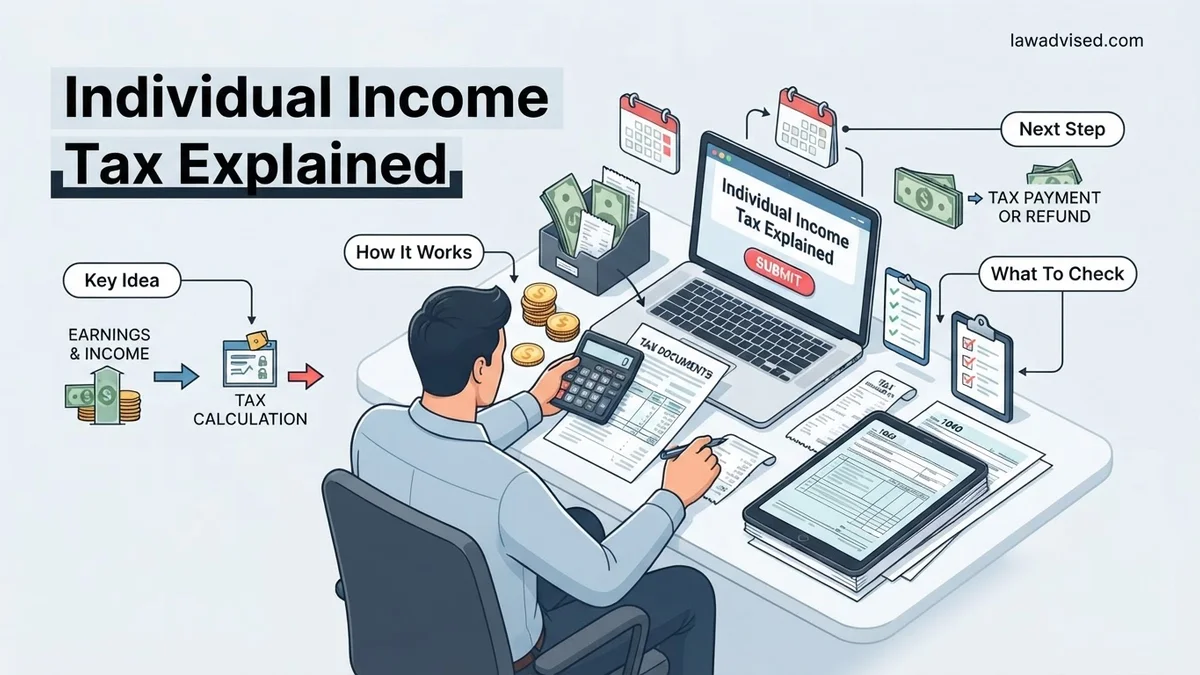
Individual Income Tax Explained A Step-by-Step Guide 2026
Individual income tax is a mandatory levy collected by federal, state, and local governments on money you earn throughout the year. Understanding how this tax works requires looking at how your gross earnings transform into taxable income through adjustments, deductions, and tax brackets.
Individual income tax is a mandatory percentage of your earnings collected by federal, state, and local governments to fund public services, infrastructure, and national defense. It applies to both earned income, such as your salary or wages from a 2026 job, and unearned income, including investment dividends, interest, and rental revenue.
Navigating this system matters practically because keeping more of your hard-earned money depends on understanding how these calculations work. Knowing the mechanics prevents costly surprises on Tax Day and empowers you to make smarter financial choices throughout the year.
Key Takeaways
- Income tax is levied on both earned and unearned income by various government levels.
- Your Adjusted Gross Income subtracts specific adjustments from your total gross earnings.
- Tax deductions lower your taxable income, while tax credits directly reduce your tax bill.
- Marginal tax brackets tax your income in progressive tiers rather than at a single flat rate.
- Filing an accurate return ensures you avoid penalties and claim eligible refunds.
What Causes Confusion With Individual Income Tax
Misunderstanding Marginal Tax Brackets
One of the most common pitfalls involves how federal tax brackets actually operate. Many people mistakenly believe that entering a higher tax bracket means every dollar they earn gets taxed at that elevated rate. In reality, the U.S. uses a progressive tax system for 2026. Your income is sliced into chunks, and each chunk is taxed at its corresponding marginal rate. Crossing into a 24 percent bracket only applies that higher rate to the dollars that fall within that specific tier, not your entire salary.
Confusing Gross Income with Taxable Income
Another major source of confusion is the difference between what you earn and what the government actually taxes. Your employer reports your gross earnings, but you never pay taxes on that exact gross figure. Taxpayers often mix up total earnings with Adjusted Gross Income and final taxable income. Because governments allow various adjustments and deductions, your final tax bill is calculated on a much smaller, adjusted figure.
- Gross income includes all your wages, tips, and investment gains before any adjustments.
- Taxable income is the final amount left after subtracting deductions from your adjusted gross income.
- Tax credits directly reduce your tax liability dollar-for-dollar, unlike deductions which only lower taxable income.
How to Calculate Your Individual Income Tax Step-by-Step
Step 1: Determine Your Adjusted Gross Income (AGI)
Calculating your 2026 individual income tax always starts with your gross income. You then subtract specific above-the-line deductions, such as contributions to a traditional IRA, student loan interest, or health savings account payments. The resulting figure is your Adjusted Gross Income, which serves as the foundational baseline for all subsequent tax calculations and eligibility limits.
Step 2: Apply Deductions to Find Taxable Income
Next, you must lower your AGI further by taking either the standard deduction or itemizing your deductions. For the 2026 tax year, the standard deduction provides a flat, guaranteed reduction based on your filing status. If your qualifying mortgage interest, charitable donations, and state taxes exceed that flat amount, you itemize instead. Subtracting this deduction gives you your final taxable income.
- Start with your total gross income from all 2026 earnings and investments.
- Subtract adjustments to income to arrive at your Adjusted Gross Income (AGI).
- Subtract the standard deduction or your total itemized deductions to get taxable income.
- Apply the appropriate 2026 tax brackets to your taxable income to find your preliminary tax liability.
What If Your Tax Calculation Still Seems Confusing
Navigating individual income tax rules in 2026 can occasionally lead to unexpected discrepancies between your estimated liability and your final software calculations. Complex financial portfolios, multiple income streams, or shifting deduction limits often trigger these calculation bottlenecks. Resolving these variances requires a systematic approach to auditing your tax documents against current federal and state guidelines.
Step-by-Step Troubleshooting for Tax Calculation Discrepancies
- Reverify Gross Income Inputs: Cross-reference every Form W-2, 1099, and investment statement to ensure no secondary income sources or dividend distributions were omitted from your primary calculation software.
- Audit Your Deduction Selections: Compare the financial impact of taking the 2026 standard deduction against itemizing your medical expenses, mortgage interest, and state and local taxes. Standard deduction thresholds adjust annually for inflation.
- Check Phase-Out Thresholds: Review income-restricted credits, such as the Child Tax Credit or educational deductions, to determine if your adjusted gross income exceeded the strict 2026 phase-out boundaries.
- Run an Error Diagnostic: Most modern tax preparation platforms feature a diagnostic tool that flags mathematical conflicts, missing taxpayer identification numbers, or conflicting filing statuses.
What If It Still Doesn’t Work?
If self-guided troubleshooting fails to resolve persistent calculation errors or conflicting tax software outputs, targeted escalation steps are necessary. According to industry data from the National Society of Accountants, complex individual returns often require specialized intervention to prevent costly filing mistakes or subsequent IRS audits.
- Consult a Certified Public Accountant (CPA) or Enlisted Agent: Schedule a consultation with a licensed tax professional who specializes in individual returns and current 2026 tax code updates. Professional preparation fees typically range from $250 to $600 depending on the complexity of your financial situation.
- Utilize IRS Free File Interactive Tools: Access verified calculators and guided interactive tax assistant tools hosted directly on the official IRS website to verify specific deduction rules.
- Contact the IRS Taxpayer Assistance Center: For direct procedural questions regarding notices or account discrepancies, schedule an appointment at a local IRS office or call their dedicated individual assistance helpline.
- File for an Extension: If unresolved calculation errors threaten the filing deadline, submit Form 4868 to secure an automatic six-month extension, reducing the risk of hasty, inaccurate calculations.
Conclusion
Mastering individual income tax calculation prevents costly financial surprises and ensures accurate compliance with federal and state regulations. By systematically tracking your adjusted gross income, comparing deduction options, and addressing software discrepancies early, you secure a smooth filing season. According to verified research and expert sources from the American Institute of Certified Public Accountants (AICPA), proactive document organization remains the single most effective strategy for minimizing tax liability errors. Your actionable next step for the 2026 tax year is to gather all primary income statements and run a preliminary software diagnostic today.
❓ Frequently Asked Questions
How does individual income tax apply to unearned income?
Unearned income includes money from investments, dividends, interest, and capital gains. While wages are subject to regular income tax brackets, certain types of unearned income like long-term capital gains may qualify for preferential tax rates.
What is the main difference between the standard deduction and itemized deductions?
The standard deduction is a fixed dollar amount that reduces your taxable income based on your filing status. Itemized deductions allow you to list out specific eligible expenses, such as mortgage interest and medical costs, and deduct the total if it exceeds the standard amount.
How do state and local income taxes interact with federal taxes?
Federal income tax is separate from state and local income taxes. Depending on where you live, you may need to file and pay taxes to multiple authorities, and certain state taxes may offer their own sets of deductions and brackets.
What happens if you make a calculation error on your income tax return?
The IRS or state tax agency typically reviews your return for mathematical errors. If they find a discrepancy, they may adjust your return automatically, send you a notice explaining the change, or request additional documentation.
Can tax credits result in a refund if you owe no tax?
Some tax credits are refundable, meaning that if the credit reduces your tax liability below zero, the government will pay you the remaining balance. Non-refundable credits can only reduce your tax liability down to zero.
How do deductions lower your overall tax burden?
Deductions reduce the amount of income that is subject to taxation. By lowering your taxable income, you may drop a portion of your earnings into a lower marginal tax bracket, resulting in less overall tax owed.

Ismail Hossain is the founder of Law Advised. He is an Divorce, Separation, marriage lawyer. Follow him.