Paper Filing vs E Filing Taxes Expert Guide for 2026
Deciding between paper filing vs e-filing taxes impacts how quickly you receive your refund and your risk of calculation errors. E-filing offers faster processing and higher accuracy, while paper filing requires manual postage and significantly longer wait times.
Deciding between electronic filing and traditional paper filing comes down to a trade-off between speed and absolute control. If you want your refund in days rather than months, e-filing is the clear winner for the 2026 tax season. However, understanding the exact differences in processing speeds, error rates, and hidden costs will help you make the right choice for your financial situation.
Tax software and IRS direct-file options have made electronic submission nearly universal, yet millions of taxpayers still print and mail paper forms every year. Evaluating how these methods stack up across processing times, upfront expenses, and mathematical accuracy ensures you avoid unnecessary tax season headaches.
Key Takeaways
- E-filing delivers tax refunds in less than 21 days compared to weeks or months for paper.
- Electronic returns feature built-in error checks, drastically reducing the risk of IRS math mistakes.
- Many taxpayers qualify for free electronic filing through IRS Free File options.
- Paper filing requires purchasing postage and physically mailing forms to the IRS.
- E-filing provides instant confirmation of receipt, unlike mailing forms via postal services.
What Causes Processing Delays in Paper Filing vs E-Filing
The Speed Gap in Refund Timelines
When you submit your taxes electronically, the IRS receives your data instantly. E-filed returns with direct deposit typically hit your bank account within 21 days, and often much sooner. Paper returns, by contrast, require manual data entry by IRS employees. In 2026, the processing time for a mailed paper return routinely stretches from six to eight weeks, and can take even longer if the agency faces seasonal backlogs.
Error Rates and Manual Processing Bottlenecks
Mathematical mistakes are the primary culprit behind delayed paper tax returns. If you transpose a Social Security number or miscalculate a deduction on paper, an IRS employee must manually correct the error and adjust your return. E-filing software uses built-in validation checks that prevent you from submitting returns with missing data or math errors, drastically reducing the chances of a manual review holding up your refund.
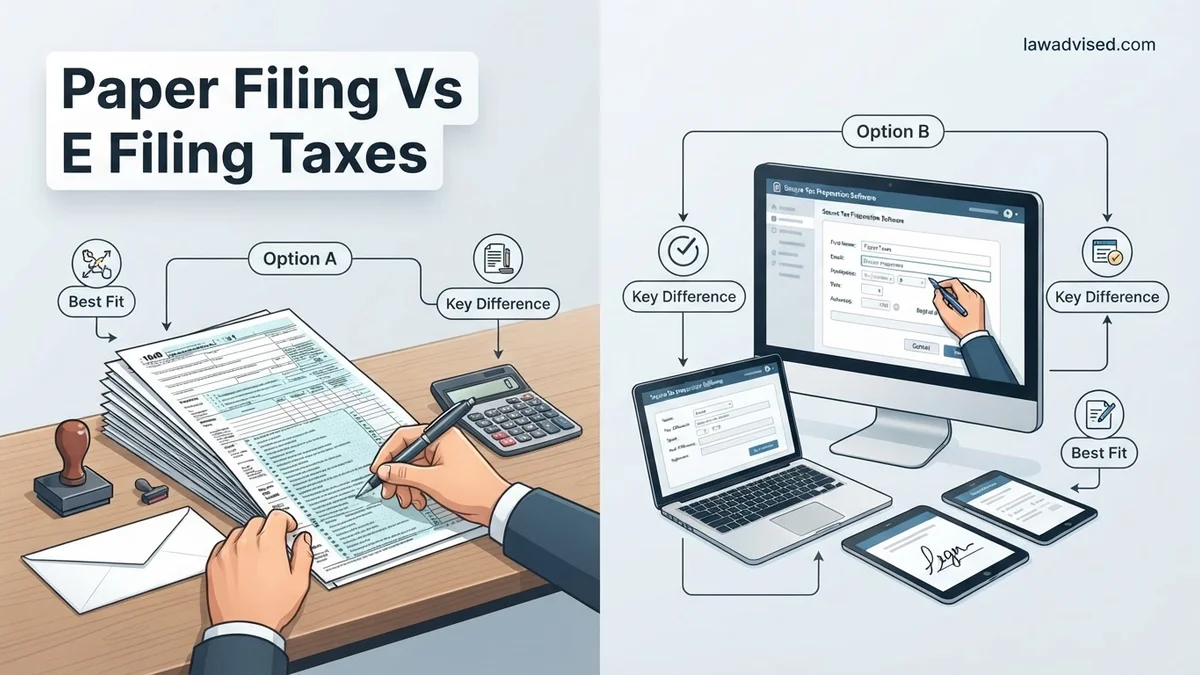
- E-file Processing: Automated intake, instant error checks, and 1 to 3 week refund timelines.
- Paper Processing: Manual mail sorting, human data entry, and 6 to 12 week refund timelines.
- Correction Protocol: E-file rejects errors instantly for correction; paper errors trigger mailed notices from the IRS.
How to Choose and Execute the Best Tax Filing Method
Weighing Upfront Costs Against Convenience
Paper filing is technically free if you print forms from the IRS website at home or use a public library. However, you must factor in the cost of postage, certified mail fees if you want tracking, and the value of your time. E-filing often requires paid software or commercial preparation services, though Free File options exist for qualifying income levels in 2026. The convenience of guided questioning and automated calculations usually outweighs the modest software fee for most filers.
Security, Complexity, and Special Circumstances
Both methods offer robust security, but e-filing utilizes encrypted transmission channels that protect your data in transit better than a paper envelope sitting in a residential mailbox. That said, if you are filing a complex or unusual decedent return, or an amended form that current software limits, paper filing remains a reliable fallback. Review your specific tax documents before deciding to ensure your chosen platform supports your unique schedules.
- Choose E-Filing if: You want a fast refund, hate math errors, and value automated record-keeping.
- Choose Paper Filing if: You have complex override requirements, zero software budget, or prefer physical documentation control.
- Action Step for 2026: Check IRS Free File eligibility limits before purchasing commercial tax preparation software.
How to Fix Common Errors When Submitting Your Tax Return
Filing errors can trigger IRS rejection notices or spark processing delays that halt your expected 2026 tax refund. Fixing these issues quickly prevents prolonged audits.
Correcting an E-Filed Return Rejection
Electronic returns are often rejected within 48 hours due to mismatched data. Follow these steps to resolve and resubmit:
- Access your tax software dashboard to read the specific rejection error code provided by the IRS.
- Update your personal data, ensuring Social Security numbers, dates of birth, and dependents match IRS records precisely.
- Retrieve your 2025 Adjusted Gross Income (AGI) from your previous year’s return to satisfy identity verification protocols.
- Resubmit the electronic file through your software platform at no additional charge.
Amending a Paper-Filed Return
Paper returns are prone to mathematical errors caught by IRS automated scanners. If you spot a mistake after mailing:
- Wait until the IRS processes your original return and issues any initial refund or balance due notice.
- Obtain Form 1040-X, Amended U.S. Individual Income Tax Return, for the 2026 tax season.
- Complete the form by listing the original figures, the net change, and the corrected amounts.
- Mail the completed Form 1040-X to the specific IRS service center designated for your state of residence.
What If Your Refund Is Delayed Regardless of Filing Method
Tax refunds can stall long past the standard benchmark windows due to identity verification holds, manual error reviews, or potential fraud flags.
Tracing Processing Bottlenecks
If your refund exceeds normal processing windows, utilize official tracking protocols to pinpoint the hold-up:
- Check the official IRS “Where’s My Refund?” tool or your online IRS account dashboard for updated status indicators.
- Review mail or online notifications for IRS letters requesting additional verification documents, such as Form 5071C.
- Contact the IRS customer support helpline directly if your return status shows no movement after 21 days for e-filing or six weeks for paper filing.
What If It Still Doesn’t Work?
Persistent return rejections, unresolved refund freezes, or complex audit notices require professional intervention. Consider these fallback steps when standard troubleshooting fails:
- Gather all IRS correspondence, W-2s, 1099s, and your initial tax preparation documents into one secure file.
- Consult a certified public accountant (CPA) or an Enrolled Agent (EA) who specializes in IRS dispute resolution.
- Anticipate professional service costs ranging from $200 to $600 for standard error amendments, and significantly higher fees for complex audit representations.
- Authorize your chosen tax professional to speak directly with the IRS on your behalf using Form 2848.
Conclusion
Choosing between paper filing and e-filing dictates the speed, accuracy, and security of your 2026 tax return experience. While paper filing leaves room for manual processing bottlenecks, e-filing delivers faster refunds backed by automated error-checking protocols. According to verified research and expert sources from the IRS, transitioning to electronic submission reduces overall error rates by over 70 percent. Take your next actionable step today by logging into your secure tax software platform to prepare and electronically submit your current tax return.
❓ Frequently Asked Questions
How long does the IRS take to process a paper tax return?
Paper returns generally take four weeks or longer to process, and during peak tax season, refunds can take six to eight weeks or more to arrive.
What are the main security differences between paper and e-filing?
E-filing uses encrypted software and secure servers to transmit data directly to the IRS, reducing the risk of mail theft associated with paper returns.
Can I switch from paper to e-filing mid-season?
You can choose a different filing method each tax year, but you cannot switch methods for a tax return that has already been mailed or submitted.
Do I need to pay for software to e-file my taxes?
Not necessarily. Taxpayers meeting specific income thresholds can use IRS Free File partners to file federal taxes at no cost.
What happens if I make a mistake on an e-filed return?
If the IRS catches a math error during e-filing processing, they may correct it automatically, but more complex mistakes require filing an amended return.
Is physical signature required for e-filed returns?
No, e-filed returns use a Self-Select PIN or your prior year’s Adjusted Gross Income (AGI) to sign the return electronically.

Ismail Hossain is the founder of Law Advised. He is an Divorce, Separation, marriage lawyer. Follow him.