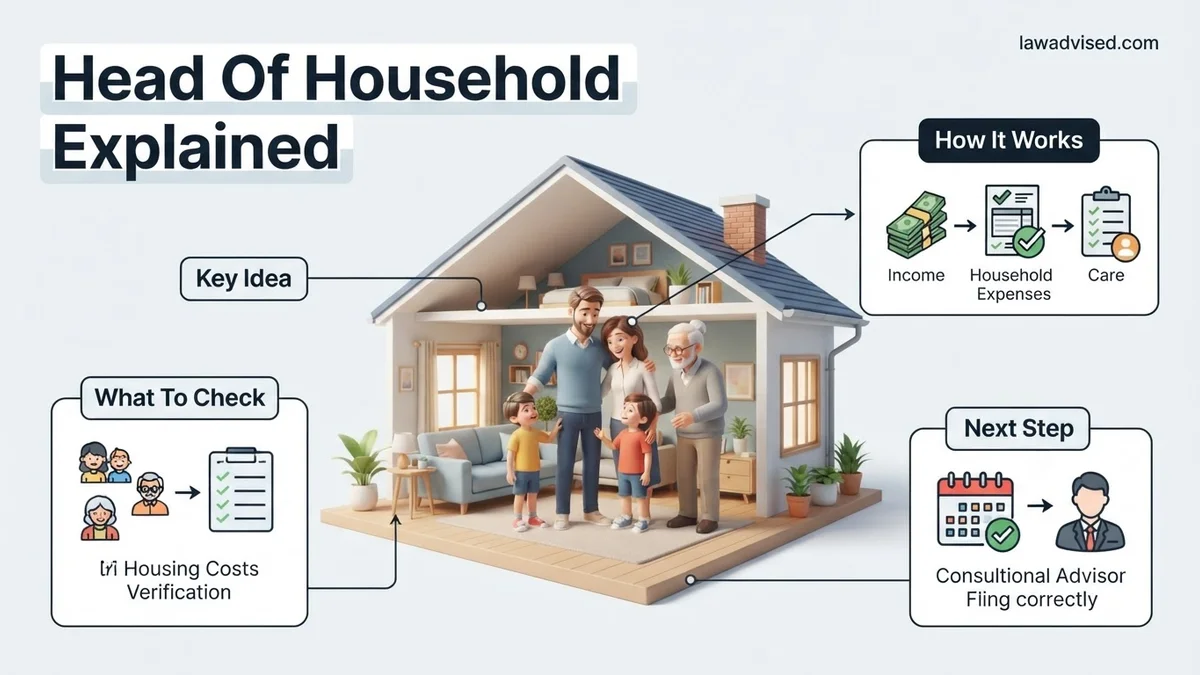
Head of Household Explained 2026 Expert Guide to IRS Rules
Filing taxes as head of household offers significantly lower tax brackets and a higher standard deduction than filing as single. However, taxpayers must meet strict IRS criteria regarding marital status, household expenses, and qualifying dependents to legally claim this status in 2026.
Head of Household is a special IRS tax filing status designed to provide financial relief for unmarried taxpayers who financially support a dependent and pay the majority of household expenses. Compared to filing as single, this status gives you a significantly larger standard deduction and wider tax brackets, which drastically lowers your overall income tax liability for 2026.
Qualifying for this status requires meeting strict IRS rules regarding your marital status, your home expenses, and who lives with you. Many taxpayers assume that simply living with a dependent or sharing rent makes them eligible, but the IRS applies precise formulas and legal definitions that catch many filers off guard.
Key Takeaways
- You must be unmarried or considered unmarried on the last day of the tax year.
- You must pay more than half the cost of keeping up your home.
- A qualifying dependent, such as a child or relative, must live with you for over half the year.
- The standard deduction for head of household is substantially higher than the single filing status.
- The ‘abandoned spouse’ rule allows married individuals living apart from their spouse to qualify.
What Causes Taxpayers to Misunderstand Head of Household Status
The Head of Household status carries the highest audit rate among individual filing statuses because taxpayers frequently misinterpret the complex IRS guidelines. People often assume that any single parent or unmarried caregiver automatically qualifies, overlooking the strict financial contribution and residency tests required by federal tax law.
The Myth of the Shared Household
Many taxpayers believe that if they split rent or mortgage payments with a roommate, sibling, or romantic partner, they can claim Head of Household. In reality, the IRS mandates that you must pay more than half of the total cost of keeping up your home entirely out of your own pocket. If another adult living in the house contributes half or even 45 percent of the utility, grocery, and housing expenses, you automatically fail the primary financial test.
Misinterpreting the “Considered Unmarried” Rule
Married individuals often mistakenly file as Head of Household because they live apart from their spouse. The IRS does allow you to claim this status if you are “considered unmarried” for 2026, but this requires meeting severe conditions. You must have lived apart from your spouse for the last six months of the tax year, paid more than half the cost of maintaining your home, and your home must be the main home of your dependent child for more than half the year.
How to Qualify for Head of Household Status Step-by-Step
Claiming Head of Household for your 2026 tax return requires passing three distinct, non-negotiable IRS tests. Missing even one of these criteria means you must file as Single or Married Filing Separately, potentially costing you thousands of dollars in higher taxes.
Test 1: Marital Status Requirements
You must meet specific legal definitions regarding your relationship status on the last day of the tax year.
- You must be unmarried on December 31, 2026.
- You can be legally divorced or legally separated under a decree of divorce or separate maintenance.
- You are considered unmarried if your spouse was a nonresident alien at any time during the year and you do not choose to treat them as a resident alien.
- You can qualify while legally married if you meet the strict six-month separation rule and maintain a home for a qualifying dependent child.
Test 2: Cost of Keeping Up a Home
You must prove that you paid more than half of the actual operating costs for your household during the entire calendar year of 2026.
- Include rent, mortgage interest, real estate taxes, property insurance, and home repairs.
- Include utility bills such as electricity, gas, water, and internet service.
- Include food eaten inside the home, but exclude clothing, education, medical treatment, vacations, or life insurance.
- Keep meticulous receipts and bank statements to prove your exact percentage of financial contribution if the IRS requests verification.
How to Fix Common IRS Disqualifications and Errors
Filing errors regarding Head of Household status frequently trigger automated IRS flags, delaying tax refunds by up to 21 days or longer. According to recent IRS compliance data, the most common error involves failing to meet the strict “more than half the cost of keeping up a home” threshold. When the IRS audits these claims, taxpayers must produce receipts, utility bills, and mortgage statements proving their financial contribution.
Correcting Financial Support Calculations
If the IRS rejects a Head of Household claim due to financial support disputes, taxpayers must recalculate their household maintenance costs. Eligible expenses include rent, mortgage interest, real estate taxes, property insurance, repairs, utilities, and groceries consumed on the premises. Excluded costs are clothing, education, medical treatment, vacations, life insurance, and transportation. Taxpayers should compile these figures meticulously to prove they crossed the 50 percent threshold.
Resolving Dependent Status Discrepancies
Another frequent disqualification occurs when a dependent’s Social Security Number does not match IRS database records or when a non-custodial parent improperly claims the qualifying person. To resolve this error:
- Review the exact spelling and digits of the dependent’s Social Security Number against their official card.
- Confirm that the qualifying person lived with the taxpayer for more than half of the 2026 tax year, barring temporary absences for school or medical care.
- Check if another family member claimed the same dependent on a separate return, which triggers an IRS freeze.
- File Form 8812 or amended return documents if an adjustment is required to rectify the filing status.
What If Your Dependent Situation Changes During the Tax Year
Life events during the 2026 tax year—such as the birth of a child, a divorce, or the death of a qualifying relative—directly impact Head of Household eligibility. The IRS determines filing status based on the taxpayer’s marital status and household composition on the final day of the tax year, December 31, 2026. However, qualifying dependent tests often require time-apportioned presence calculations.
Navigating Mid-Year Marital Status Changes
Taxpayers who experience a divorce or separation during 2026 may still qualify as Head of Household if they lived apart from their spouse for the final six months of the year. Furthermore, they must have paid more than half the cost of maintaining their home for a qualifying dependent. If a spouse moved out on or after July 2, 2026, the taxpayer generally cannot file as Head of Household for that tax year, regardless of dependent support.
Handling the Loss or Gain of a Dependent
When a qualifying person moves in or out mid-year, strict timelines apply. For a child born or adopted during 2026, the infant is considered to have lived with the taxpayer for the entire year, satisfying the residency test. Conversely, if a dependent adult passes away or moves out permanently before July 1, 2026, they may fail the residency duration requirement for Head of Household status, forcing a switch to Single filing status.
What If It Still Doesn’t Work?
When automated IRS rejections persist despite careful corrections, taxpayers must take decisive escalation steps to resolve their filing status disputes for 2026.
- Review the specific rejection code on your tax software notification or IRS notice CP75, which highlights documentation requests for Head of Household claims.
- Gather all physical or digital proof of residency, including school records, medical bills, and lease agreements matching the 2026 tax year.
- Consult a certified public accountant (CPA) or an Enrolled Agent specializing in IRS audit defense to review complex custody agreements and financial ledgers. Expect professional tax representation fees to range from $300 to $1,000 depending on the complexity of the audit.
- Submit a formal reconsideration package to the IRS or request assistance from the Taxpayer Advocate Service if your refund remains frozen for more than 90 days.
Conclusion
Claiming Head of Household status correctly in 2026 requires strict adherence to IRS residency, marital, and financial contribution rules. When errors occur, systematic documentation and prompt correction prevent costly refund delays. According to verified research and expert tax sources, utilizing professional software or certified assistance significantly reduces audit risk and ensures full compliance with current federal tax codes. The next actionable step is to audit your 2026 household expenses and dependent timelines today to verify they meet every statutory requirement before final submission.
❓ Frequently Asked Questions
What are the three strict IRS requirements for head of household status?
You must be unmarried or considered unmarried on the last day of the tax year, pay more than half the cost of keeping up a home, and have a qualifying person live with you for more than half the year.
How does the standard deduction compare between single and head of household?
The head of household standard deduction is significantly higher than the single deduction, which directly reduces the amount of income subject to federal income tax.
What is the ‘considered unmarried’ rule for married taxpayers?
A married individual can be considered unmarried if they file a separate return, paid more than half the cost of keeping up their home for the year, and their spouse did not live in the home during the last six months of the tax year.
Can a qualifying child who is not my dependent let me file as head of household?
Generally, the qualifying person must be your dependent. However, an unmarried qualifying child who is not your dependent due to a divorce decree or release of claim can still make you eligible.
What expenses count toward keeping up a home?
Qualifying expenses include rent, mortgage interest, real estate taxes, insurance, repairs, utilities, and groceries eaten in the home. Personal expenses like clothing and education do not count.
What happens if my qualifying dependent moves out temporarily?
Temporary absences for special circumstances, such as illness, education, business, or military service, count as time living in the home as long as it is reasonable to assume the dependent will return.

Ismail Hossain is the founder of Law Advised. He is an Divorce, Separation, marriage lawyer. Follow him.