Married Filing Jointly Explained Expert 2026 Tax Guide
Married Filing Jointly is a tax filing status designed for married couples that offers significantly larger standard deductions and lower tax brackets than filing separately. To qualify, you must be legally married on or before the last day of the tax year and agree to combine your incomes and tax liabilities.
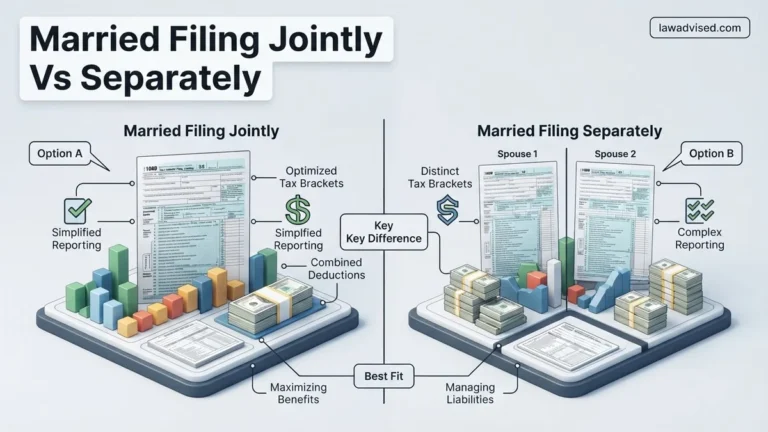
Married Filing Jointly is a federal tax filing status that allows legally married couples to combine their incomes, deductions, and tax credits onto a single tax return. For the vast majority of couples, this status unlocks significantly lower tax brackets and higher standard deductions than filing separately.
Choosing this status directly impacts your household take-home pay, eligibility for major tax credits, and the overall complexity of your annual tax preparation. Understanding how it works for the 2026 tax year ensures you do not leave money on the table.
Key Takeaways
- Must be legally married by December 31 to qualify for this status.
- Provides a substantially higher standard deduction than single or separate statuses.
- Unlocks valuable tax credits like the Earned Income Tax Credit.
- Both spouses share joint and several liability for any owed taxes.
- Comparing with married filing separately helps determine the lowest tax bill.
What Causes Confusion With Married Filing Jointly Status
Legal Marital Status on December 31
The IRS does not care how many months out of the year you were married. Your filing status for 2026 is determined by your legal marital status on the very last day of the year, December 31, 2026.
- If you are legally married by December 31, the IRS considers you married for the entire tax year.
- If you are going through a divorce that is not finalized by December 31, you cannot file as single or head of household.
- Couples who are legally separated under a decree of divorce or separate maintenance are generally treated as unmarried.
The Joint and Several Liability Trap
The biggest source of anxiety and confusion with this status is joint and several liability. When you sign a joint return, both you and your spouse are legally responsible for the entire tax liability, penalties, and interest due, even if one spouse earned all the income.
- If your spouse makes a mathematical error or omits income, the IRS can pursue either of you for the full balance.
- Relief options like Innocent Spouse Relief exist, but they are difficult to qualify for and require formal application.
- Open, honest communication about financial records is essential before signing a joint return.
How to Evaluate Your Eligibility and Tax Benefits
Eligibility Rules for 2026
To use the Married Filing Jointly status for your 2026 tax return, you must meet specific legal and situational criteria established by the IRS.
- You must be legally married on or before December 31, 2026.
- Both you and your spouse must agree to file a joint return together.
- Nonresident aliens married to US citizens or residents have specific rules to qualify, often requiring an election to be taxed on worldwide income.
Financial Advantages: Brackets and Deductions
The primary reason most couples choose this status is the substantial financial incentives built into the tax code. The government rewards joint filers with wider tax brackets and larger deductions.
- Standard Deduction: For 2026, married couples filing jointly enjoy a significantly higher standard deduction compared to single filers or those married filing separately.
- Tax Brackets: The income thresholds for each marginal tax rate are broader for joint filers, which helps prevent couples from hitting higher tax brackets too quickly.
- Tax Credits: Filing jointly unlocks eligibility for lucrative credits like the Child Tax Credit, the Earned Income Tax Credit, and education credits that phase out quickly or disappear entirely if you file separately.
Step-by-Step Guide to Choosing Joint vs Separate Statuses
Choosing between married filing jointly and married filing separately requires a rigorous financial evaluation. Tax experts recommend running dual calculations annually before final submission to determine the optimal mathematical outcome for your household.
Assessing Dual Income Impacts
Evaluate your combined gross income against current tax bracket thresholds. High-income earners often face the “marriage penalty” when combined earnings push them into a higher marginal bracket than filing individually.
Evaluating Deductions and Credits
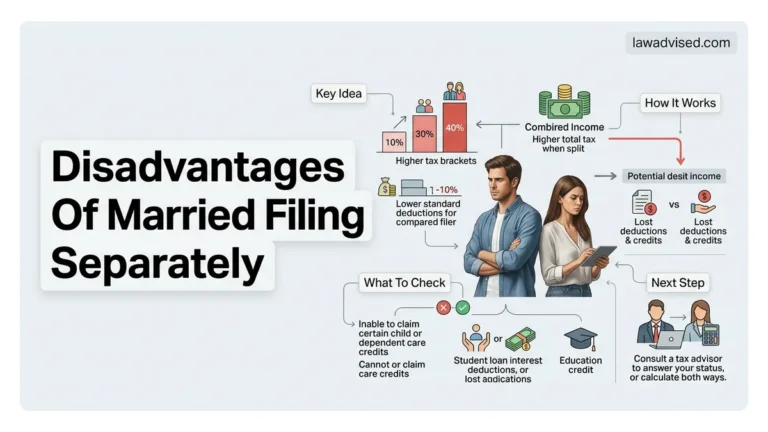
Review eligibility restrictions for key tax breaks before making a final status selection. Certain credits, such as the Earned Income Tax Credit and education credits, are entirely unavailable to taxpayers utilizing the married filing separately status.
- Gather all W-2s, 1099s, and investment statements for both spouses for the 2026 tax year.
- Input your financial data into tax software using the married filing jointly framework to establish baseline liability.
- Recalculate the return using the married filing separately status to compare total tax owed and refund amounts.
- Weigh the financial savings against potential administrative burdens and loss of targeted credits.
- Select the filing status that yields the lowest net tax liability or best aligns with your long-term financial strategy.
What If Joint and Several Liability Becomes a Risk
Filing a joint return legally binds both spouses to the accuracy and tax liability of the entire document. If a partner conceals income or claims erroneous deductions, the IRS can pursue either individual for the full balance due, including penalties and interest.
Understanding Innocent Spouse Relief
Taxpayers who sign a joint return can request relief from understatements of tax caused by their partner’s erroneous items. The IRS evaluates whether the requesting spouse had knowledge or reason to know about the discrepancy when signing the return.
Separation of Liability and Equitable Relief
Individuals who are divorced, legally separated, or living apart for at least 12 months may request a separation of liability. This allocates the understated tax accurately between the spouses. Equitable relief serves as a final fallback for those who do not qualify for other statutory exceptions.
What If It Still Doesn’t Work?
Complex tax disputes or disagreements over joint filing decisions require specialized intervention beyond standard software solutions. Consider these fallback steps if standard evaluation methods fail to resolve your filing status dilemma:
- Consult a Certified Public Accountant (CPA) or Enrolled Agent (EA) specializing in marital tax compliance. Professional fees for complex status assessments typically range from $300 to $800 depending on asset complexity.
- Request an extension using Form 4868 to secure additional time for professional review without incurring late-filing penalties.
- Contact the IRS Taxpayer Advocate Service if systemic processing errors prevent the submission of your chosen filing status.
- Engage a certified tax resolution attorney if facing active collection activity or suspected fraudulent activity by a spouse. Legal retainers for tax controversies generally start at $1,500 to $3,500.
Conclusion
Navigating the married filing jointly status requires balancing significant tax savings against shared legal liabilities. According to verified research and expert tax sources, running dual calculations annually remains the most reliable method for avoiding costly filing errors. Your next actionable step is to compile both spouses’ financial documents and run a comparative tax software simulation before the 2026 filing deadline.
❓ Frequently Asked Questions
What happens if my spouse owes back taxes from before we married?
An injured spouse allocation can help protect your portion of a joint tax refund from being applied to your partner’s pre-existing debts.
Can we file jointly if we lived apart for part of the year?
Yes, temporary physical separation does not disqualify you as long as you remain legally married and do not have a final decree of divorce or separate maintenance.
How does filing jointly affect student loan payments?
Joint returns combine your adjusted gross incomes, which can significantly increase monthly payments under income-driven repayment plans.
Are same-sex married couples eligible for this status?
Yes, legally recognized same-sex marriages are treated the same as opposite-sex marriages for federal tax purposes.
What if one spouse has no income?
You can still file a joint return to claim larger deductions and tax credits, even if only one partner earned money during the year.
Can we change our filing status after submitting the return?
You generally cannot switch from married filing jointly to married filing separately after the tax filing deadline has passed.

Ismail Hossain is the founder of Law Advised. He is an Divorce, Separation, marriage lawyer. Follow him.