Disadvantages of Married Filing Separately A 2026 Guide
Choosing the Married Filing Separately status often results in higher overall tax liabilities and the loss of major credits. Taxpayers face strict limits on deductions, phase-outs for savings accounts, and complex matching rules that trap unwary filers.
Choosing the Married Filing Separately (MFS) status in 2026 often triggers a steep financial penalty known as the marriage penalty. While filing separately keeps your tax liabilities legally isolated from your spouse, it strips away dozens of valuable tax breaks designed to support married couples. From losing eligibility for major federal credits to facing aggressive income phase-outs, opting out of a joint return can cost you thousands of dollars.
You might choose this status for asset protection, liability separation, or pending divorce proceedings. However, the IRS penalizes MFS filers by design to prevent high-income households from gaming the tax code. Understanding these steep financial drawbacks before you file is critical to avoiding unexpected tax bills and penalties.
Key Takeaways
- Filing separately immediately disqualifies you from claiming the Earned Income Tax Credit.
- You completely lose eligibility for the Student Loan Interest Deduction.
- Both spouses must either itemize deductions or both take the standard deduction.
- Child and Dependent Care Credit limits are severely reduced or eliminated entirely.
- Income phase-out thresholds for Roth IRAs drop dramatically to $0 in many cases.
What Causes the High Costs of Married Filing Separately
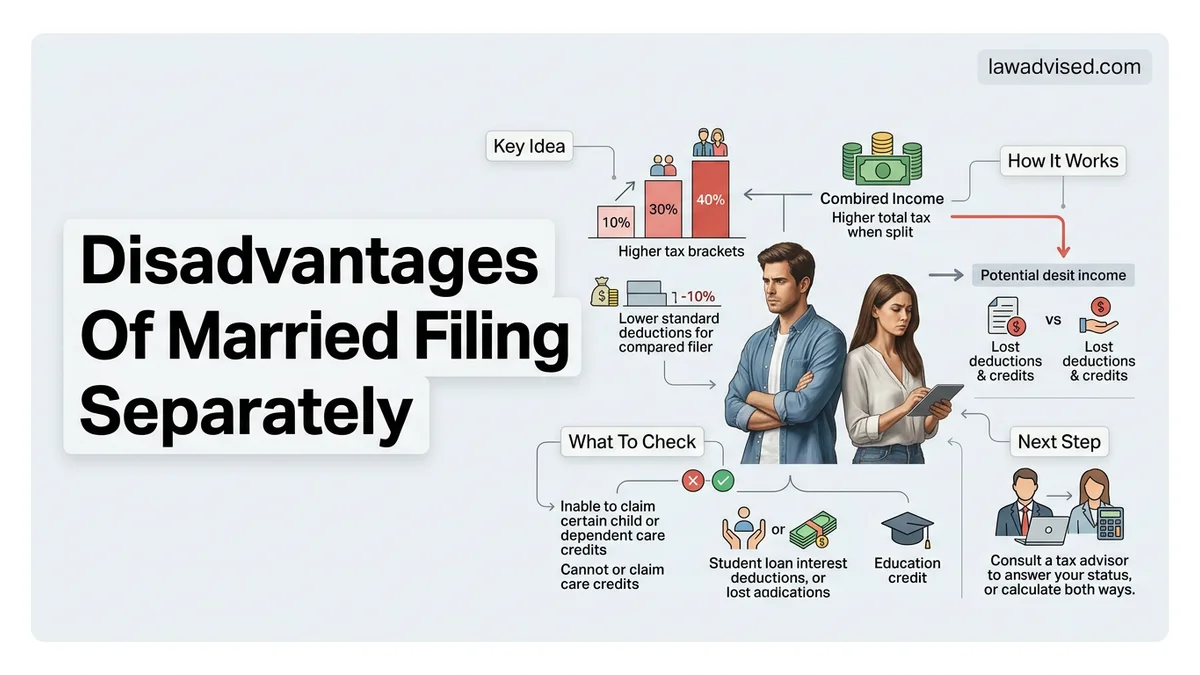
The primary financial driver behind the MFS tax penalty is the automatic disqualification from standard credits and deductions. When you file separately, the IRS treats you as ineligible for the most powerful wealth-building and family support mechanisms in the tax code.
Loss of Major Tax Credits and Deductions
Filing separately erects strict legal barriers between you and vital government assistance programs. If you choose MFS for the 2026 tax year, you immediately forfeit access to several key financial resources:
- Child and Dependent Care Credit: You generally cannot claim this credit, which helps offset the high costs of daycare and after-school care.
- Earned Income Tax Credit (EITC): MFS filers are completely barred from claiming the EITC, removing a crucial cash injection for lower-to-middle-income earners.
- Education Credits: You lose eligibility for the American Opportunity Tax Credit and the Lifetime Learning Credit.
- Student Loan Interest Deduction: You cannot deduct any interest paid on qualified student loans if you use the MFS status.
Stricter Income Thresholds and Deduction Limits
Beyond losing specific credits, MFS filers face hostile income thresholds that restrict basic deductions. Your standard deduction is often halved compared to married filing jointly, and if your spouse itemizes deductions, you are forced to itemize as well—even if your total deductions are zero. Furthermore, Roth IRA contribution phase-outs drop to zero dollars of modified adjusted gross income for MFS filers living with their spouse, completely blocking your ability to save tax-free for retirement using this vehicle.
How to Evaluate Your Tax Status and Fix Potential Penalties
Navigating the MFS status requires careful mathematical modeling before you submit your tax return to the IRS. Because the tax penalties are so severe, you must compare your potential joint liability against the combined total of two separate returns.
Running the Numbers Before Filing
Never assume that filing separately is cheaper just because your spouse has high medical debt, erratic freelance income, or questionable tax history. To accurately evaluate your position for 2026, take these analytical steps:
- Calculate your projected tax liability using software simulation for both Joint and Separate statuses.
- Factor in the absolute loss of credits like the Child Tax Credit, which provides up to $2,000 per qualifying child for joint filers but faces immediate phase-outs or total denial under MFS rules depending on state and income guidelines.
- Weigh the financial cost of lost deductions against the legal protection you gain by keeping your tax liability entirely separate from your partner.
Strategic Workarounds for High-Risk Situations
If you are forced into the MFS status due to domestic abuse, separation, or protection of personal assets, look for statutory exceptions. For example, the IRS grants “Head of Household” status to married individuals who lived apart from their spouse for the last six months of the year, provided they paid more than half the cost of maintaining a home for a dependent child. This status restores many lost credits and offers a much better tax bracket than standard MFS filing.
Step-by-Step Guide to Transitioning Back to Filing Jointly
Many couples use the Married Filing Separately status temporarily to manage specific financial risks or resolve tax disputes. Transitioning back to a joint return in 2026 requires careful timing and compliance with IRS amendment rules. Joint filing generally restores valuable credits, but switching status demands a structured approach.
H3: Reviewing Prior Year Elections
Before amending previous returns, verify whether statutory deadlines permit a status change. According to IRS regulations, couples generally have up to three years from the original filing deadline to amend a separate return to a joint return. However, specific restrictions apply once a notice of deficiency has been issued.
H3: Executing the Status Change
- Calculate the combined tax liability using tax software or a qualified professional to ensure the joint return yields a financial benefit for the 2026 tax year.
- Complete Form 1040-X, Amended U.S. Individual Income Tax Return, reflecting the combined income, deductions, and credits of both spouses.
- Attach all required schedules, W-2s, and 1099s that support the figures reported on the amended joint return.
- Obtain signatures from both spouses on the Form 1040-X, as the IRS requires dual execution for any joint filing amendment.
- Mail the completed package to the designated IRS service center for your geographic region, or submit it electronically if supported by modern tax filing platforms.
What If Separate Filing Is Legally Required or Unavoidable
Certain legal and personal circumstances make filing jointly impossible or financially dangerous, even with the steep tax penalties involved. Certified Public Accountants note that couples undergoing contested divorces often have no viable alternative. Understanding how to minimize the damage of mandatory separate filing protects both parties from unnecessary liabilities.
H3: Mitigating Separate Filing Penalties
State community property laws complicate separate filings significantly. If you live in a community property state, you must generally report half of your combined earned income on your separate return. Working with a family law attorney and a tax specialist ensures compliance without triggering unintended audit flags with the IRS.
H3: Protecting Your Credit and Assets
Maintain strictly separated bank accounts and credit lines while filing separately. This physical and financial separation prevents the IRS from asserting that joint assets should cover your spouse’s individual tax debts. Clear documentation remains your strongest defense against erroneous deficiency assessments.
What If It Still Doesn’t Work?
If your attempt to resolve filing complications or amend a separate return stalls with the IRS, specific fallback measures can prevent severe penalties. Implement these steps when standard corrections fail:
- Request a formal Account Transcript from the IRS website to identify exact processing errors or missing documentation on your separate returns.
- Contact the IRS Taxpayer Advocate Service if processing delays or systemic errors prevent your amended return from posting correctly.
- Consult a Certified Public Accountant (CPA) or a Certified Financial Planner (CFP) to untangle complex state-level community property allocations. Professional fees for complex separate-to-joint transitions typically range from $400 to $1,200 depending on asset complexity.
- File for a formal extension of time to pay if back taxes accrued under the separate filing status create an immediate liquidity crisis.
Conclusion
Filing taxes under the Married Filing Separately status creates distinct financial disadvantages, ranging from lost credits to higher tax brackets. Fortunately, taxpayers can transition back to a joint return or navigate unavoidable separations with careful planning. According to verified research and expert tax sources, proactive communication and adherence to IRS amendment timelines remain the most effective tools for minimizing tax liability. Your immediate next step is to run a comparative tax projection for 2026 to evaluate the exact financial impact of switching your filing status.
❓ Frequently Asked Questions
What are the biggest financial risks of choosing Married Filing Separately?
The primary risks include losing valuable tax credits like the EITC and Child Tax Credit, facing compressed tax brackets, and being barred from student loan interest deductions. Additionally, income limits for Roth IRA contributions drop to zero.
Why do tax professionals generally advise against filing separately?
The IRS intentionally designs the tax code to penalize separate filing by reducing thresholds for deductions and credits. Most couples end up paying significantly more in combined taxes compared to filing a joint return.
Are there any situations where filing separately makes sense?
It may protect you from joint and several liability if you suspect your spouse is underreporting income or committing tax fraud. Some couples also use it during pending divorces or to manage income-driven student loan repayment calculations.
How does Married Filing Separately impact retirement account contributions?
The phase-out range for making deductible contributions to a traditional IRA is reduced to $0 to $10,000 if you lived with your spouse at any time during the year, severely restricting tax-advantaged savings.
How do matching rules work for itemized deductions?
If you live in a non-community property state and choose to itemize, you can only deduct expenses that you paid with your own funds. You cannot claim deductions for expenses your spouse paid out of their separate account.
Can filing separately protect me from my spouse’s tax debt?
Yes, filing separately ensures that you are only responsible for the tax liability reported on your individual return, protecting your tax refund from being seized for your spouse’s past-due debts.

Ismail Hossain is the founder of Law Advised. He is an Divorce, Separation, marriage lawyer. Follow him.