Who Qualifies as Head of Household 2026 Expert Guide
Filing as head of household offers a higher standard deduction and more favorable tax brackets than filing as single. To qualify, you must meet three strict IRS criteria regarding marital status, paying for household upkeep, and supporting a qualifying dependent.
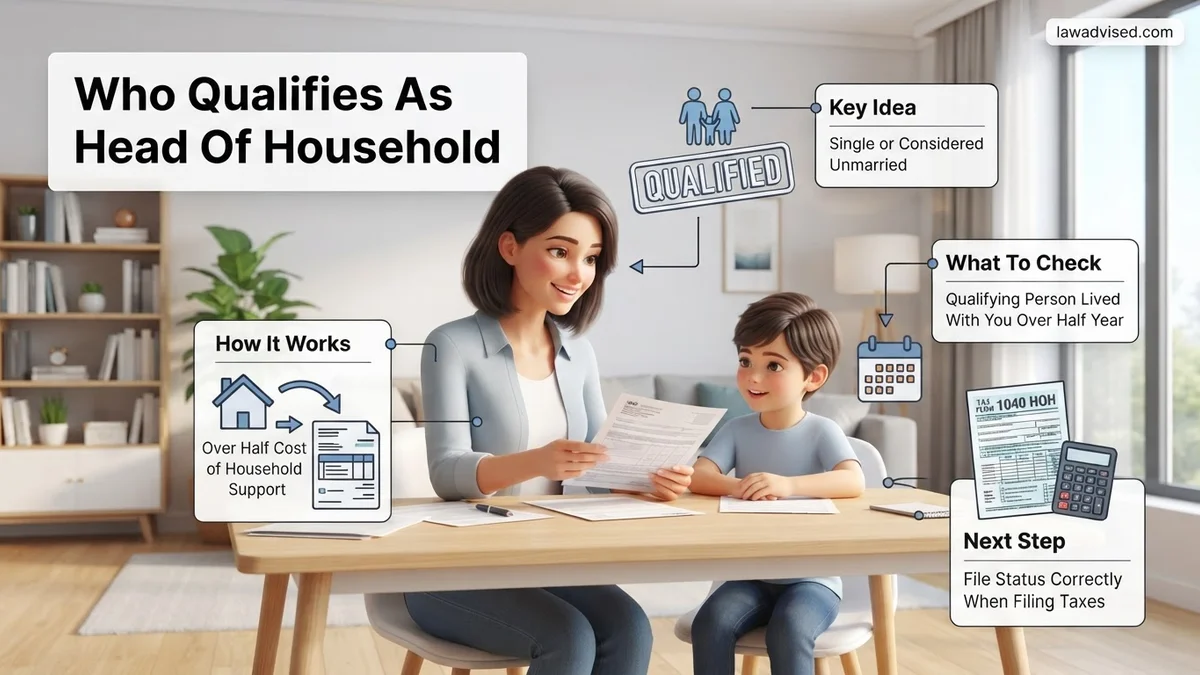
Filing your 2026 federal income tax return as head of household requires meeting three strict IRS conditions: you must be unmarried or considered unmarried, you must pay more than half the cost of keeping up your home, and a qualifying person must live with you for more than half the year. This specific filing status grants you a significantly higher standard deduction and lower tax brackets than filing as single.
Choosing the right filing status directly impacts your bottom line. Securing the head of household designation for the 2026 tax year can save you thousands of dollars compared to a single status. However, the IRS audits these claims frequently. You need absolute certainty that your household dynamics match the federal tax code before you file.
Key Takeaways
- You must be unmarried or considered unmarried on the last day of the tax year.
- You must pay more than half the cost of keeping up your home.
- A qualifying dependent, such as a child or parent, must live with you for over half the year.
- Married taxpayers separated for the last six months may qualify.
- Claiming this status incorrectly can trigger an IRS audit and tax adjustments.
What Causes Confusion About Who Qualifies as Head of Household
Taxpayers often struggle with head of household rules because the definition of a family does not always match the IRS definition. Sharing a roof with a relative does not automatically make them a qualifying person for tax purposes.
Misunderstanding the Qualifying Person Rule
You cannot claim head of household status just by supporting an adult child or relative financially. The individual must meet strict relationship, residency, and dependency tests. For example, a non-relative living with you who relies on your financial support never qualifies you for this status, even if you pay one hundred percent of the household bills.
The Trap of Temporary Absences
Confusion also arises around the residency requirement when a qualifying person temporarily leaves the home. A child away at college or a dependent elderly parent in a short-term rehabilitation facility still counts as living with you, provided the absence is temporary and your home remains their primary residence.
- Temporary absences include school, illness, business, or military service.
- The dependent must maintain a presumptive return to your household.
- Proof of continued financial support during the absence is mandatory.
How to Determine If You Meet IRS Marital and Upkeep Rules
To qualify as head of household for 2026, you must clear two initial hurdles before looking at dependents: your marital status and your financial contribution to the home. The IRS enforces these rules rigidly to prevent single individuals from gaming the system.
Unmarried or Considered Unmarried Status
You qualify if you are unmarried on the last day of the tax year. If you are legally married, you can still qualify as “considered unmarried” if you meet specific separation criteria. This rule exists to protect separated spouses who are raising children independently.
- You did not live with your spouse for the last six months of 2026.
- You paid more than half the cost of keeping up your home for the year.
- Your home was the main home of your qualifying dependent child for more than half the year.
Calculating Cost of Upkeep
You must prove you paid more than fifty percent of the total household expenses for the entire year of 2026. Total costs include rent or mortgage interest, real estate taxes, property insurance, utilities, repairs, maintenance, and groceries consumed on the premises.
For example, if your total household expenses equal forty thousand dollars for 2026, you must personally contribute at least twenty thousand and one dollars from your own funds. Government assistance, child support payments received from others, or funds provided by an adult roommate do not count toward your contribution total.
Step-by-Step Guide to Verifying Your Qualifying Dependent
Confirming your filing status requires strict adherence to IRS compliance metrics for the 2026 tax year. According to Internal Revenue Service Publication 501 guidelines, taxpayers must systematically verify their dependent relationships before submitting Form 1040.
1. Audit the Residency Timeline
Calculate the exact number of nights your dependent lived in your primary home during 2026. Temporary absences for school, medical care, or vacations still count toward the mandatory six-month requirement.
2. Review Financial Support Records
Gather bank statements, grocery receipts, and utility bills to prove you paid more than 50 percent of total household maintenance costs. Financial data must reflect the complete 2026 calendar year to satisfy standard tax audits.
3. Cross-Check Exemption Rules
Verify that your dependent has not filed a joint tax return for 2026, unless they filed solely to claim a refund of withheld income tax. Qualified dependents must also meet citizenship or residency tests outlined by federal tax authorities.
What If Your Living Situation Does Not Fit Standard IRS Rules
Unconventional family dynamics often create confusion regarding head of household status. When living arrangements deviate from traditional nuclear family structures, taxpayers must apply specific statutory exceptions.
Non-Traditional Custody Arrangements
Divorced parents who share joint custody often alternate claiming dependents. However, federal tax law dictates that only the custodial parent—the one with whom the child lived for the greater number of nights—can claim head of household status, regardless of what a divorce decree states.
Supporting Aging Parents
You can qualify for head of household status if you maintain a separate home for a dependent parent, such as an assisted living facility. IRS rules permit this exception provided you pay more than half the cost of keeping up that specific parent-designated residence for the entire 2026 tax year.
What If It Still Doesn’t Work?
If automated tax software rejects your head of household filing status or your situation remains ambiguous, do not guess. Implement these targeted fallback steps to resolve compliance risks:
- Re-run your 2026 household expense calculations using a certified IRS worksheet to eliminate mathematical errors.
- Consult a certified public accountant (CPA) or an enrolled agent to review complex multi-household support proofs. Professional tax advisory fees typically range from $250 to $600 depending on complexity.
- Utilize the IRS Volunteer Income Tax Assistance (VITA) program for free, qualified tax help if you meet income eligibility thresholds.
- File for a standard filing status extension if documentation cannot be verified before the April 2026 deadline, preventing costly amended return fees later.
Conclusion
Claiming head of household status for 2026 requires meticulous proof of residency, financial contribution, and qualifying dependent relationships. Miscalculating these variables can trigger federal tax audits and delayed refunds. According to verified research and expert sources from the National Society of Accountants, proactive documentation remains the most effective safeguard against filing discrepancies. Your immediate next step is to gather all 2026 utility bills, mortgage or lease statements, and dependent birth records before launching your tax software.
❓ Frequently Asked Questions
What are the exact three rules to qualify as head of household?
You must be unmarried or considered unmarried on the last day of the year, pay more than half the cost of keeping up your home, and have a qualifying person live with you for more than half the year.
What expenses count toward keeping up a home?
Countable expenses include rent, mortgage interest, real estate taxes, insurance, repairs, utilities, and food eaten in the home. Personal items, clothing, and life insurance do not count.
Can I claim head of household if my dependent is away at college?
Yes, temporary absences for education, medical care, or military service still count as living in your home, provided the home was their main residence during the rest of the year.
What does ‘considered unmarried’ mean by IRS standards?
You are considered unmarried if you file a separate return, paid more than half the cost of keeping up your home for the year, and your spouse did not live in the home during the last six months of the tax year.
Can I claim a parent as a qualifying person if they live elsewhere?
Yes, you can qualify if you maintain a home for your parent and pay more than half the cost of keeping up that parent’s home, including if they live in a nursing facility or rest home.
What happens if I file as head of household but do not qualify?
If the IRS audits your return and finds you ineligible, they will reclassify your status to single or married filing separately, resulting in back taxes, interest, and potential penalties.

Ismail Hossain is the founder of Law Advised. He is an Divorce, Separation, marriage lawyer. Follow him.