Filing Status Rules Explained Expert Guide to IRS 2026
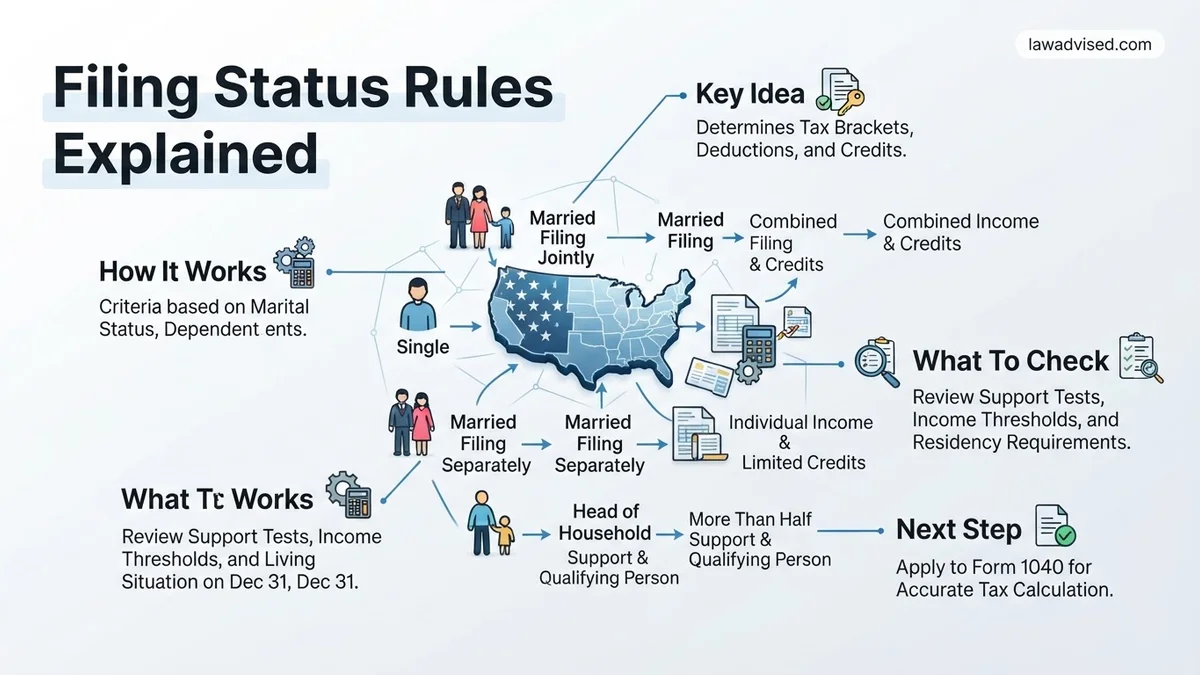
Choosing the wrong IRS filing status can cost you thousands in overpaid taxes or trigger costly audits. Filing status rules dictate your standard deduction, tax brackets, and eligibility for key credits based strictly on your marital and family situation as of December 31.
Your IRS filing status dictates your standard deduction amount, tax bracket thresholds, and eligibility for specific credits. For the 2026 tax year, choosing the correct status depends entirely on your legal marital status and household responsibilities as of December 31, 2026. Picking the wrong option directly triggers automated IRS matching notices, processing delays, or costly audits.
The rules leave zero room for interpretation, and life changes like marriage, divorce, or a child moving out completely shift your legal category. This guide breaks down the strict criteria for all five IRS filing statuses so you can lock in the right choice and keep your return compliant for 2026.
Key Takeaways
- Your marital status on the last day of the tax year determines your legal filing options.
- Head of Household status offers a higher standard deduction than Single status for qualifying unmarried taxpayers.
- Married couples must weigh the lower tax rates of Filing Jointly against the liability protections of Filing Separately.
- Qualifying Surviving Spouse status allows recently widowed taxpayers with dependents to use joint tax brackets for two years.
- Qualifying for multiple statuses requires applying strict IRS tie-breaker rules to choose the most advantageous option.
What Causes Filing Status Confusion and IRS Audit Triggers
The Decmber 31st Marital Status Rule
The IRS does not care what your status was for the first eleven months of the year. Your marital status on the very last day of 2026 dictates whether you must file as Single or Married. If you finalize a divorce on December 31, 2026, the IRS views you as unmarried for the entire tax year. Conversely, if you are legally separated under a decree of divorce or separate maintenance by year-end, you cannot file as married.
Common Misclassifications That Flag Returns
Automated IRS systems cross-reference Social Security numbers to catch filing status errors instantly. The most frequent audit triggers occur when two unmarried parents living in the same home both try to claim Head of Household status, or when separated spouses file as Single before a final decree is issued. Using an incorrect status automatically invalidates your standard deduction and shifts your tax math, prompting the IRS to freeze refunds and demand documentation.
How to Fix Your Filing Status Choice Using Step-by-Step IRS Rules
Evaluating Single Versus Married Filing Statuses
If you were unmarried, divorced, or legally separated on December 31, 2026, your baseline status is Single. If you are legally married, you generally choose between Married Filing Jointly or Married Filing Separately. Joint filing unlocks higher standard deductions and access to crucial credits like the Earned Income Tax Credit, though it carries joint liability for all tax debts. Married Filing Separately is rarely advantageous unless you need to isolate your tax liability from a spouse.
Navigating the Strict Head of Household Requirements
Head of Household offers a higher standard deduction than Single status, but the eligibility tests are rigorous for 2026. You must meet three distinct criteria:
- You were unmarried or considered unmarried on the last day of the tax year.
- You paid more than half the cost of keeping up a home for the year.
- A qualifying dependent lived in that home for more than half of 2026, with temporary absences for school or medical care counting as time at home.
If you are legally married but lived apart from your spouse for the last six months of 2026, paid over half the home maintenance costs, and provided a home for your dependent child, the IRS may still treat you as unmarried and grant you Head of Household status.
How to Qualify for the Head of Household Status Safely
The Head of Household filing status offers a significantly higher standard deduction and more favorable tax brackets than filing as Single or Married Filing Separately. However, the IRS subjects this status to strict audits for the 2026 tax year. According to tax compliance data from the IRS, misclaiming this status is a leading trigger for automated correspondence audits.
To safely qualify, you must meet three distinct criteria set by federal tax code: you must be considered unmarried on the last day of the year, you must pay more than half the cost of keeping up a home, and a qualifying dependent must live with you for more than half the year.
Step-by-Step Qualification Checklist
- Verify your marital status: You must either be legally unmarried, divorced, or considered unmarried under the abandoned spouse rules by December 31, 2026.
- Calculate household maintenance costs: Add up rent, mortgage interest, utilities, property taxes, repairs, and groceries. Ensure you paid greater than 50 percent of these total expenses using your own independent funds.
- Confirm dependent residency: Ensure your qualifying child, parent, or relative lived in your primary residence for more than six months of the 2026 tax year, barring temporary absences for school or medical care.
What If It Still Doesn’t Work and You Qualify for Multiple Statuses?
Taxpayers occasionally find themselves meeting the strict qualifications for more than one filing status simultaneously. When a primary fix fails or overlapping rules create an impasse for the 2026 filing season, systematic troubleshooting is required to prevent costly penalties or delayed refunds.
- Test the mutually exclusive rules: Review IRS Publication 501 guidelines. If you are legally married on the final day of the tax year, you cannot legally use the Single or Head of Household status unless you meet specific abandoned spouse exceptions.
- Run dual calculations for married couples: If you qualify for both Married Filing Jointly and Married Filing Separately, prepare a mock return for both options to identify which yields the lowest overall tax liability.
- Consult a credentialed tax professional: When complex family dynamics or overlapping dependency rules prevent a clear choice, engage a Certified Public Accountant (CPA) or Enrolled Agent (EA). According to the National Society of Accountants, professional tax preparation fees typically range from $250 to $500 for complex individual returns.
- Request a formal private letter ruling: For unprecedented or highly ambiguous scenarios, your tax professional can petition the IRS directly for a formal written determination before filing your 2026 return.
Conclusion
Navigating complex IRS filing status rules for the 2026 tax year requires strict adherence to federal definitions regarding marital status, household expenses, and dependency. Choosing the correct status prevents costly processing delays, automated audits, and unnecessary tax liabilities. According to verified research and expert sources from the American Institute of Certified Public Accountants (AICPA), accurate initial filing status selection remains the single most effective way to optimize individual tax health. Your immediate actionable next step is to review your draft 2026 tax return against official IRS Publication 501 guidelines before final submission.
❓ Frequently Asked Questions
What are the five IRS filing statuses available to taxpayers?
The five statuses are Single, Married Filing Jointly, Married Filing Separately, Head of Household, and Qualifying Surviving Spouse. Each comes with specific criteria regarding marital status, dependents, and household maintenance costs.
What are the strict requirements to file as Head of Household?
To qualify, you must be unmarried or considered unmarried on the last day of the year, pay more than half the cost of keeping up your home, and have a qualifying dependent, such as a child or parent, living with you for more than half the year.
Is it better to file jointly or separately when married?
In most cases, Married Filing Jointly yields a lower tax liability and access to more tax credits. However, Married Filing Separately is sometimes used to limit liability for a spouse’s tax debt or to manage income-based student loan repayments.
Can I use Qualifying Surviving Spouse status if my partner passed away?
Yes, if your spouse died during the past two tax years, you have not remarried, you paid over half the cost of maintaining a home for a dependent child, and you could have filed jointly in the year of death.
What does ‘considered unmarried’ mean for tax purposes?
You are considered unmarried for Head of Household purposes if you file a separate return, paid more than half the home upkeep costs, your spouse did not live in the home for the last six months of the year, and your home was the main home of your qualifying dependent child for over half the year.
How do I handle a divorce finalized on December 31?
Under IRS rules, if your divorce or legal separation is finalized by December 31, you are considered unmarried for the entire tax year and cannot file a joint return for that year.

Ismail Hossain is the founder of Law Advised. He is an Divorce, Separation, marriage lawyer. Follow him.