Filing Status for Separated Couples 2026 Expert Guide
If you are separated from your spouse by the end of the tax year but not yet legally divorced, you cannot automatically file as single. Your default IRS status is Married Filing Separately unless you qualify for the Head of Household exception by meeting specific criteria.
If you are separated from your spouse but not legally divorced by December 31, 2026, the IRS generally views you as still married for tax purposes. Your primary filing status choices in this scenario are Married Filing Separately or, if you qualify, Head of Household. You cannot automatically file as single simply because you live in separate residences.
Navigating separation during tax season is stressful. Choosing the wrong status triggers IRS audit flags, processing delays, and incorrect tax liabilities. This guide details the exact rules you must follow for the 2026 tax year to ensure full IRS compliance.
Key Takeaways
- Physical separation alone does not make you single in the eyes of the IRS.
- Married Filing Separately is the default status without a final decree.
- Head of Household requires paying more than half the home upkeep costs.
- You must live apart from your spouse for the last six months of the year.
- State laws on legal separation directly impact your federal tax options.
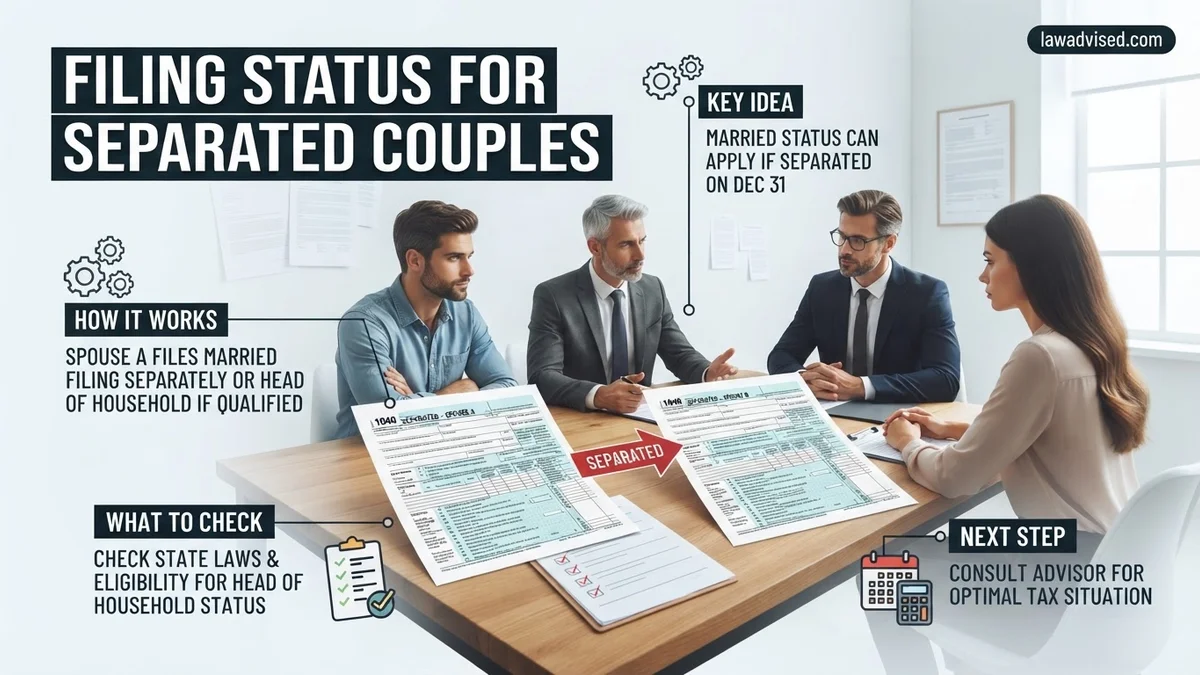
What Causes Confusion With Filing Status for Separated Couples
Many separated taxpayers assume that living apart for a few months changes their legal marital status in the eyes of the federal government. This misconception leads to costly filing errors every single year.
The Myth of Automatic Single Status
State laws dictate whether you are legally married, separated, or divorced. The IRS defers to these state-level definitions:
- Living apart without a formal, court-ordered legal separation decree does not make you unmarried.
- Filing initial paperwork for divorce does not change your status until a judge signs the final decree by December 31, 2026.
- Filing as Single while legally married is an automatic audit trigger that results in recalculations and back taxes.
The Trap of Married Filing Separately
When couples separate amicably or otherwise, Married Filing Separately is often the default choice. However, it carries severe financial drawbacks that catch people off guard.
- You lose eligibility for major tax credits, including the Earned Income Tax Credit (EITC) and education credits.
- Your deduction limits for retirement contributions and capital losses are significantly reduced.
- Both spouses must match their deduction choices: if one itemizes deductions, the other cannot take the standard deduction.
How to Determine Your Correct IRS Filing Status Step-by-Step
Finding your correct status for the 2026 tax year requires evaluating your living arrangements, state legal decrees, and household finances. Follow this step-by-step framework to identify your exact requirements.
Step 1: Check for a Finalized Legal Decree
Look closely at your legal paperwork and calendar. Your status depends entirely on your situation as of the final day of the tax year, December 31, 2026.
- Divorce or Separate Maintenance Decree: If a court finalized your divorce or legal separation on or before December 31, 2026, you are considered unmarried for the entire year and can file as Single or Head of Household.
- No Final Decree: If you are only physically separated without a court-ordered decree, the IRS still considers you married, pushing you toward Married Filing Separately or the stricter Head of Household rules.
Step 2: Evaluate the Head of Household Requirements
You might still qualify for the much more favorable Head of Household status even if you are legally married. The IRS provides a specific pathway for married individuals living apart, provided you meet strict criteria for the 2026 tax year.
- The Last Six Months Rule: Your spouse must not have lived in your home for the last six months of 2026 (from July 1 through December 31).
- Financial Support: You must have paid more than half the cost of keeping up your home for the entire year.
- Qualifying Dependent: You must maintain a home that was the main home for a qualifying dependent child, stepchild, or foster child for more than half of 2026. You must be able to claim them as a dependent, or be the custodial parent who releases the claim.
How to Qualify for Head of Household While Married
For separated couples in 2026, filing as Head of Household offers a significantly higher standard deduction and lower tax brackets than filing Married Filing Separately. However, the IRS maintains strict criteria for married individuals seeking this status. According to Internal Revenue Service Publication 501, you must meet five specific tests to qualify while legally married.
The Five Crucial Requirements
- The Separate Return Test: You must file a separate tax return from your spouse.
- The Financial Support Test: You must pay more than half the cost of keeping up your home for the tax year 2026.
- The Principal Residence Test: Your dependent child, stepchild, or eligible foster child must live with you for more than half of the year.
- The Absence Test: Your spouse must not have lived in your home for the last six months of the calendar year. Temporary absences for business, medical care, or school do not count.
- The Dependent Test: You must be able to claim the child as a dependent, or you could have claimed them except that the noncustodial parent is entitled to the exemption under specific divorce decree rules.
Tax experts emphasize that failing even one of these five tests forces a default into the Married Filing Separately category. Documenting your household expenses and exact dates of separation is vital for audit protection in 2026.
What If State Laws and IRS Rules Conflict During Separation
Navigating tax filing status becomes exceptionally complex when state community property laws clash with federal IRS guidelines. In community property states like California, Texas, and Arizona, earned income is typically considered jointly owned by both spouses until a final divorce decree is entered. This creates unique reporting challenges for couples who are separated but still legally married.
Resolving State and Federal Discrepancies
- Determine Domicile and State Status: Review state-specific tax agency guidelines to see if formal legal separation changes your property status for state returns.
- Apply IRS Special Rules: Under federal law, if you lived apart all year, earned unshared income, and filed separate returns, the IRS may disregard community property laws for earned income.
- Attach Form 8958: When state and federal income allocations differ, you must complete and attach IRS Form 8958 (Allocation of Tax Amounts Between Certain Individuals in Community Property States) to your federal return.
- Reconcile Withholding: Ensure that tax withholdings and estimated payments are allocated accurately between both spouses to prevent automated IRS matching notices.
According to verified research from national accounting associations, failing to properly allocate community property income is a primary trigger for IRS automated underreporting notices during separation.
What If It Still Doesn’t Work?
If complex separation dynamics, missing documentation, or conflicting state laws make it impossible to determine your correct 2026 filing status independently, consider these fallback steps:
- Consult a Certified Public Accountant (CPA): Schedule a consultation with a tax professional who specializes in marital dissolutions and complex family law taxation. Estimated costs range from $300 to $600 for a targeted filing status review.
- Request an IRS Private Letter Ruling: For highly unique or high-net-worth scenarios, your attorney can request formal IRS guidance, though this incurs significant administrative costs and time.
- File an Extension: If you cannot verify your residency timeline or support test by the April 2026 deadline, file Form 4868 to secure a six-month extension, reducing the risk of filing an amended return later.
- Utilize VITA Programs: Low-to-moderate-income separated taxpayers can access free tax preparation assistance through the IRS Volunteer Income Tax Assistance program.
Conclusion
Choosing the correct filing status during a separation prevents costly IRS audits, mismatched return flags, and unnecessary financial penalties. By carefully evaluating the physical separation timeline, household contribution tests, and community property rules, you can select the most advantageous status available under 2026 tax codes. According to verified research and expert sources from the IRS and national CPA associations, precise documentation remains your greatest defense during marital transitions. Your actionable next step is to gather your 2026 housing expense receipts and formally verify the exact calendar dates your spouse vacated the primary residence.
❓ Frequently Asked Questions
What happens if my divorce or legal separation is finalized on December 31?
For IRS purposes, your marital status on the last day of the tax year determines your status for the entire year. If the court finalizes the paperwork by December 31, you are considered unmarried for the full year.
What specific tests must I pass to file as Head of Household while separated?
You must pay more than half the cost of keeping up your home for the year, your spouse must not have lived in the home for the last six months of the year, and the home must be the main home of your dependent child for more than half the year.
How does Married Filing Separately affect my tax deductions and credits?
Filing separately often results in higher tax brackets and disqualifies you from claiming several valuable tax credits, such as the Earned Income Tax Credit and certain education credits.
Does a temporary separation agreement signed by a mediator count as a legal separation?
Generally, informal agreements or mediation documents do not count as a legal separation decree unless they are officially issued and signed by a judge under state law.
What if my spouse refuses to sign a joint return while we are separated?
You are not required to file a joint return. Your primary alternative in that scenario is to file using the Married Filing Separately status.
Can I claim our dependent child if we share custody after separating?
Usually, the custodial parent—the one with whom the child lived for the greater number of nights during the year—claims the child as a dependent, though the noncustodial parent can claim them if the custodial parent signs a formal waiver.

Ismail Hossain is the founder of Law Advised. He is an Divorce, Separation, marriage lawyer. Follow him.