What Reduces the Standard Deduction A Proven 2026 Guide
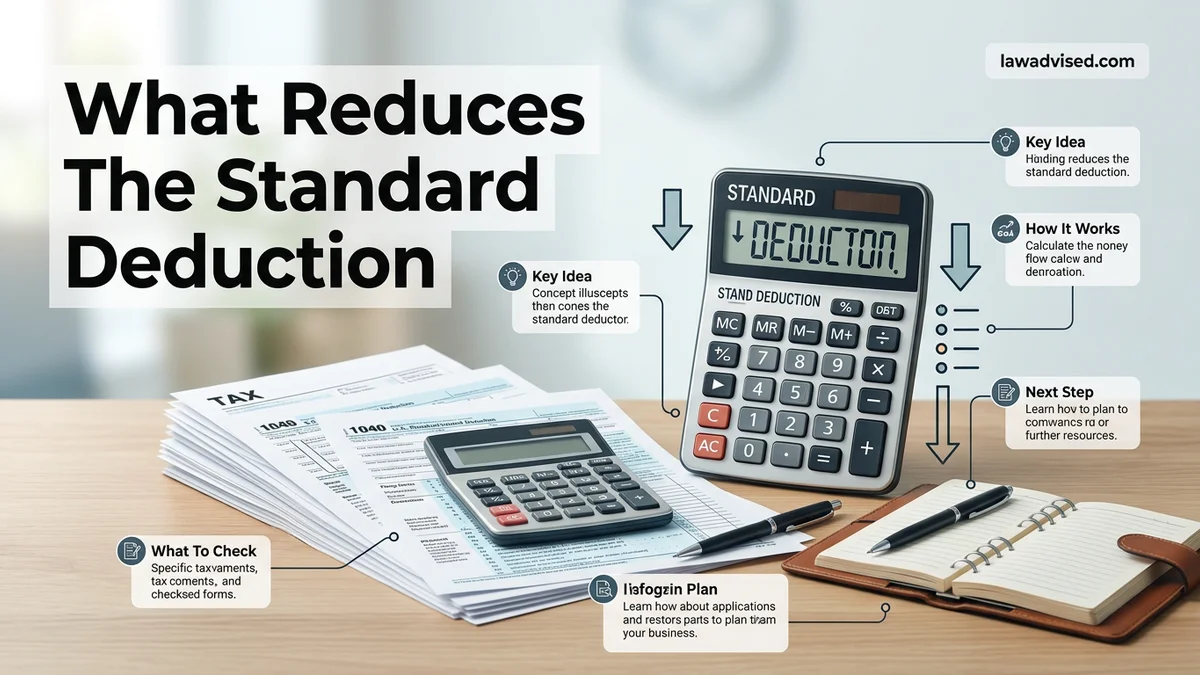
The standard deduction is a fixed IRS amount, but being claimed as a dependent on another person’s tax return significantly reduces or limits your deduction. Dependents face a special calculation based on their earned and unearned income rather than receiving the full basic deduction.
Your standard deduction drops primarily because someone else claims you as a dependent on their tax return. If you file your own taxes and a parent or guardian claims you, you lose the full, unreduced standard deduction amount that independent filers enjoy.
For the 2026 tax year, the IRS enforces strict limits on dependent standard deductions. Knowing these rules helps you avoid unexpected tax bills and accurately report your income.
Key Takeaways
- Being claimed as a dependent is the primary reason for a reduced standard deduction.
- Dependent standard deduction limits depend on whether income is earned or unearned.
- Non-resident alien filing statuses can restrict standard deduction eligibility.
- Age and blindness generally increase deductions rather than reduce them.
- Check IRS guidelines annually to verify exact dependent income thresholds.
What Causes a Reduced Standard Deduction on Your Taxes
The Dependent Status Rule
The single biggest factor that reduces your standard deduction is being eligible to be claimed as a dependent. The IRS does not let dependents take the full basic standard deduction. Instead, your deduction shrinks to a much lower baseline amount, preventing shifting of investment income from parents to children to avoid taxes.
Age and Filing Status Exceptions
Your standard deduction also faces adjustments if you are over 65 or blind, but those factors increase your deduction rather than reduce it. The reduction specifically targets individuals who fail the independent test. If you provide less than half of your own financial support in 2026, expect your standard deduction to face strict statutory limitations.
- Being claimed as a dependent on a parent’s return
- Filing as a qualifying child or relative
- Failing the self-support test for the 2026 tax year
How to Calculate the Standard Deduction for Dependents Step-by-Step
The 2026 IRS Formula for Dependents
If you are a dependent in 2026, your standard deduction is limited to the greater of two specific figures. You cannot simply take the standard flat amount for single filers. You must run a quick calculation using your earned income, such as wages from a part-time job, and your unearned income, such as interest or dividends.
The standard deduction for a dependent is limited to the greater of:
- A set statutory minimum floor amount adjusted for 2026
- Your earned income plus a specific statutory addition amount
Applying the Calculation to Real Income
Imagine you earn 2,000 dollars from a summer job and 400 dollars in stock dividends during 2026. Your earned income is 2,000 dollars. You add the IRS-mandated statutory addition for 2026 to your earned income total.
If that total is higher than the minimum base floor for dependents, you use your earned income total plus the addition. If your unearned income is high, a different set of Kiddie Tax rules might apply, but the standard deduction calculation remains anchored to your earned income plus that statutory cushion.
How to Fix Filing Status Errors Impacting Your Deductions
Filing status errors remain one of the primary catalysts for unexpected reductions in your standard deduction. Choosing an incorrect status—such as filing as Single when you qualify as Head of Household—fundamentally alters your tax math. According to IRS compliance data, millions of taxpayers miscalculate their baseline allowances annually due to qualifying dependent discrepancies or overlooked marital status rules for the 2026 tax year.
To correct a filing status error and protect your standard deduction, follow this procedural sequence:
- Review your marital status and household situation as of December 31, 2026, to determine your legally accurate IRS category.
- Gather documentation proving your head of household eligibility, including household expense records, lease agreements, and dependent residency forms.
- Log into your tax preparation software or review your drafted Form 1040 to update the filing status field before final transmission.
- If you already submitted an incorrect return, prepare Form 1040-X (Amended U.S. Individual Income Tax Return) to adjust your filing status and reclaim any lost deduction value.
What If Your Income Thresholds Still Limit Your Tax Savings
Even with the correct filing status, specific income thresholds and dependency rules can restrict how much tax relief you ultimately realize. If your dependents fall under complex rules, such as those impacting older students or non-child relatives, your deduction framework might face statutory caps. High earners navigating phase-outs must implement advanced tracking to ensure their taxable income stays aligned with optimal brackets.
When standard adjustments fail to maximize your 2026 tax position, evaluate these alternative strategies:
- Audit your gross income sources to verify whether pre-tax deductions like 401(k) or HSA contributions are effectively lowering your adjusted gross income.
- Weigh the financial advantage of itemizing deductions against the standard deduction if your combined charitable, medical, and mortgage interest expenses cross the statutory threshold.
- Consult a certified public accountant (CPA) or enrolled agent to model complex multi-tier income scenarios. Professional tax advisory fees typically range from $300 to $1,000 depending on your return complexity.
- Utilize official IRS Interactive Tax Assistant tools to verify dependent qualification criteria down to the specific month of support.
Conclusion
Protecting your standard deduction requires precise navigation of filing statuses, dependent rules, and income thresholds as defined for the 2026 tax year. Failing to address these variables can lead to unnecessary tax liabilities and reduced savings. According to verified research and expert financial sources, proactive verification of your tax inputs remains the most effective defense against accidental deduction reductions. Your immediate actionable next step is to review your draft Form 1040 today to confirm your filing status and dependent claims match current IRS standards.
❓ Frequently Asked Questions
What is the main reason a standard deduction gets reduced?
The primary reason a standard deduction is reduced is when a taxpayer is claimed as a dependent on someone else’s federal income tax return. In these cases, the IRS limits the deduction to a specific formula based on the dependent’s earned and unearned income.
How does the IRS calculate the standard deduction for a dependent?
For a dependent, the standard deduction is typically limited to the greater of a baseline minimum amount or their earned income plus a specific statutory adjustment, up to the full basic standard deduction for that filing status.
What is considered unearned income for a dependent?
Unearned income includes investment income such as taxable interest, ordinary dividends, capital gains, and certain distributions. High amounts of unearned income for dependents can trigger complex tax rules like the Kiddie Tax.
Can a student working a part-time job keep their full standard deduction?
If a working student can be claimed as a dependent by their parents, they do not get the full standard deduction. Instead, their deduction is capped based on their earned wages plus a small statutory allowance.
Does filing status affect standard deduction amounts?
Yes, your filing status determines your basic standard deduction amount. While filing statuses like Married Filing Separately or Single have set amounts, switching or qualifying for a different status changes your baseline before any dependent limitations apply.
What should I do if my standard deduction was incorrectly limited?
If you were incorrectly claimed as a dependent or if your filing status was processed in error, you may need to file an amended tax return using Form 1040-X to claim the correct deduction amount.

Ismail Hossain is the founder of Law Advised. He is an Divorce, Separation, marriage lawyer. Follow him.