Tax Bracket Myths Explained Real Guide for 2026
Many taxpayers falsely believe that earning a pay raise can push their entire income into a higher tax bracket, resulting in less take-home pay. This guide clarifies how progressive marginal tax rates actually function so you can make informed financial decisions in 2026.
The biggest myth in personal finance is that earning a pay raise can accidentally push you into a higher tax bracket and leave you with less total take-home pay. This is entirely false. Every single year, millions of workers hesitate to accept promotions, ask for raises, or pick up extra shifts because they genuinely believe the government will take a larger cut of their entire income.
Getting a handle on this math matters practically for your 2026 financial planning. When you know how the system actually works, you will never turn down extra money out of fear of a higher tax bill. Let us break down why this fear is mathematically impossible and how the system actually treats your hard-earned dollars.
Key Takeaways
- A pay raise only taxes the dollars falling into the new bracket, never previous earnings.
- Progressive tax systems apply different percentages to specific income slices, not a flat rate.
- Your effective tax rate is always lower than your top marginal tax bracket.
- Crossing into a higher bracket still results in higher total take-home pay.
- Understanding marginal versus effective rates prevents turning down beneficial career opportunities.
What Causes the Dangerous Myth That a Pay Raise Lowers Take-Home Pay
The Confusion Between Total Income and Marginal Income
People confuse how their total income is taxed versus how new income is taxed. Your entire paycheck does not suddenly get taxed at a higher rate just because you cross a threshold. Instead, the United States uses a progressive tax system for 2026. This means income is taxed in distinct slices, or brackets. Only the money that actually spills over into the higher bracket gets taxed at that higher rate. The money sitting in the lower brackets keeps its original, lower tax rate.
Real-World Workplace Misconceptions
Workplace watercooler chatter often spreads bad tax advice. Someone might get a small raise, notice their next paycheck has a slightly higher tax withholding, and panic. They assume the raise triggered a penalty. In reality, payroll software occasionally miscalculates withholdings on unexpected bonuses or overtime pay. This leads to a temporary adjustment, not a permanent pay cut. Here is what actually happens to your money:
- Your first dollars earned are always taxed at the lowest bracket rate.
- Crossing a bracket threshold only changes the tax rate on the exact dollars that sit above that line.
- Your net take-home pay will always increase when your gross income increases.
How to Calculate Your True Progressive Taxes Step-by-Step
Breaking Down Marginal Tax Brackets
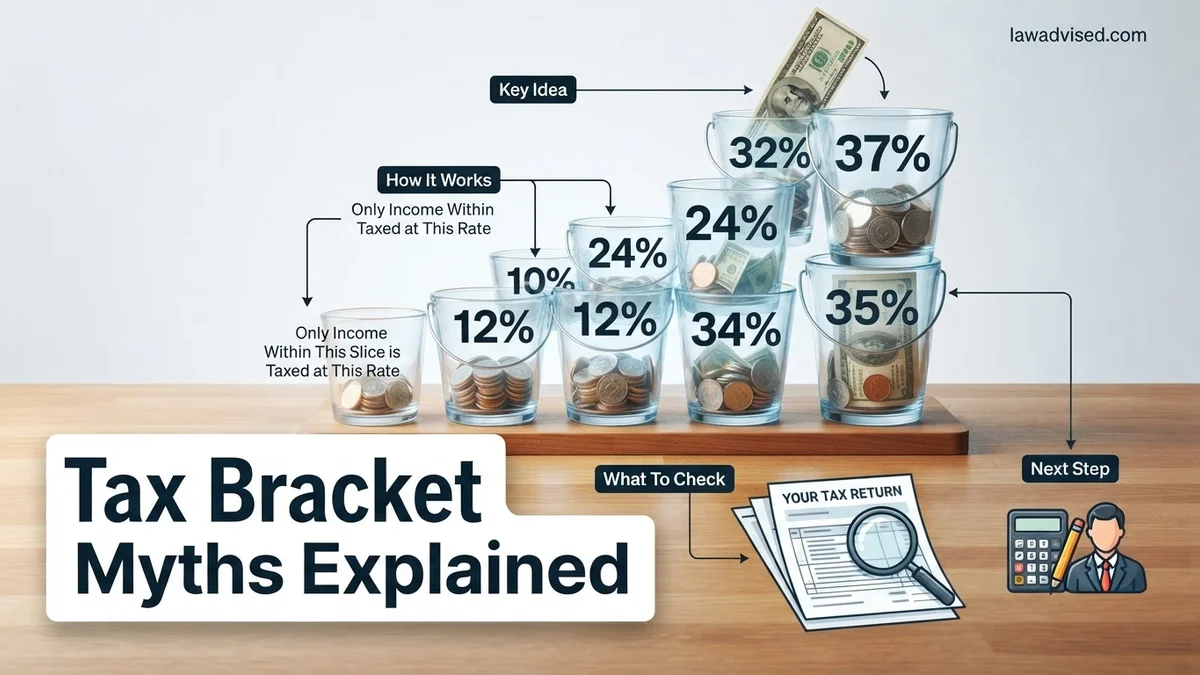
To see why you never lose money by making more, you need to look at how the 2026 federal income brackets stack on top of each other. Think of your income like filling a set of buckets with water. As each bucket fills up, the water overflows into the next bucket up. Only the water in the topmost, newest bucket faces the highest rate.
A Clear Step-by-Step Mathematical Example
Imagine a simplified single-filer tax system for 2026 where the first 10,000 dollars of income are taxed at 10 percent, and any dollar earned between 10,001 and 40,000 dollars is taxed at 20 percent. If you make 10,000 dollars, you pay 1,000 dollars in taxes. If you get a raise and now make 11,000 dollars, you do not pay 20 percent on all 11,000 dollars. Here is the math:
- The first 10,000 dollars are still taxed at 10 percent, totaling 1,000 dollars.
- The extra 1,000 dollars sits in the 20 percent bracket, costing you 200 dollars in taxes.
- Your total tax bill becomes 1,200 dollars on an 11,000 dollar income.
- Your net take-home pay rises from 9,000 dollars to 9,800 dollars.
How to Fix Misunderstandings Between Marginal and Effective Tax Rates
Taxpayers frequently confuse their marginal rate with their effective rate, leading to severe budgeting errors. According to the Tax Foundation, the marginal rate represents the tax paid on the next dollar of income. Meanwhile, the effective rate measures the actual percentage of overall income paid to the government.
Understanding the Mathematical Reality
Many earners panic when they approach a higher bracket because they assume all income is taxed at that elevated percentage. Financial planners stress that tax brackets apply in progressive tiers. Only the income crossing the specific threshold faces the higher rate.
Calculating Your True Burden
Tax software and IRS guidelines establish clear formulas for determining exact liability. Follow these procedural steps to compute your effective rate for 2026:
- Locate your total taxable income from line 15 of IRS Form 1040.
- Identify your total federal income tax liability from line 24.
- Divide your total tax liability by your total taxable income.
- Multiply the resulting decimal by 100 to find your true effective percentage.
What If Your Tax Withholdings Still Seem Wrong After Crossing Brackets
Crossing into a new bracket can cause unexpected fluctuations in monthly take-home pay. If calculations still look incorrect after adjusting your documentation, systemic withholding errors may be to blame.
Troubleshooting Withholding Discrepancies
Employers often apply outdated formulas or misinterpret complex allowances. Execute these steps to resolve ongoing withholding anomalies:
- Review your most recent pay stub to confirm that federal withholding matches your current earnings trajectory.
- Access the IRS Tax Withholding Estimator online to input your 2026 data and verify your projected liability.
- Submit a newly completed Form W-4 to your employer’s payroll department to correct specific deductions.
- Monitor your subsequent two pay cycles to ensure the payroll adjustments took effect correctly.
What If It Still Doesn’t Work?
If DIY withholding adjustments and bracket calculations fail to balance your tax picture, structural complexities may require specialized intervention. Persistent discrepancies often stem from self-employment income, complex investments, or multi-state residency.
Consider these fallback steps if standard fixes do not resolve the issue:
- Gather all relevant 2026 income documents, including W-2s, 1099s, and investment statements, to prepare for a formal review.
- Schedule a consultation with a Certified Public Accountant (CPA) or an Enrolled Agent (EA) specializing in individual taxation.
- Expect to pay an estimated cost range of $250 to $600 for a comprehensive professional tax planning and withholding review session.
- Establish a quarterly estimated tax payment schedule with your professional if withholding alone proves insufficient for your income structure.
Conclusion
Misunderstanding tax brackets leads to unnecessary anxiety and flawed financial planning. Remember that higher brackets only apply to income earned above specific thresholds, protecting your total earnings from a flat penalty. According to verified research and expert sources from the IRS and major fiscal policy institutions, understanding your effective rate remains the best defense against withholding errors. Your actionable next step for 2026 is to run your current income through the official IRS withholding calculator today.
❓ Frequently Asked Questions
Why do so many people believe that making more money can net you less take-home pay?
This myth persists because people assume tax rates apply retroactively to all earnings rather than just the money sitting inside that specific bracket’s threshold. In reality, a progressive tax system ensures that every dollar taxed at a lower rate remains untouched when you cross a line.
How do marginal tax brackets actually work in practice?
Think of your income as being divided into distinct buckets or layers. As you earn more, each bucket fills up and gets taxed at its designated rate before the remaining money spills over into the next higher bucket taxed at the next rate.
Can a supplemental tax rate on a bonus change how brackets work?
Employers often withhold taxes on bonuses at a flat federal rate of 22%, which can temporarily make your paycheck look like you were taxed heavily. However, this is just a withholding mechanism and is trued up when you file your annual tax return.
What is an effective tax rate and why is it important?
Your effective tax rate represents the actual percentage of your total gross income that you pay in taxes. Because lower brackets shield portions of your income, your effective rate is always lower than your top marginal bracket.
Does crossing a tax bracket affect standard deductions?
Standard deductions reduce your overall taxable income before you even apply tax brackets. Crossing a bracket threshold does not eliminate or reduce your standard deduction eligibility.
How can I explain tax brackets to someone who refuses to take a raise?
Show them a simple math example where earning an extra $1,000 in a 24% bracket means they keep $760 of that extra money. Emphasize that turning down money means walking away from net gains.

Ismail Hossain is the founder of Law Advised. He is an Divorce, Separation, marriage lawyer. Follow him.