Property Tax Deduction Explained Step-by-Step Guide 2026
The property tax deduction allows eligible homeowners to reduce their taxable income, but the $10,000 SALT limit heavily restricts high-tax areas. Taxpayers must weigh whether itemizing deductions makes more financial sense than taking the standard deduction. Knowing which property types and local assessments qualify is essential for maximizing tax savings.
You can claim a federal property tax deduction by itemizing your return, but your total state and local tax write-off remains strictly limited. Homeowners often expect to deduct their full local property tax bill. Instead, federal tax rules cap this benefit, meaning many taxpayers cannot claim the full amount they pay to their local governments.
Navigating this tax break in 2026 requires understanding rigid federal caps and knowing whether itemizing your deductions actually beats taking the standard deduction. If you live in an area with high property taxes, this distinction dictates whether your homeownership costs yield any federal tax relief at all.
Key Takeaways
- The federal SALT deduction is currently capped at $10,000 for total state and local taxes.
- You must itemize deductions on Schedule A to claim property taxes on your federal return.
- Primary residences, vacation homes, and bare land generally qualify for property tax deductions.
- HOA fees, transfer taxes, and local service fees for specific improvements are not deductible.
- Compare your total itemized expenses against the standard deduction before filing.
What Causes the SALT Deduction Cap and How It Limits Tax Savings
The state and local tax deduction, widely known as the SALT deduction, includes your property taxes alongside state income or sales taxes. Federal tax law imposes a hard ceiling on this combined bucket, directly overriding what you actually paid to your local municipality.
The 10000 Dollar Federal Limit
Current federal tax rules cap the total SALT deduction at 10,000 dollars per year for most filers, or 5,000 dollars for married individuals filing separately. This limit applies regardless of your marital status or whether your actual combined state income and property taxes reach 15,000 dollars or 30,000 dollars.
-
Key impacts of the SALT cap include:
- Property taxes exceeding the limit provide zero additional federal tax benefit.
- The cap applies equally to single filers and married couples filing jointly.
- State-level workaround entities for business owners do not erase federal limits on standard residential property.
Legislative Status and 2026 Outlook
Lawmakers frequently debate proposals to raise, suspend, or completely eliminate the SALT cap. While various bills target relief for homeowners in high-tax states, the 10,000 dollar limit remains the law of the land for the 2026 tax year. Congress has not permanently altered this threshold, forcing homeowners to plan around the existing ceiling.
How to Fix Your Filing Strategy: Itemizing Versus the Standard Deduction
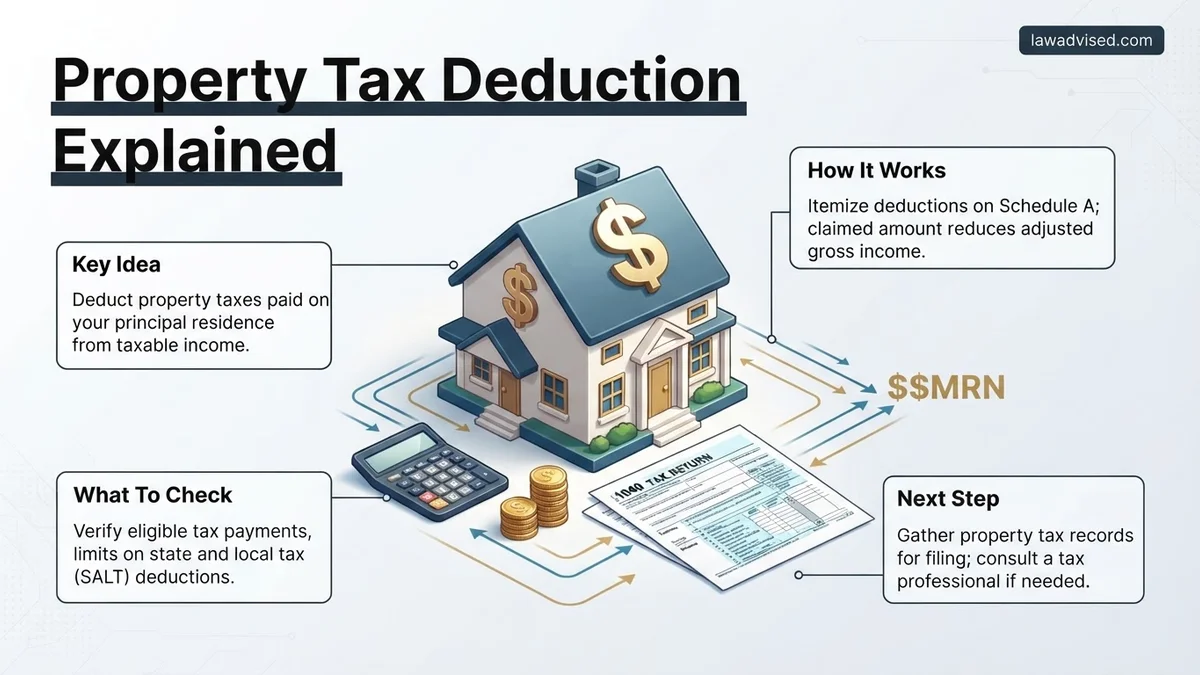
You cannot claim a property tax deduction if you take the standard deduction. Federal rules require you to itemize your deductions on Schedule A to write off property taxes, meaning your total itemized expenses must cross a specific financial threshold to make the effort worthwhile.
When Itemizing Property Taxes Actually Makes Sense
The standard deduction for 2026 sits at high levels for both single filers and married couples filing jointly. Your total itemized deductions—including mortgage interest, charitable donations, medical expenses, and your capped SALT amount—must exceed that standard deduction threshold for you to see any tax savings.
-
Scenarios where itemizing works in your favor:
- Your mortgage interest is high, especially during the early years of a home loan.
- You make substantial charitable contributions throughout the year.
- Your combined SALT total hits the full 10,000 dollar cap, pushing your total itemized deductions past the standard threshold.
The Math Behind Standard Versus Itemized Filings
Imagine your itemized deductions total 27,000 dollars, which includes your maximum 10,000 dollar property and income tax write-off plus 17,000 dollars in mortgage interest. If the standard deduction is lower than that 27,000 dollar sum, itemizing saves you money. If your total itemized expenses fall short of the standard deduction, you should skip itemizing entirely and take the standard deduction, meaning your property taxes ultimately generate no direct federal tax savings for that year.
Step-by-Step Guide to Calculating Qualifying Property Taxes
Calculating your deductible property tax amount for the 2026 tax year requires careful attention to your local government assessment statements. Not every fee listed on your annual property tax bill qualifies for the federal income tax deduction.
Step 1: Locate Your Annual Form 1098
If you pay your property taxes through an escrow account managed by your mortgage lender, they will issue you a Form 1098 by January 31, 2026. Box 10 on this form typically shows the total property tax paid out of your escrow account during the previous calendar year.
Step 2: Review Itemized Line Items on Your Local Bill
If you pay your property taxes directly to your municipality, pull your official local tax assessment bill. You must separate deductible general ad valorem taxes from non-deductible local assessment fees. According to IRS guidelines, charges for local benefits that increase property value—such as sidewalk installation, sewer hookups, or street paving—are generally not deductible.
Step 3: Apply the $10,000 SALT Cap Limit
Sum your eligible local property taxes and state income or sales taxes. Under current federal tax law for 2026, the total combined deduction for State and Local Taxes (SALT) is capped at a strict maximum of $10,000 for single filers and married couples filing jointly ($5,000 for married individuals filing separately). Even if your total qualifying property tax bill equals $15,000, your federal deduction cannot exceed the statutory limit.
What If Your Itemized Deductions Fall Below the Standard Threshold
Many homeowners find that even after calculating their maximum allowable property taxes and adding mortgage interest and charitable donations, their total itemized deductions still fail to surpass the federal standard deduction. For the 2026 tax year, the standard deduction threshold makes itemizing unnecessary for the vast majority of taxpayers.
Evaluate the Standard Deduction Threshold
Compare your projected total itemized deductions against the 2026 standard deduction amounts. If the standard deduction provides a higher tax reduction, take it. You do not need to calculate or report individual property taxes on your federal return.
Consider Bunching Your Deductions
If your combined itemized expenses sit just below the threshold, financial experts recommend strategic “bunching.” Pay two years’ worth of property taxes in a single calendar year—if your municipality allows early payments—to push your itemized deductions well above the standard limit for that specific tax year.
What If It Still Doesn’t Work?
If complex local assessments, state-specific caps, or escrow discrepancies prevent you from accurately calculating your property tax deduction for 2026, utilize these professional fallback steps:
- Request a Detailed Ledger: Contact your mortgage servicer or local tax assessor to request an itemized payment ledger showing exact dates and disbursement amounts.
- Consult a Certified Public Accountant (CPA): If your local tax structure includes complex Mello-Roos or special district assessments, schedule a consultation with a licensed tax professional. Professional fees for standard itemization review generally range from $300 to $600.
- Utilize IRS Publication 530: Review the official Internal Revenue Service Tax Information for Homeowners publication for definitive definitions on deductible versus non-deductible property fees.
Conclusion
Navigating the property tax deduction requires strict adherence to IRS guidelines, accurate Form 1098 review, and strict awareness of the $10,000 SALT cap limit. According to verified research and expert financial sources, strategic tax planning ensures you never leave legitimate deductions on the table. Your next actionable step is to pull your latest property tax statement and compare your total itemized expenses against the current standard deduction threshold before filing your 2026 return.
❓ Frequently Asked Questions
How does the $10,000 SALT cap affect married filing separately taxpayers?
For married individuals filing separate tax returns, the SALT deduction cap is typically split evenly at $5,000 per spouse, limiting total deductions further.
What happens if my state property taxes exceed $10,000?
Any amount paid toward state and local income or property taxes above the $10,000 threshold cannot be deducted on your federal tax return.
Do I need to keep receipts for my property tax payments?
Yes, you should retain copies of your local property tax bills and proof of payment, such as canceled checks or escrow statements, in case of an IRS audit.
Are foreign property taxes eligible for the deduction?
No, federal tax rules generally prohibit deducting foreign real property taxes on personal residences under current tax law.
How do escrow payments affect when I can deduct property taxes?
You can deduct property taxes in the year the money is actually paid to the taxing authority by your mortgage escrow company, not necessarily when you deposit funds into escrow.
Can landlords deduct property taxes on rental properties?
Yes, landlords deduct rental property taxes as a business expense on Schedule E rather than as an itemized personal deduction on Schedule A.

Ismail Hossain is the founder of Law Advised. He is an Divorce, Separation, marriage lawyer. Follow him.