State and Local Tax Deduction Explained 2026 A Proven Guide
The state and local tax (SALT) deduction allows itemizing taxpayers to deduct property, income, or sales taxes paid to local governments on their federal returns. However, the Tax Cuts and Jobs Act imposed a strict $10,000 annual cap, significantly impacting residents in high-tax states. This guide breaks down the limits, qualifying taxes, and legal workarounds to help minimize your tax liability.
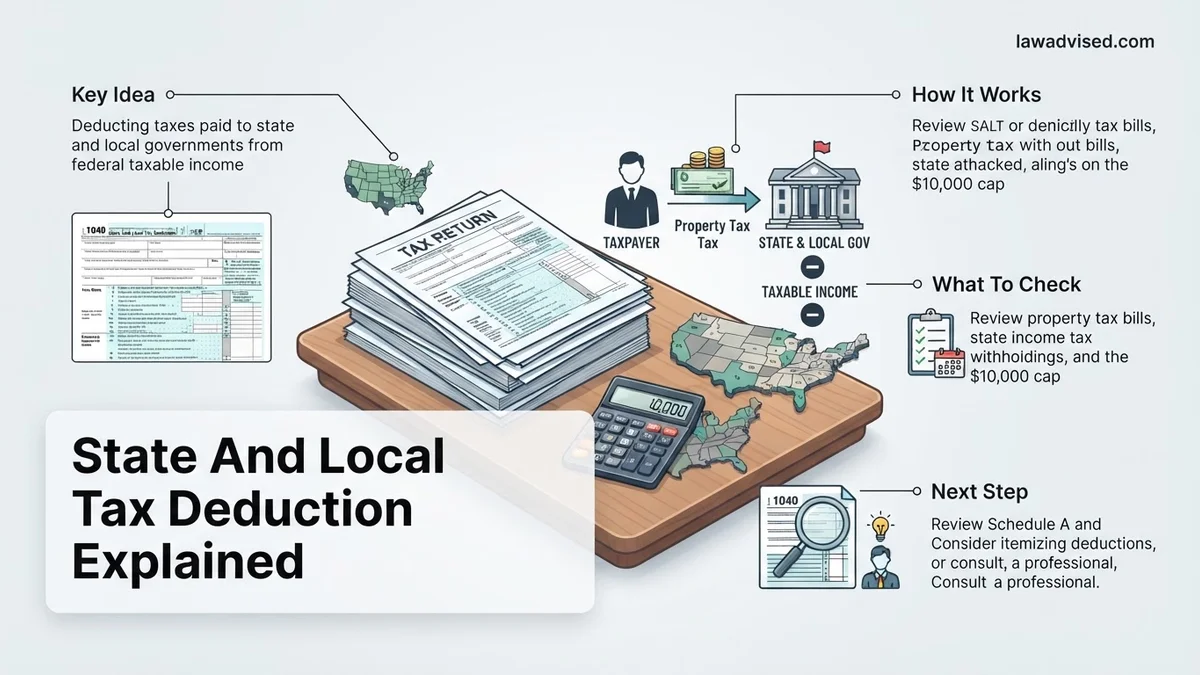
The state and local tax, or SALT, deduction allows you to deduct certain taxes paid to state and local governments from your federal taxable income. For the 2026 tax year, the most critical rule governing this write-off remains the federal statutory limit of $10,000 for your combined state property taxes and state income (or sales) taxes.
Understanding this cap is vital because it directly limits how much you can reduce your federal tax liability. If you live in a high-tax state and itemize your deductions, running into this ceiling means you will pay federal taxes on state levies that exceed the threshold, significantly impacting your annual financial planning.
Key Takeaways
- The SALT deduction cap is strictly limited to $10,000 annually for both single and married filing jointly statuses.
- Taxpayers must choose between deducting state and local income taxes or general sales taxes, not both.
- Property taxes on primary residences and real estate investments qualify for the SALT deduction.
- Pass-through entity (PTE) taxes act as a legal workaround for business owners to bypass the individual $10,000 cap.
- You must itemize deductions on Schedule A to claim the SALT deduction instead of taking the standard deduction.
What Causes SALT Deduction Limits and Why the $10,000 Cap Exists
The federal government capped the state and local tax deduction under the Tax Cuts and Jobs Act of 2017. Before this legislation, taxpayers could deduct an unlimited amount of state and local levies. Lawmakers instituted the cap to generate federal revenue and shift the tax burden away from taxpayers in low-tax states.
The $10,000 Statutory Cap Broken Down
The current $10,000 limit applies broadly, but it creates a distinct marriage penalty within the tax code. Here is how the statutory cap applies:
- Single Filers: You can deduct a maximum of $10,000 in combined state and local taxes.
- Married Filing Jointly: You are also capped at a maximum deduction of $10,000 total.
- Married Filing Separately: Each spouse is limited to a maximum deduction of $5,000.
Impact on High-Tax States
If you reside in states with high income and property taxes like New York, California, or New Jersey, you will likely hit the $10,000 ceiling immediately. For example, if you pay $8,000 in property tax and $7,000 in state income tax, your total is $15,000. Under the 2026 rules, you lose $5,000 of deductibility because of the hard statutory cap.
How to Calculate and Claim Your Eligible State and Local Taxes Step-by-Step
To benefit from the SALT deduction, you must forego the standard deduction and choose to itemize your deductions on Schedule A of your federal tax return. You need to meticulously calculate your eligible state and local payments to ensure you capture the full $10,000 limit without running afoul of IRS compliance rules.
Eligible Taxes and the Income Versus Sales Tax Choice
You cannot deduct every type of fee paid to your local government. You must separate eligible taxes from non-deductible fees like parking tickets or utility charges. Your eligible categories include:
- State and Local Income Taxes: Amounts withheld from your paycheck or paid via estimated quarterly state tax payments.
- Real Estate Property Taxes: Taxes assessed on real property you own, provided the rates are uniform and for general public welfare.
- Personal Property Taxes: Ad valorem taxes based on the value of personal property, such as an annual vehicle registration tax.
- Sales Tax Alternative: You can choose to deduct major state and local sales taxes instead of state income taxes, which is particularly useful if you live in a state with no income tax like Texas or Florida.
Step-by-Step Calculation Process
Follow these steps to tally your deduction for 2026:
- Gather all W-2s, 1099s, and state quarterly payment receipts to find your total state income tax paid.
- Review your mortgage statements and local assessor records to total your real estate property taxes.
- Check vehicle registration renewals to calculate any personal property taxes based on vehicle value.
- Compare your total state income taxes against the IRS sales tax calculator if you prefer the sales tax deduction.
- Add your chosen income (or sales) tax total to your property tax totals, then apply the strict $10,000 maximum cap.
How to Fix SALT Cap Limitations Using Pass-Through Entity Workarounds
High-income earners and business owners facing the strict $10,000 federal limit can bypass the restriction entirely. According to IRS Notice 2020-75, the pass-through entity (PTE) tax workaround allows business owners to deduct state and local taxes at the entity level rather than the individual level.
By shifting the tax burden to an LLC, S-corporation, or partnership, the business pays state tax directly. This reduces the owner’s federal adjusted gross income dollar-for-dollar without triggering the personal SALT cap. Almost all states with an income tax now authorize this mechanism for the 2026 tax year.
Steps to Implement the PTE Workaround
- Consult your CPA: Verify your specific business structure qualifies for pass-through taxation in your state.
- Opt-in annually: File the required PTE election form with your state department of revenue by their mandated deadline.
- Pay entity-level tax: Remit quarterly state tax payments directly from the business checking account.
- Claim the credit: Report the state tax credit on your individual federal return to offset your pass-through income.
Tax experts note that while this strategy effectively unlocks unlimited SALT deductions for business owners, it requires precise accounting. State-specific rules vary significantly regarding election deadlines and credit calculations for 2026.
What If Your Itemized Deductions Still Fall Below the Standard Deduction Threshold
Many taxpayers find that even after maximizing property and income taxes, their total itemized deductions fail to clear the federal standard deduction threshold. For the 2026 tax year, the standard deduction remains significantly higher than historical averages, meaning millions will continue taking the standard deduction over itemizing.
When SALT limitations and mortgage interest combined still do not exceed the standard deduction, traditional itemizing yields zero financial benefit. Tax planners recommend evaluating advanced strategies to cross the threshold in alternating years rather than losing the deduction entirely.
Alternative Strategies for Taxpayers
- Bunch charitable donations: Combine multiple years of charitable contributions into a single tax year using a donor-advised fund to clear the threshold.
- Accelerate medical expenses: Schedule elective medical and dental procedures in a single calendar year to exceed the 7.5 percent adjusted gross income floor.
- Review property tax timing: Pay upcoming property tax installments early if your state permits, clustering payments into a targeted high-deduction year.
- Time major capital gains: Coordinate the sale of appreciated assets with years when your itemized deductions naturally spike.
What If It Still Doesn’t Work?
If standard tax optimization fails to clear the itemized threshold or your state does not offer a viable PTE workaround, alternative measures are necessary. Consider the following troubleshooting steps to manage your 2026 tax liability:
- Maximize above-the-line deductions: Contribute heavily to traditional IRAs, health savings accounts, and employer-sponsored retirement plans to lower your adjusted gross income directly.
- Review residency options: Evaluate the long-term financial feasibility of relocating your primary residence to a state with no personal income tax.
- Hire a certified public accountant: Engage a qualified tax professional or CPA to conduct a comprehensive multi-year tax projection. Professional fees for complex entity restructuring typically range from $1,500 to $4,000 depending on business complexity.
Conclusion
The federal SALT deduction cap significantly limits tax savings for residents in high-tax states, but strategic workarounds like pass-through entity elections and tax bunching provide viable solutions. By proactively restructuring your business taxes and timing your deductions, you can legally minimize your overall tax burden. According to verified research and expert sources from leading national accounting firms, implementing these specialized strategies remains the most effective defense against the $10,000 federal cap. Schedule a consultation with a licensed tax professional today to review your 2026 filing strategy.
❓ Frequently Asked Questions
How does the $10,000 SALT cap apply to married taxpayers filing separately?
For married individuals filing separate returns, the SALT deduction cap is cut in half to $5,000 for each spouse. This prevents couples from doubling their deduction limit by filing separately.
Are foreign property taxes eligible for the SALT deduction?
No, foreign real property taxes are generally no longer deductible as itemized deductions for individual federal income tax purposes under current tax laws.
How do I choose between deducting state income tax versus sales tax?
You should calculate your actual state income tax paid during the year and compare it to the IRS sales tax deduction calculator tables based on your income and local sales tax rates. Whichever amount is higher is the one you should claim.
Can married couples filing jointly deduct more than $10,000?
No, despite the higher standard deduction and combined filing status, the maximum aggregate SALT deduction for married filing jointly remains capped at $10,000.
What types of personal property taxes qualify for the deduction?
Personal property taxes qualify only if they are ad valorem—meaning they are assessed based on the value of the property, such as an annual state tax on a vehicle’s value.
Are state and local tax deductions expected to change?
The $10,000 cap was introduced by the 2017 Tax Cuts and Jobs Act and is scheduled to sunset after 2025 unless Congress acts to extend or modify the legislation.

Ismail Hossain is the founder of Law Advised. He is an Divorce, Separation, marriage lawyer. Follow him.