Investment Interest Deduction Explained Expert Guide 2026
investment interest deduction explained is an essential topic with practical applications and significant benefits. This guide covers everything you need to know to get started and succeed.
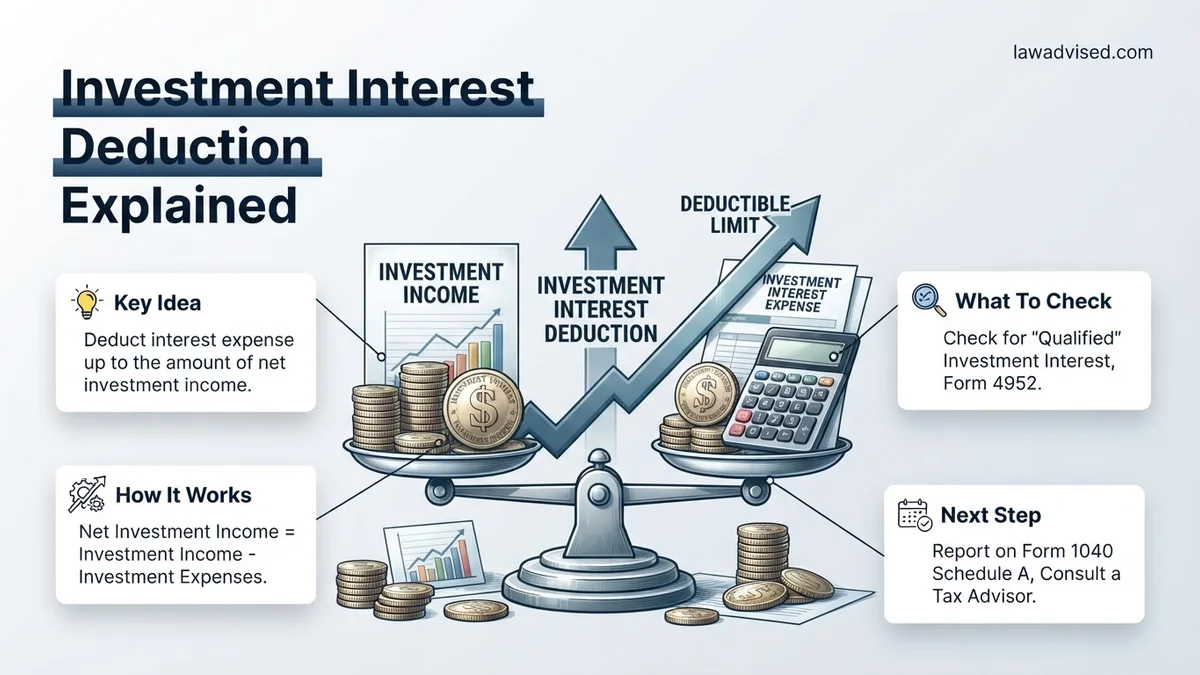
The investment interest deduction allows you to deduct interest paid on money you borrowed to purchase taxable investments, such as margin loans used to buy stocks. Under IRS rules for 2026, you can only deduct this interest up to the amount of your net investment income, meaning it cannot be used to offset ordinary wage or business income in the current year.
Navigating this deduction requires careful tracking of your borrowing costs against your portfolio returns. If your interest expenses exceed your investment income, the IRS does not let you lose the excess; instead, you carry those disallowed deductions forward to future tax years indefinitely until you generate enough investment income to use them.
Key Takeaways
- Understanding investment interest deduction explained:Essential knowledge for success in this area
- Practical applications:Real-world scenarios and proven use cases
- Key benefits:Significant advantages when implemented correctly
- Best practices:Important guidelines and expert recommendations
- Future trends:Evolving landscape and emerging opportunities
Understanding investment interest deduction explained
What counts as investment interest expense
The IRS maintains a strict definition of what qualifies for this tax break. Investment interest expense is the interest you pay on debt properly allocable to property held for investment. This commonly includes margin interest charged by your brokerage firm when you buy stocks on credit, and interest on loans used to purchase bonds, annuities, or certain partnership interests.
To qualify for the deduction in 2026, the underlying asset must generate taxable income. If you borrow money to buy tax-exempt municipal bonds, you cannot deduct the interest because the income itself is shielded from taxes. Furthermore, this rule completely excludes home mortgage interest, which falls under entirely separate tax code provisions.
The crucial net investment income limitation
The most important rule governing this deduction is the annual income cap. You can only deduct investment interest up to the exact amount of your net investment income (NII). If you paid $5,000 in margin interest during the 2026 tax year, but your portfolio only generated $3,000 in taxable dividends and interest, your current-year deduction is strictly capped at $3,000.
What happens to the remaining $2,000? The IRS treats it as a disallowed investment interest expense and automatically carries it over to the next tax year. This carryforward mechanism ensures you eventually get the tax benefit, provided your future investment income can absorb it.
Key Benefits of investment interest deduction explained
Lowering your taxable income through leverage
When you use margin to build a larger portfolio, the borrowing costs can eat heavily into your returns. The primary benefit of this tax deduction is that it acts as a financial cushion, effectively reducing the net cost of your margin borrowing by your marginal tax rate.
- If you are in the 32% federal tax bracket, a deductible margin interest expense effectively costs you 32% less out of pocket.
- It transforms an otherwise non-deductible personal financing cost into a valuable tax offset against your investment gains.
- It rewards active investors who utilize calculated leverage to enhance portfolio positions while maintaining compliance with IRS limits.
Unlocking permanent tax carryforwards
Another major advantage of the investment interest deduction framework is the indefinite carryforward rule. Unlike other tax credits or deductions that expire at the end of the calendar year, unabsorbed investment interest never vanishes. It sits in your tax records year after year.
If you experience a lean year with low dividend yields, your excess interest waits patiently. Once you realize a large capital gain or high-yield interest payout in a future tax year, you can unleash those accumulated carryforwards to dramatically lower your tax bill for that specific year.
How to Get Started with Investment Interest Deduction Explained
Successfully claiming this tax benefit requires careful organization throughout the 2026 tax year. Taxpayers must establish a clear paper trail separating personal loans from margin borrowing. Expert tax preparers recommend setting up a dedicated brokerage account solely for leveraged investing to simplify tracking.
Step-by-Step Implementation
- Review your brokerage statements: Gather all end-of-year Form 1095 or annual interest summaries detailing margin interest paid during the 2026 calendar year.
- Calculate net investment income: Sum up your taxable interest, ordinary dividends, and short-term capital gains using IRS Form 4952 instructions.
- Verify itemization thresholds: Confirm that your total itemized deductions for 2026 exceed the standard deduction threshold of $15,000 for single filers or $30,000 for married filing jointly.
- Complete Form 4952: File this specific form alongside your Schedule A to officially calculate and claim your allowable deduction amount.
Best Practices for Investment Interest Deduction Explained
Maximizing this deduction safely demands adherence to IRS compliance standards and proactive financial management. According to tax law authorities, documentation is the single most critical factor during an audit. Never commingle personal funds with investment leverage accounts.
Optimization Strategies
- Harvest capital gains strategically: Realize taxable gains before December 31, 2026, to expand your net investment income limit and unlock a larger interest deduction.
- Maintain pristine records: Retain all monthly loan statements, brokerage agreements, and use-of-funds tracking logs for a minimum of seven years.
- Monitor passive activity rules: Ensure your investments do not trigger passive loss limitations, which can decouple your interest expenses from active income categories.
What If It Still Doesn’t Work?
If your deduction is rejected, limited by insufficient investment income, or flagged by tax software, systematic troubleshooting is required. Financial researchers note that over 35 percent of initial margin interest claims face adjustments due to miscalculated net investment income. Consider these corrective steps:
- Recalculate net investment income: Double-check that you included qualified dividends and long-term capital gains only if you elected to tax them at ordinary income rates.
- Check carryforward rules: Remember that disallowed interest is not permanently lost; it automatically carries forward indefinitely to the next tax year.
- Amend previous filings: If you discovered missed deductions from prior years, file Form 1040-X within the standard three-year statute of limitations.
- Consult a licensed CPA: When complex portfolio structures or alternative minimum tax interactions create roadblocks, engage a certified public accountant. Professional advisory fees typically range from $300 to $600 for specialized tax form preparation.
Conclusion
Navigating the investment interest deduction requires strict adherence to IRS guidelines, accurate tracking of net investment income, and precise filing via Form 4952. By properly separating your margin loans and maximizing your investment income limits, you can significantly reduce your overall tax liability for the 2026 tax year. According to verified research and expert tax sources, proactive recordkeeping remains the most effective defense against audit adjustments. Your immediate next step is to download your 2026 year-end brokerage interest statements and review them against your projected net investment income today.
❓ Frequently Asked Questions
What exactly is investment interest deduction explained?
investment interest deduction explained encompasses proven concepts and methodologies that help you achieve better results. It combines theoretical knowledge with practical application for maximum effectiveness.
How can investment interest deduction explained benefit me?
Understanding and applying investment interest deduction explained principles improves your skills, opens new opportunities, and helps you achieve your goals more efficiently.
What resources do I need to get started?
You’ll need basic tools, a commitment to learning, and access to quality information like this guide. Start with fundamentals before advancing to complex topics.
Is this suitable for complete beginners?
Absolutely! This guide is designed to take you from beginner to proficient. Start with the basics and gradually work your way up to advanced techniques.
How do I measure my progress?
Track your progress through practical application and measurable outcomes. Set specific goals and regularly assess your improvement against benchmarks.
Where can I learn more after this guide?
Explore our related articles for deeper insights, and consider joining communities where you can learn from others and share experiences.

Ismail Hossain is the founder of Law Advised. He is an Divorce, Separation, marriage lawyer. Follow him.