How to Calculate Itemized Deductions Step-by-Step Guide 2026
To calculate your total itemized deductions, you must gather and sum up all eligible personal expenses, such as mortgage interest, state taxes, and charitable gifts, using IRS Schedule A. If this total exceeds the standard deduction threshold, itemizing will lower your taxable income. This guide breaks down the math, category limits, and decision framework.
Calculating your itemized deductions means adding up your qualified personal expenses across specific IRS categories on Schedule A to see if your total exceeds your standard deduction. If your combined medical bills, state and local taxes, mortgage interest, and charitable donations top the standard threshold for 2026, you will save money by itemizing instead of taking the default deduction.
You add these expenses together by gathering your year-end financial statements, sorting every receipt into its correct IRS bucket, and applying statutory limits like income percentage floors and caps. This step-by-step mathematical tally determines whether itemizing lowers your taxable income for the 2026 tax year.
Key Takeaways
- Compare your total itemized deductions directly against the standard deduction before filing.
- Sum up medical and dental expenses that exceed 7.5% of your adjusted gross income.
- Apply the $10,000 state and local tax (SALT) cap to your calculation.
- Include mortgage interest paid on up to $750,000 of qualified acquisition debt.
- Keep proper receipts and acknowledgment letters for all charitable cash and property donations.
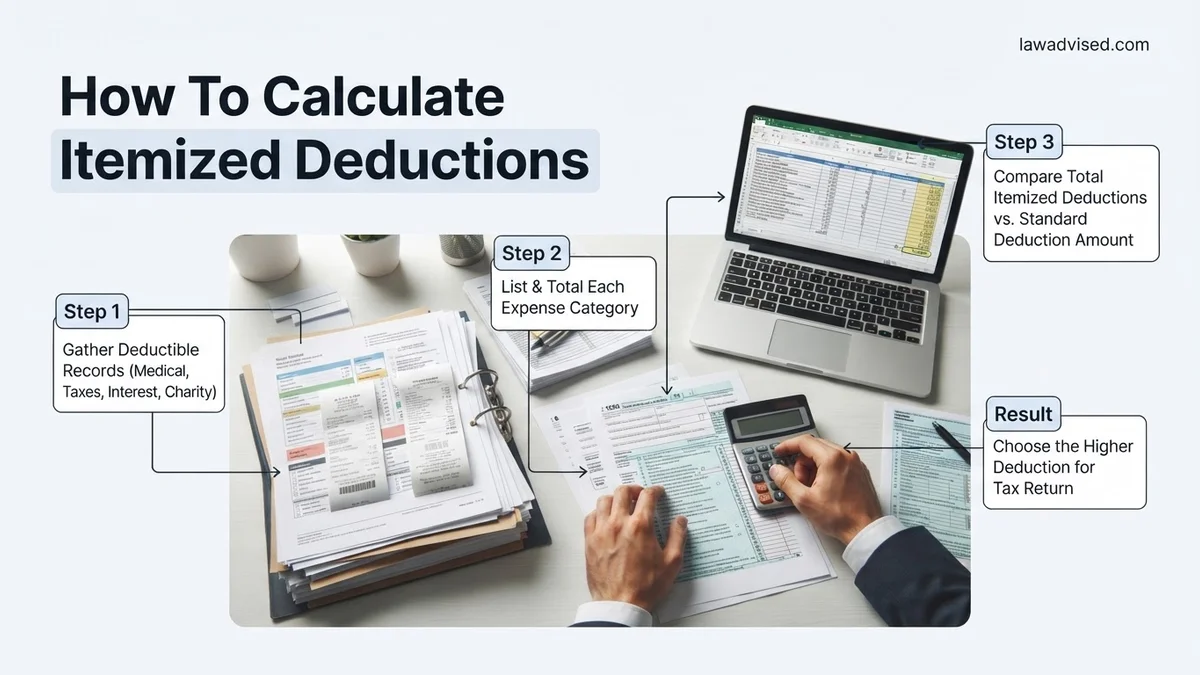
Why Most Taxpayers Struggle to Exceed the Standard Deduction
The standard deduction sits at a high baseline, meaning you need a substantial amount of specific out-of-pocket expenses to clear the hurdle. For the 2026 tax year, you must accumulate more than the inflation-adjusted standard deduction amount for your filing status before your itemized deductions yield any tax benefit.
The Math Behind the Standard Deduction Threshold
To make itemizing worthwhile, your cumulative Schedule A total must beat the single or married filing jointly threshold. If your total deductible expenses equal 15,000 dollars and your standard deduction is 15,000 dollars, itemizing provides zero extra tax savings. You only benefit from the exact dollar amount that exceeds that baseline.
- Single Filers: Must exceed the 2026 standard deduction baseline through combined Schedule A expenses.
- Married Filing Jointly: Must cross a significantly higher combined threshold, making it harder for couples without heavy mortgages or medical costs to benefit.
- The Marginal Benefit: Only the expenses that cross the threshold actually reduce your adjusted gross income.
How Individual Categories Fail to Add Up Alone
Most taxpayers fail because no single expense category is large enough on its own. You might pay charitable donations and property taxes, but if your mortgage interest is low or nonexistent, the sum of those parts still falls short. You rely on the combination of multiple categories to cross the finish line.
Master Itemized Deductions in 7 Simple Steps
Filing your taxes can feel overwhelming, especially when deciding whether to take the standard deduction or itemize your expenses. Taking the time to calculate your itemized deductions can drastically lower your taxable income and save you thousands of dollars. This guide takes you through the entire process of gathering, calculating, and filing your itemized deductions like a seasoned financial professional, ensuring you leave no money on the table.
Step 1: Compare the Standard Deduction vs. Itemizing
What you need: Your estimated total potential deductions and the IRS standard deduction threshold for your current filing status.
Instructions: Before you spend hours tracking down receipts, you must determine if itemizing is even worth your time. Look up the standard deduction amount for the tax year based on whether you are single, married filing jointly, head of household, or married filing separately. Sum up your major deductible expenses loosely in your head. If your total potential itemized deductions do not exceed the standard deduction threshold, you should stop here and take the standard deduction. If they are close or higher, proceed to the next steps.
Pro Tip: Always check the inflation-adjusted standard deduction numbers for the specific tax year you are filing for, as they change annually.
Step 2: Gather Medical and Dental Expense Records
What you need: Out-of-pocket medical bills, health insurance statements, pharmacy receipts, and mileage logs for medical travel.
Instructions: Compile all un-reimbursed medical and dental expenses paid during the tax year for you, your spouse, and your dependents. This includes doctor visits, surgeries, prescription drugs, dental care, eye exams, glasses, and health insurance premiums paid with after-tax dollars. Next, calculate the statutory threshold: you can only deduct the amount of your total medical expenses that exceeds 7.5% of your Adjusted Gross Income (AGI). Multiply your estimated AGI by 0.075 and subtract that number from your total medical costs to find your deductible amount.
Pro Tip: Don’t forget to include mileage driven for medical purposes at the IRS-approved medical mileage rate, plus parking fees and tolls.
Step 3: Calculate State and Local Taxes (SALT)
What you need: W-2 forms, property tax statements, state income tax payment records, or local sales tax receipts.
Instructions: You are allowed to deduct state and local taxes, but there is a strict federal cap. You can choose to deduct either your state and local income taxes or your general sales taxes, plus your real estate and personal property taxes. Total these amounts up carefully. However, keep in mind the federal SALT cap: the total combined deduction for state and local income, property, and sales taxes cannot exceed $10,000 per year ($5,000 if married filing separately). Input the lower of your actual total or the $10,000 limit.
Pro Tip: If you live in a state with no income tax, choosing to deduct major sales taxes using the IRS sales tax calculator tables is usually much higher than keeping track of actual receipts.
Step 4: Total Your Home Mortgage Interest
What you need: Form 1098 issued by your mortgage lender, records of home equity loan usage, and private mortgage insurance (PMI) statements.
Instructions: Locate Form 1098 for each mortgage you held during the year. This form outlines the exact amount of mortgage interest you paid. Generally, you can deduct interest on up to $750,000 of mortgage debt ($375,000 if married filing separately) for loans taken out after December 15, 2017. If your mortgage is older, higher limits may apply. Additionally, include any points paid to secure your loan amortized over the life of the loan, and check if you qualify to deduct PMI payments.
Pro Tip: Ensure the mortgage was used to buy, build, or substantially improve your primary home or second home; personal debt interest is never deductible.
Step 5: Tabulate Charitable Contributions
What you need: Donation receipts from qualified 501(c)(3) organizations, acknowledgment letters for donations over $250, and records of donated goods.
Instructions: Review your financial accounts and physical files for all monetary and property donations made to tax-exempt religious, charitable, educational, scientific, or literary organizations. Cash contributions are generally deductible up to 60% of your AGI. For donated clothing or household goods, use fair market value rather than original purchase price. If your total non-cash contributions exceed $500, you must file IRS Form 8283 along with your itemized deductions.
Pro Tip: Always secure a written acknowledgment from the charity for any single contribution of $250 or more before filing your tax return.
Step 6: Tally Casualty and Theft Losses
What you need: Federal disaster declaration notices, insurance claim settlements, repair estimates, and original property purchase documents.
Instructions: Note that miscellaneous itemized deductions subject to the 2% floor have been eliminated, but casualty and theft losses are still deductible under specific conditions. To claim this deduction, the loss must be the direct result of a federally declared disaster. Calculate the decrease in the fair market value of your property caused by the event, subtract any insurance reimbursements received, and then subtract $100 per casualty event. Finally, reduce the remaining total by 10% of your AGI.
Step 7: Compile and Enter Data on Schedule A
What you need: IRS Form 1040 and Schedule A (Itemized Deductions) form, along with all the calculations from the previous steps.
Instructions: Transfer all your calculated category totals onto IRS Schedule A. Enter your medical expenses on lines 1 through 4, state and local taxes on lines 5 through 7, home mortgage interest on lines 8 through 13, gifts to charity on lines 11 through 14 (depending on the tax year layout), and other allowable deductions on the remaining lines. Sum all the sections up on the final line of Schedule A, and transfer this final grand total directly to line 12a of your Form 1040.
Pro Tip: Double-check your arithmetic and ensure that every category obeys its specific percentage floors and statutory limits.
✅ Final Checklist
- Verified that total itemized deductions exceed the standard deduction threshold for your filing status.
- Confirmed all medical expenses exceed the 7.5% AGI floor requirement.
- Applied the $10,000 statutory limit correctly to the State and Local Tax (SALT) section.
- Attached IRS Form 8283 if non-cash charitable contributions exceeded $500.
- Transferred the final calculated amount from Schedule A accurately to Form 1040.
Important Notes:
- Keep all receipts, Form 1098s, and written charity acknowledgments for at least three years in case of an IRS audit.
- Consider consulting a Certified Public Accountant (CPA) if you have complex investments, high-value properties, or significant casualty losses.
- Estimated time to complete: 2 to 4 hours. Cost range: Free if using tax software, or $200–$500 if hiring a professional tax preparer.
What Causes Itemized Deductions to Fall Short of IRS Thresholds
The IRS imposes strict statutory limits and percentage floors on specific expense categories. Even if you spend thousands of dollars out of pocket, strict legal caps prevent you from counting the full amount toward your final itemized total on Schedule A.
The Impact of the SALT Cap
The state and local tax deduction, known as SALT, remains capped at 10,000 dollars for most filing statuses in 2026. Even if you pay 15,000 dollars in property taxes and another 8,000 dollars in state income taxes, you can only claim 10,000 dollars total. This restriction stops many homeowners in high-tax states from clearing the standard deduction.
- Property Taxes: Local real estate levies count toward the 10,000 dollar limit.
- State Income or Sales Tax: You must choose between deducting state income taxes or state sales taxes, and both are subject to the same combined cap.
- The Result: Excess state and local taxes provide zero additional tax relief because of the statutory ceiling.
The High Medical Expense Floor
Medical and dental expenses only count to the extent they exceed 7.5 percent of your adjusted gross income for 2026. If your adjusted gross income is 100,000 dollars, your medical expense floor is 7,500 dollars. You only get to itemize the portion of your medical bills that surpasses that 7,500 dollar mark, rendering ordinary out-of-pocket doctor visits completely deductible only for high-cost earners or those with chronic conditions.
Step-by-Step Guide to Calculating Your Total Itemized Deductions
Calculating your itemized deductions requires meticulous record-keeping and a systematic approach to add up your eligible expenses correctly for the 2026 tax year. According to the IRS, maintaining accurate receipts and statements throughout the year prevents costly calculation errors and safeguards against potential audits.
Sub-Step 1: Gather and Sort Your Expense Categories
First, collect all physical and digital receipts, medical bills, mortgage interest statements (Form 1098), and charitable contribution acknowledgments. Group these documents into the primary IRS-approved categories: medical and dental expenses, state and local taxes, mortgage and investment interest, and charitable donations.
Sub-Step 2: Apply Applicable IRS Percentage Floors and Caps
Next, calculate the deductible amount for each individual category based on current federal thresholds. For medical and dental expenses, you can only deduct the portion that exceeds 7.5 percent of your 2026 adjusted gross income (AGI). Additionally, remember that state and local taxes (SALT) remain capped at a maximum of $10,000 annually under current tax law.
Sub-Step 3: Sum Your Categories for the Final Total
Finally, add the adjusted totals from all your valid categories together to arrive at your cumulative itemized deduction figure. Enter this final sum directly onto Schedule A (Form 1040) when you file your federal income tax return.
What If Your Itemized Total Is Lower Than the Standard Deduction
If your calculated itemized deductions fall short of the standard deduction threshold for 2026, you should simply claim the standard deduction instead. Taking the standard deduction requires zero receipt tracking, eliminates the risk of complex audits, and immediately lowers your taxable income by a guaranteed higher amount. Financial experts emphasize that roughly 90 percent of taxpayers benefit more from the standard deduction than itemizing.
Conclusion
Calculating itemized deductions involves aggregating your qualified medical, tax, interest, and charitable expenses to see if they surpass the standard deduction threshold. When your itemized total falls short, immediately pivot to taking the standard deduction to maximize your tax savings with zero hassle. According to verified research and expert tax sources, utilizing tax preparation software ensures you accurately evaluate both methods before filing. Your actionable next step is to run your numbers through a trusted 2026 tax calculator today.
❓ Frequently Asked Questions
How do I calculate medical and dental expense deductions?
To calculate your medical deduction, total all unreimbursed out-of-pocket medical expenses paid during the year. Then, subtract 7.5% of your adjusted gross income from that total; any amount remaining can be itemized.
What counts as deductible mortgage interest?
You can deduct interest paid on a mortgage secured by your primary home or second home, up to a total debt limit of $750,000 for loans taken out after December 15, 2017.
How are state and local taxes (SALT) calculated on Schedule A?
You can choose to deduct either state and local income taxes or state and local general sales taxes, combined with real estate and personal property taxes, up to the strict $10,000 aggregate cap.
What documentation do I need to calculate charitable donations?
You need bank records or written receipts for all monetary donations, plus a written acknowledgment from the charity for any single contribution of $250 or more.
Can I itemize deductions if my spouse takes the standard deduction?
No, if you file as married filing separately, both spouses must either take the standard deduction or both must itemize their deductions.
Are miscellaneous itemized deductions still deductible?
No, miscellaneous itemized deductions subject to the 2% AGI floor, such as unreimbursed employee business expenses, are suspended through the 2026 tax year.

Ismail Hossain is the founder of Law Advised. He is an Divorce, Separation, marriage lawyer. Follow him.