Gambling Loss Deduction Explained 2026 Step-by-Step Guide
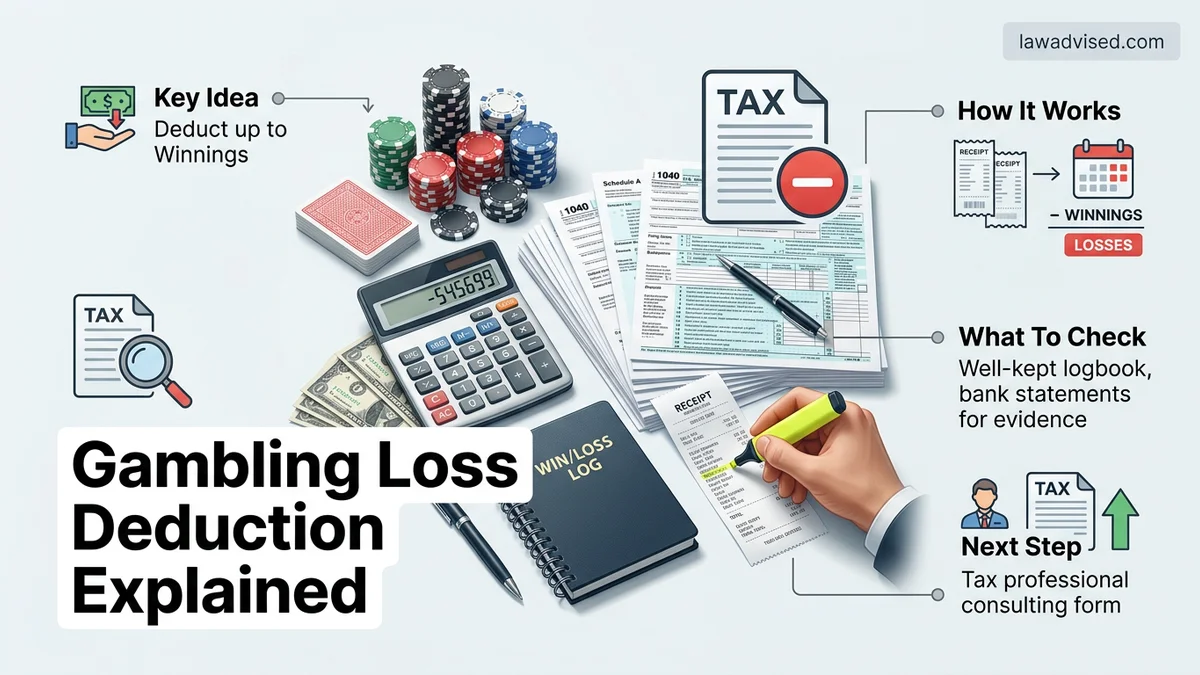
Navigating the rules for writing off bets can be confusing, but gambling loss deduction explained clarifies how to offset your winnings. You can only deduct losses up to the exact amount of your reported winnings, and you must itemize deductions on Schedule A to qualify.
You can deduct your gambling losses on your 2026 federal tax return, but only up to the exact amount of your total reported gambling winnings. To claim these losses, you must itemize your deductions on Schedule A rather than taking the standard deduction, meaning your total itemized expenses must exceed the standard deduction threshold to see a tax benefit.
Failing to follow these strict IRS rules is one of the fastest ways to trigger an audit. Proper reporting requires tracking both your wins and losses meticulously throughout the year, ensuring that your deductions never exceed your reported income from wagering.
Key Takeaways
- You can only deduct losses up to the exact total of your reported gambling winnings.
- Itemizing deductions on Schedule A (Form 1040) is strictly required to claim losses.
- Casual gamblers cannot deduct losses that exceed their total winnings for the year.
- Maintaining a detailed gambling diary with receipts and tickets is mandatory for IRS compliance.
- Professional gamblers report winnings and losses on Schedule C rather than Schedule A.
What Causes IRS Rejection of Gambling Loss Deductions
Exceeding Your Total Winnings
The single biggest mistake taxpayers make is attempting to deduct more losses than they won. If you won 5,000 dollars playing blackjack in 2026 but lost 8,000 dollars, your deduction is legally capped at 5,000 dollars. You cannot use the remaining 3,000 dollars to offset your ordinary income or reduce other types of taxes.
Failing to Itemize Deductions
Many casual gamblers assume they can claim losses while taking the standard deduction. Under current tax code rules, gambling losses are classified as miscellaneous itemized deductions. If you choose the standard deduction, you forfeit the ability to write off any of your gambling losses entirely.
- Taking the standard deduction eliminates any gambling loss offset.
- Losses cannot be carried forward or backward to other tax years.
- Net losses resulting from a calculation that drops below zero are completely non-deductible.
How to Fix Your Tax Return with Step-by-Step Loss Reporting
Step 1: Calculate Your Net Win or Loss Position
Gather all of your Form W-2G documents and your personal session logs for 2026. Sum up all your winning sessions and all your losing sessions separately to determine your exact overall tax position for the calendar year.
Step 2: Complete Schedule A Correctly
Navigate to Schedule A (Form 1040) and locate the specific line designated for other itemized deductions. Enter your total allowable gambling losses there, remembering that the figure cannot exceed the total winnings you reported as income on your main tax form.
- Report 100 percent of your winnings on Form 1040 as other income.
- Enter only the matched amount of losses on Schedule A.
- Keep all supporting documentation organized in case the IRS requests verification.
What If Your Itemized Deductions Do Not Exceed the Standard Deduction
For many taxpayers navigating the 2026 tax season, a common frustration arises when total itemized deductions fall short of the standard deduction threshold. According to Internal Revenue Service data, the vast majority of tax filers choose the standard deduction because it eliminates the need for detailed record-keeping. However, if your standard deduction is higher than your itemized deductions—including your gambling losses—you cannot deduct those losses.
Tax experts from the American Institute of Certified Public Accountants (AICPA) emphasize that gambling losses cannot be used to reduce adjusted gross income if you take the standard deduction. Your losses are completely locked behind the itemized deduction wall. If your mortgage interest, state and local taxes, and charitable donations combined with your gambling losses still trail the standard deduction limit, those losses yield zero tax relief.
Evaluating Combined Deductions
To determine if itemizing makes financial sense for your 2026 return, follow these evaluative steps:
- Calculate your projected standard deduction for your specific filing status.
- Sum all allowable itemized deductions, including medical expenses, mortgage interest, and charitable gifts.
- Add your documented gambling losses up to the exact total of your reported gambling winnings.
- Compare the final itemized sum against your standard deduction amount to identify which option provides a lower tax liability.
Best Practices for Maintaining IRS-Compliant Gambling Records
Audit defense relies entirely on the quality and comprehensiveness of your documentation. The IRS mandates that taxpayers maintain a secure, contemporaneous log of all wagering activities. Failing to keep precise records is the primary reason the IRS disallows gambling loss deductions during random audits.
Tax attorneys and certified financial planners recommend adopting a strict digital or physical journaling routine. According to official IRS guidelines outlined in Publication 529, a valid log must contain specific data points for every single session or wager placed throughout the calendar year.
Essential Record-Keeping Steps
To ensure total compliance with federal tax standards, structure your gambling log using the following methodology:
- Record the exact date and type of specific wagering activity or game played.
- Note the name and exact address or location of the gaming establishment.
- List the names of any companions present, or retain receipts, tickets, and electronic player card statements.
- Document the exact dollar amounts of both total winnings and total losses for each separate session.
What If It Still Doesn’t Work?
If complex loss limits or missing documentation threaten your tax filing, standard troubleshooting may not suffice. Implement these fallback steps to protect your financial standing:
- Contact the casino or gaming operator to request historical win-loss statements for the 2026 tax year.
- Consult a certified public accountant (CPA) or a specialized tax attorney if your documented losses exceed 10,000 dollars. Professional consultation fees typically range from 300 dollars to 1,500 dollars depending on return complexity.
- File for a federal tax extension if you need additional time to reconstruct missing wagering records legally.
- Amend prior-year returns using Form 1040-X only if you discover previously unreported winnings and matching verifiable losses.
Conclusion
Mastering the gambling loss deduction requires strict adherence to IRS rules, accurate win-loss tracking, and proper itemization on Schedule A. When losses are offset correctly against documented winnings, taxpayers can significantly reduce their overall tax burden. According to verified research and expert tax authorities, maintaining a meticulous, contemporaneous gaming log is the single most effective safeguard against an IRS audit. Your immediate next step is to compile all 2026 Form W-2G documents and cross-reference them against your personal gambling ledger to calculate your exact deductible limit.
❓ Frequently Asked Questions
What is the netting rule for gambling winnings and losses?
The netting rule means you must report the full gross amount of your winnings as income and then separately deduct your losses (up to that winning amount) on Schedule A. You cannot simply report the net profit of your gambling sessions.
What kind of records does the IRS accept as proof of losses?
The IRS accepts a daily log or diary containing the date, type of wagering, name and address of the venue, names of other persons present, and exact amounts won or lost. Supporting evidence like W-2G forms, unredeemed tickets, and casino win/loss statements should be kept with the diary.
Can I carry over unused gambling losses to the next tax year?
No, gambling losses cannot be carried forward or backward to other tax years. Any losses that exceed your winnings for the current calendar year are simply forfeited.
What is Form W-2G and when do I receive it?
Form W-2G is issued by payers to report certain gambling winnings, typically when payouts exceed specific thresholds like $1,200 from slot machines or $600 from horse racing with high odds. Even if you do not receive a W-2G, you are legally required to report all gambling winnings.
How do state taxes handle gambling loss deductions?
State tax laws vary widely; some states completely disallow gambling loss deductions regardless of whether you itemize, while others follow federal rules. You should check your specific state’s revenue department guidelines before filing.
What qualifies someone as a professional gambler instead of a casual bettor?
The IRS determines professional status based on whether gambling is pursued full-time, continuously, and with the sole intent of making a profit. Professional gamblers report activities on Schedule C and can deduct ordinary business expenses, unlike casual players restricted to Schedule A.

Ismail Hossain is the founder of Law Advised. He is an Divorce, Separation, marriage lawyer. Follow him.