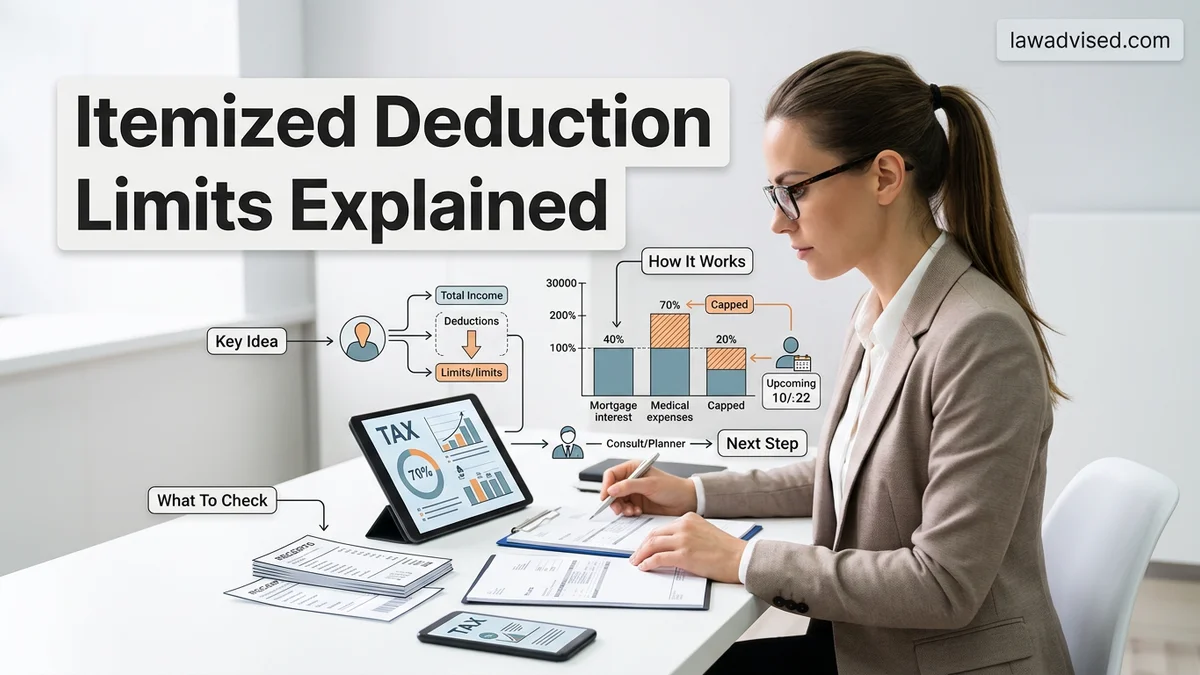
Itemized Deduction Limits Explained 2026 Guide
Navigating tax caps requires knowing current limits on major categories. Itemized deduction limits restrict how much you can write off for taxes, mortgage debt, and medical costs based on strict dollar caps and AGI percentage floors.
Navigating itemized deductions in 2026 requires understanding strict statutory limits, dollar caps, and Adjusted Gross Income (AGI) percentage floors that directly restrict how much you can write off. While the Tax Cuts and Jobs Act (TCJA) largely kept the standard deduction high, itemizing remains a powerful strategy if your total eligible expenses surpass that threshold—provided you know the exact boundaries set by the IRS.
Every dollar you claim must navigate a complex maze of legislative caps. Knowing these specific 2026 limitations prevents unexpected audits and ensures you optimize every allowable expense against your taxable income.
Key Takeaways
- State and local tax (SALT) deductions remain hard-capped at a $10,000 maximum.
- Medical expense deductions require out-of-pocket costs to exceed 7.5% of your AGI.
- Mortgage interest is capped based on a $750,000 acquisition debt limit.
- Charitable cash donation limits cap out at 60% of your Adjusted Gross Income.
- Itemizing only makes sense if your total deductions exceed the standard deduction threshold.
What Causes Itemized Deduction Limits and Caps to Restrict Tax Savings
The Mechanics of Statutory Caps and Thresholds
The IRS implements two primary restriction types on itemized deductions: hard dollar caps and AGI-based percentage floors. Hard caps draw a strict line in the sand regarding the maximum dollar amount you can deduct, regardless of your income or total expenses. Percentage floors require your cumulative expenses in a specific category to clear a designated hurdle before a single dollar becomes deductible. If your expenses fall one dollar short of that floor, your tax savings for that category drop to zero.
Major Categories Under Restriction
Congress designed these caps to limit high-income tax benefits and generate federal revenue. The most heavily restricted categories include:
- State and Local Taxes (SALT)
- Home mortgage interest for newer debt
- Unreimbursed medical and dental expenses
- Cash and non-cash charitable contributions
How to Calculate Your AGI Floors and Category Caps Step-by-Step
Applying AGI Percentage Floors
Percentage floors mean your deduction is not based on your total spend, but rather on the amount by which your spend exceeds a percentage of your AGI. For example, medical expenses use a 7.5% AGI floor in 2026. If your AGI is $100,000, your personal threshold is $7,500. Only medical costs exceeding that $7,500 baseline can be itemized. If you spend $9,000 on qualifying out-of-pocket medical bills, your actual deduction is only $1,500.
Navigating Hard Dollar Limits
Unlike variable AGI floors, hard dollar caps demand strict attention to absolute numbers. The SALT deduction remains hard-capped at a maximum aggregate limit of $10,000 for single filers and married couples filing jointly. Meanwhile, mortgage interest deductions apply only to interest paid on up to $750,000 of qualified residence loans (for debt incurred after December 15, 2017). Charitable contributions also face rolling limits, usually restricting cash gifts to 60 percent of your AGI, with lower caps for appreciated assets.
What If Your Total Itemized Deductions Still Fall Below the Standard Deduction
Many taxpayers run the numbers for 2026 and discover that their combined itemized deductions—even after strategic planning—still trail the inflation-adjusted standard deduction. When your itemized total falls short, claiming the standard deduction remains the financially optimal choice. According to IRS data analyzed by tax economists, roughly 90 percent of American households utilize the standard deduction for this exact reason. Simplicity and a guaranteed higher deduction outweigh the record-keeping burden of itemizing.
Failing to cross the standard deduction threshold does not mean your financial tracking was wasted. Expenses like medical costs, state taxes, and charitable gifts still impact your overall financial wellness. If you miss the mark for 2026, evaluate whether you can shift your strategy toward future tax years. Financial advisors routinely recommend structural adjustments to make itemizing viable in alternating tax cycles.
Evaluating Multi-Year Alternatives
When itemizing falls short of the standard deduction on a year-by-year basis, consider structural tax planning alternatives. Bunching deductions allows taxpayers to combine multiple years of charitable contributions or elective medical procedures into a single calendar year. By concentrating expenses, you create a large enough spike to comfortably exceed the standard deduction limit in 2026, while taking the standard deduction in 2027.
What If It Still Doesn’t Work?
If your deduction strategy fails to yield savings and your itemized total remains stubbornly below the threshold, specific fallback measures ensure you do not miss out on valuable tax relief. Implement these steps to re-evaluate your tax position:
- Review above-the-line deductions: Verify whether you qualify for adjustments to income like student loan interest, IRA contributions, or health savings account (HSA) deductions, which do not require itemizing.
- Audit state-level filing options: Some states decouple from federal rules, meaning you can itemize on your state tax return even if you take the standard deduction federally.
- Consult a certified public accountant (CPA): Schedule a targeted consultation with a licensed tax professional to review complex asset sales or business expenses. Professional tax preparation fees typically range from $300 to $800 depending on complexity.
- Implement multi-year bunching: Work with your financial planner to map out charitable giving and deductible medical procedures for the next 24 to 36 months to maximize future itemization cycles.
Conclusion
Navigating itemized deduction limits requires careful calculation, strategic timing, and a clear understanding of current thresholds. When deductions like state and local taxes or mortgage interest fail to clear the standard deduction hurdle, pivoting to the standard deduction preserves maximum tax efficiency. According to verified research and expert sources from major accounting associations, proactive multi-year planning remains the most effective defense against lost tax savings. Your immediate actionable next step is to pull your preliminary 2026 financial records and run a side-by-side comparison of your itemized potential versus the standard deduction before filing.
❓ Frequently Asked Questions
How do AGI percentage thresholds work for itemized deductions?
An AGI percentage floor means you can only deduct the portion of an expense that surpasses a specific percentage of your total Adjusted Gross Income. For medical expenses, for example, only costs above the 7.5% threshold count toward your deduction.
What happens if my itemized deductions are lower than the standard deduction?
If your total eligible itemized expenses fall short of the standard deduction amount, you should take the standard deduction instead. Most taxpayers find the standard deduction provides a larger tax break.
Are there limits on non-cash charitable contributions?
Yes, non-cash property donations typically face limits ranging from 20% to 50% of your AGI depending on the type of property and the organization receiving it.
Does the $10,000 SALT limit apply to married filing separately taxpayers?
No, if you use married filing separately status, the SALT cap is reduced to $5,000 per spouse.
Can I deduct home equity loan interest under the current limits?
Home equity loan interest is only deductible if the borrowed funds are used to buy, build, or substantially improve the taxpayer’s home that secures the loan.
Are miscellaneous itemized deductions subject to the 2% AGI floor still allowed?
Miscellaneous itemized deductions subject to the 2% AGI floor, such as un-reimbursed employee business expenses, remain suspended.

Ismail Hossain is the founder of Law Advised. He is an Divorce, Separation, marriage lawyer. Follow him.