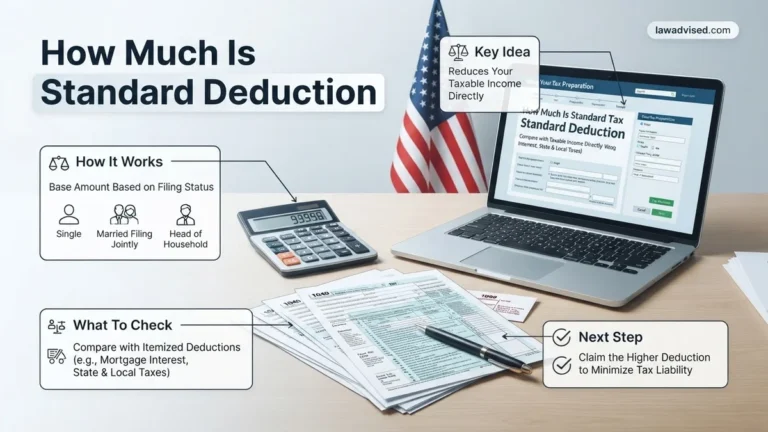
Common Itemized Deductions The Expert Guide to 2026
Deciding whether to itemize depends on whether your total deductions exceed the standard deduction threshold. Common itemized deductions include mortgage interest, state and local taxes (SALT), charitable donations, and qualified medical expenses. Knowing the current limits and thresholds ensures you maximize your tax savings legally.
Navigating your taxes requires knowing whether to take the standard deduction or itemize your return. For the 2026 tax year, you benefit most from itemizing when your total eligible expenses exceed the IRS standard deduction threshold.
Itemizing lets you write off specific personal expenses like mortgage interest, state taxes, and charitable gifts. This guide breaks down the most common itemized deductions to help you maximize your tax savings this year.
Key Takeaways
- Compare total itemized deductions against the standard deduction before filing your tax return.
- The SALT deduction remains capped at $10,000 for state and local taxes combined.
- Medical expenses must exceed 7.5% of your adjusted gross income to be deductible.
- Charitable cash donations are generally limited to 60% of your adjusted gross income.
- Mortgage interest is deductible on acquisition debt up to $750,000 for most homeowners.
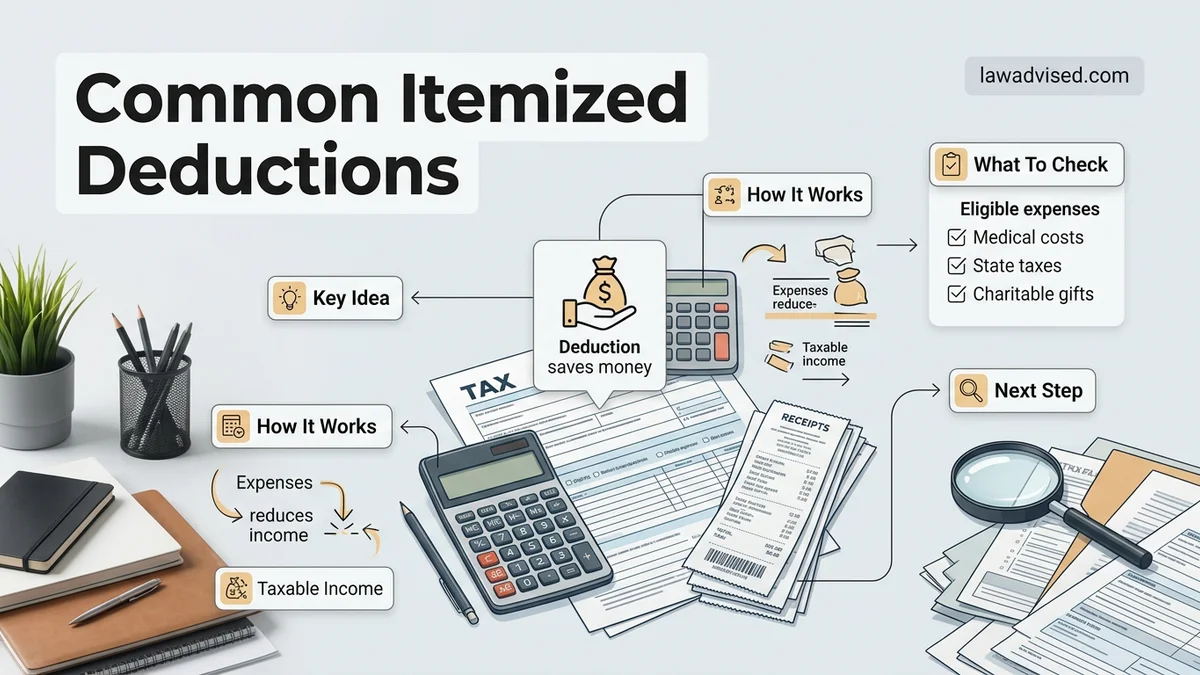
What Causes Taxpayers to Benefit from Common Itemized Deductions
The Standard Deduction vs. Itemizing Thresholds
You should always compare your potential itemized total against the 2026 standard deduction amounts before filing. If your combined deductible expenses are lower than the standard threshold, itemizing will not lower your tax bill.
- Filing status dictates your baseline standard deduction for 2026.
- Medical bills must exceed a specific percentage of your adjusted gross income to count.
- Gathering receipts throughout 2026 ensures you do not miss qualifying thresholds.
Major Life Events That Trigger Itemized Deductions
Certain milestones drastically shift your financial profile and make itemizing your best option. Buying a home or experiencing high medical costs often pushes your deductible expenses past the standard limit.
- Purchasing real estate introduces large mortgage interest and property tax deductions.
- Significant charitable giving scales up your annual write-offs instantly.
- Major medical procedures or chronic health costs create substantial tax relief opportunities.
How to Calculate and Claim the Top Four Itemized Deductions
State and Local Taxes (SALT) and Mortgage Interest
The SALT deduction allows you to deduct state and local income or sales taxes, alongside property taxes, up to the federal cap of 10,000 dollars. Meanwhile, your home mortgage interest deduction applies to interest paid on loans used to buy, build, or substantially improve your primary or secondary residence.
- SALT cap remains strictly limited to 10,000 dollars for most 2026 filers.
- Mortgage interest is generally deductible on debt up to 750,000 dollars for new loans.
- Keep Form 1098 from your lender to verify your exact mortgage interest paid.
Charitable Contributions and Medical Expenses
You can deduct cash and property donations made to qualified tax-exempt organizations, usually up to 60 percent of your adjusted gross income. For medical expenses, you can itemize any unreimbursed costs that exceed 7.5 percent of your 2026 adjusted gross income.
- Always get written receipts for charitable donations exceeding 250 dollars.
- Calculate your medical expense floor by multiplying your adjusted gross income by 0.075.
- Include doctor visits, prescriptions, dental care, and health insurance premiums in your medical total.
How to Fix Common Calculation Errors on Itemized Tax Returns
Filing errors on Schedule A can trigger automated IRS notices or processing delays. Accurate arithmetic ensures your claims survive compliance reviews for the 2026 tax year. Here is how to correct common computation mistakes before submission.
Adjusting Medical Expenses for the Adjusted Gross Income Floor
Taxpayers frequently fail to subtract the mandatory threshold from their total medical bills. According to IRS guidelines, only unreimbursed medical expenses exceeding 7.5 percent of your Adjusted Gross Income (AGI) are deductible.
- Calculate your preliminary AGI from your Form 1040 before adding medical totals.
- Multiply your final AGI by 0.075 to establish your specific nondeductible floor.
- Subtract that floor amount from your total qualified medical payments to find the exact figure for Schedule A.
Applying the SALT Cap Correctly
State and local tax (SALT) deductions remain capped under current legislation. Overlooking this statutory limit is a frequent source of adjustment letters.
- Sum your state income taxes (or general sales taxes) alongside local property taxes.
- Compare that aggregate total against the statutory maximum limit of 10,000 dollars (or 5,000 dollars if married filing separately).
- Report only the capped maximum amount on the appropriate line of Schedule A to prevent automated math mismatch flags.
What If Your Itemized Deductions Fall Short of the Standard Deduction
When your aggregated itemized expenses fail to clear the 2026 standard deduction threshold, taking the standard deduction is mathematically superior. However, strategic planning can salvage tax savings for future filing cycles.
If your total itemized deductions fall short, try these fallback steps:
- Bunch your charitable contributions and elective medical procedures into alternate tax years to exceed the standard deduction threshold every other year.
- Accelerate state property tax payments or scheduled medical treatments into the current calendar year if you are sitting close to the cutoff point.
- Utilize specialized tax preparation software with built-in optimization tools that test both filing methods automatically.
- Consult a certified public accountant or Enrolled Agent to evaluate multi-year bunching strategies, with professional consultation fees typically ranging from 250 to 600 dollars.
Conclusion
Navigating itemized deductions requires meticulous record-keeping and strict adherence to IRS thresholds to maximize your tax savings. When calculations stall or total expenses fall below the standard deduction, proactive strategies like multi-year bunching can restore your financial advantage. According to verified research and expert financial sources, utilizing professional software or certified advisors minimizes compliance risks. Your immediate actionable next step is to run a preliminary Schedule A calculation against the 2026 standard deduction limits today.
❓ Frequently Asked Questions
What qualifies as mortgage interest for itemized deductions?
You can deduct interest paid on a mortgage secured by your primary home or second home, subject to limits on total loan amounts established by tax law.
Do I need receipts for charitable donations to itemize them?
Yes, the IRS requires written acknowledgment from the charity for any single contribution of $250 or more, and bank records or receipts for smaller cash donations.
Can I deduct property taxes if I itemize?
Yes, state and local real property taxes are deductible, but they fall under the aggregate $10,000 SALT cap alongside state income or sales taxes.
What medical expenses are considered qualified by the IRS?
Qualified medical expenses include payments for doctors, dentists, hospital care, prescription drugs, and certain medical equipment or insurance premiums not covered by reimbursements.
Is there a limit on mortgage interest deductions for older loans?
Yes, mortgages taken out on or before December 15, 2017, may qualify for interest deductions on debt up to $1 million, compared to $750,000 for newer loans.
What documentation do I need to keep if I itemize my deductions?
You should retain all receipts, canceled checks, Form 1098 statements, appraisal forms for major donations, and medical bills for at least three years after filing.

Ismail Hossain is the founder of Law Advised. He is an Divorce, Separation, marriage lawyer. Follow him.