How Much Is Standard Deduction Expert 2026 Tax Guide
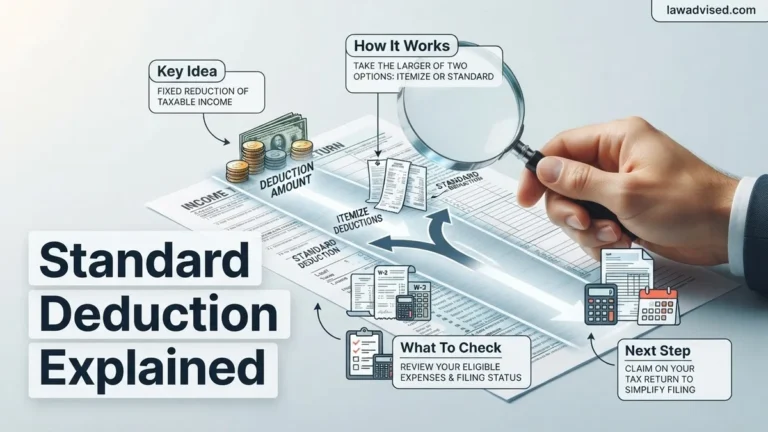
The standard deduction is a fixed dollar amount that reduces your taxable income, varying directly by your filing status and inflation adjustments for the year. Knowing your exact amount prevents overpaying taxes and simplifies your annual filing process. This expert guide outlines every threshold you need for the 2026 tax season.
For the 2026 tax year, the standard deduction is a flat dollar amount that reduces the income you are taxed on, shielding a substantial portion of your earnings from federal income tax before you even begin itemizing deductions.
Knowing this exact amount for your specific filing status helps you immediately calculate your taxable income and decide whether taking the standard deduction or itemizing will keep more money in your pocket.
Key Takeaways
- Standard deductions vary significantly depending on your official IRS filing status.
- Filers aged 65 or older or who are blind qualify for an increased standard deduction.
- Dependents claimed on another return face specific, lower standard deduction limits.
- Choosing the standard deduction prevents you from itemizing specific individual expenses.
- Inflation adjustments alter these exact dollar thresholds for every new tax year.
What Determines How Much the Standard Deduction Is Each Year
Inflation Adjustments and the IRS Formula
The Internal Revenue Service adjusts the standard deduction every single year to account for inflation, ensuring that your purchasing power does not erode due to rising consumer prices. These adjustments are tied directly to the Chained Consumer Price Index for All Urban Consumers (C-CPI-U). When the cost of living goes up, the IRS increases the standard deduction thresholds accordingly to lower your overall tax burden.
Your Official Tax Filing Status
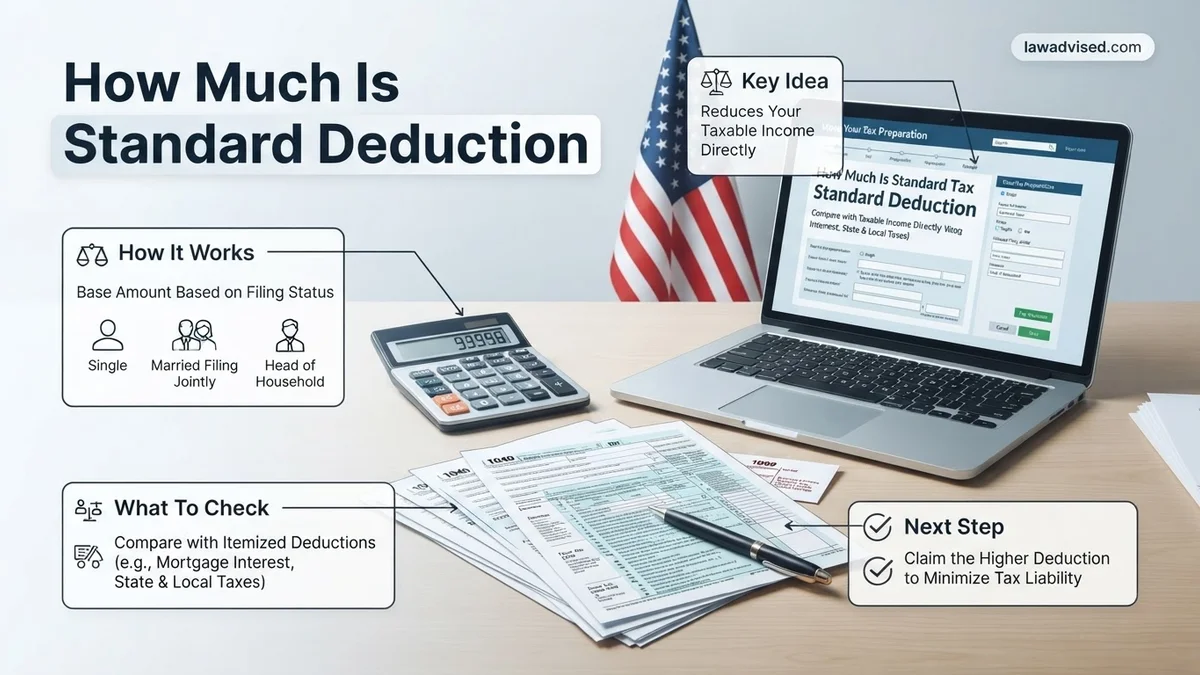
Your filing status is the single most important factor determining your specific standard deduction amount. The tax code recognizes distinct categories that reflect your household and marital situation:
- Single: For unmarried individuals or legally separated taxpayers without dependents.
- Married Filing Jointly: For couples combining their incomes and deductions on a single tax return.
- Head of Household: For unmarried individuals who pay more than half the cost of maintaining a home for a qualifying dependent.
- Married Filing Separately: For married couples who choose to keep their tax liabilities and finances completely separate.
Mastering the Standard Deduction in 6 Simple Steps
Navigating tax season can feel overwhelming, but understanding how much your standard deduction is serves as the cornerstone of filing an accurate tax return. The standard deduction is a specific dollar amount that reduces the income you’re taxed on, effectively lowering your overall tax liability without requiring you to itemize individual expenses. Because tax laws and inflation adjustments shift the numbers annually, taking a structured approach to calculating and claiming your correct deduction saves you both time and money. This guide walks you through the exact process to determine your standard deduction for the upcoming tax year, ensuring you maximize your tax savings.
Step 1: Identify Your Correct Filing Status
What you need: Your current marital status as of December 31 of the tax year, and knowledge of whether you financially support any dependents.
Instructions: Your filing status is the absolute first factor the IRS uses to determine your standard deduction amount. You must choose one of five categories: Single, Married Filing Jointly, Married Filing Separately, Head of Household, or Qualifying Surviving Spouse. Review your life changes over the past year—such as getting married, divorcing, or having a child—to ensure you select the most advantageous status. For example, filing as Head of Household provides a significantly higher standard deduction than filing as Single, provided you pay more than half the cost of keeping up a home for a qualifying dependent.
Pro Tip: If you are legally separated or going through a divorce, do not automatically assume you are “Single”—consult IRS guidelines to see if you qualify for Head of Household status instead.
Step 2: Locate the Current Tax Year Base Deduction Amounts
What you need: Access to official IRS publications (like Publication 501) or a reliable tax software platform, and the specific tax year you are filing for.
Instructions: Standard deduction amounts change almost every year to account for inflation. Once you know your filing status, look up the baseline standard deduction for that specific year. For instance, for tax year 2024, the basic standard deduction is $14,600 for single filers and married individuals filing separately, $29,200 for married couples filing jointly, and $21,900 for heads of household. Write down the precise baseline figure that corresponds directly to the filing status you identified in Step 1.
Pro Tip: Always double-check that you are looking at the numbers for the correct tax year, as using numbers from the previous year will trigger IRS processing delays and potential math errors.
Step 3: Check for Additional Standard Deductions (Age and Blindness)
What you need: Your birth date, your spouse’s birth date (if applicable), and vision status documentation if vision impairment is a factor.
Instructions: The IRS grants an extra standard deduction boost to taxpayers who are age 65 or older, or legally blind, by the end of the tax year. Review your age and your spouse’s age (if filing jointly). If you or your spouse turn 65 on or before January 1 of the following year, you are considered 65 for tax purposes. Look up the additional standard deduction amount for your filing status (which typically ranges between $1,550 and $1,950 per qualification depending on your marital status) and add it to your baseline figure.
Pro Tip: You can claim the additional deduction for both age and blindness simultaneously, meaning a senior who is also legally blind gets a double bonus added to their base deduction.
Step 4: Evaluate Special Rules for Dependents
What you need: Information on whether you can be claimed as a dependent on someone else’s tax return, and details regarding your earned versus unearned income.
Instructions: If someone else can claim you as a dependent on their tax return, your standard deduction is heavily restricted. You do not automatically get the full basic deduction. Instead, you must calculate your standard deduction by taking the greater of a specific minimum floor amount (usually around $1,300) or your earned income plus a small buffer amount, up to the maximum standard deduction for your filing status. Carefully review your status with your parents or guardians to confirm if you are classified as a dependent.
Pro Tip: Unearned income, such as dividends or interest from investments, is treated differently than wages from a job when calculating a dependent’s standard deduction limits.
Step 5: Compare Standard Deduction Versus Itemized Deductions
What you need: Receipts, records, and totals for potential itemized deductions including mortgage interest, state and local taxes (SALT) up to $10,000, charitable donations, and qualifying medical expenses exceeding 7.5% of your AGI.
Instructions: Even though you are calculating your standard deduction, you must verify whether taking the standard route actually saves you more money than itemizing. Add up your potential itemized deductions using Schedule A. If your total itemized deductions exceed your calculated standard deduction from the previous steps, you should itemize. If the standard deduction is higher—which is true for roughly 90% of American taxpayers—stick with the standard deduction to maximize your refund and simplify your paperwork.
Pro Tip: Keep all your charitable donation receipts and medical expense records organized in a folder just in case your itemized total ends up beating the standard threshold.
Step 6: Input the Final Amount Into Your Tax Return
What you need: Your completed Form 1040 (specifically lines 12a through 12c) or your chosen tax preparation software.
Instructions: Now that you have verified your filing status, checked for age/blindness additions, and confirmed the standard deduction beats itemizing, it is time to record the final figure. If you are filing electronically using software like TurboTax or FreeTaxUSA, the program will calculate this automatically based on your answers. If you are filling out a paper Form 1040, manually transfer your total standard deduction number to the designated line. Review the math one final time to ensure absolute accuracy before submitting.
Pro Tip: Save the worksheet you used to calculate your standard deduction with your tax records for that year so you have a clear paper trail of how you arrived at your numbers.
✅ Final Checklist
- Confirmed your exact tax filing status as of December 31
- Verified the correct baseline standard deduction for the specific tax year
- Checked eligibility for additional deductions due to being 65 or older, or legally blind
- Calculated adjustments if you are claimed as a dependent on another return
- Compared the final standard deduction against potential itemized deductions
Important Notes:
- Ensure you enter the correct tax year numbers; using outdated inflation adjustments will trigger IRS notices.
- If you have a complex financial situation involving trusts, nonresident alien status, or mixed filing scenarios, seek the help of a certified public accountant (CPA).
- Estimated time to complete: 15 to 30 minutes. Cost: Free (unless utilizing professional tax software or advisory services).
How to Calculate Your Exact Standard Deduction for 2026
Base Amounts by Filing Status
To find your baseline standard deduction for your 2026 tax return, you match your filing status against the indexed inflation guidelines. While exact final inflation figures for late 2025/2026 lock in these precise figures, standard projections place the baseline numbers significantly higher than previous years:
- Single filers: Projected baseline of approximately $15,000 to $15,350.
- Married Filing Jointly: Projected baseline of approximately $30,000 to $30,700.
- Head of Household: Projected baseline of approximately $22,500 to $23,000.
- Married Filing Separately: Projected baseline of approximately $15,000 to $15,350.
Adjustments for Age and Blindness
Your standard deduction is not always a flat baseline number. If you meet specific criteria, you can add an extra amount to your calculation, which lowers your taxable income even further:
- Age 65 or Older: If you reach age 65 by the final day of the 2026 tax year, you qualify for an additional standard deduction amount.
- Blindness: If you are legally blind at the end of the tax year, you qualify for an equivalent additional deduction.
- Multiple Conditions: If you are both over 65 and blind, you can claim both additional amounts, effectively doubling the extra boost to your standard deduction.
Step-by-Step Guide to Claiming Your Standard Deduction Properly
Claiming your standard deduction correctly requires attention to detail during your tax preparation process. Failing to follow the proper filing sequence can trigger automated IRS notices or delays in processing your refund.
1. Select the Correct Filing Status
Your standard deduction amount relies entirely on your legal filing status on the last day of 2026. Review IRS Publication 501 to confirm whether you qualify for Head of Household or Married Filing Jointly status, as guessing incorrectly alters your deduction baseline significantly.
2. Complete Form 1040 Accurately
Enter your chosen filing status on the designated lines of your Form 1040 or 1040-SR. Modern tax software automates this entry, but manual filers must locate the specific standard deduction box and transcribe the correct 2026 dollar amount directly onto the form.
3. Evaluate Additional Deduction Eligibility
Check the appropriate checkboxes if you or your spouse are age 65 or older, or legally blind, before the close of 2026. These boxes add the statutory extra standard deduction amount to your base calculation, lowering your overall taxable income further.
What If Your Filing Status Changes During the Tax Year
Life events like marriage, divorce, or the death of a spouse significantly impact your tax liabilities. The IRS dictates specific rules regarding how mid-year status changes affect your 2026 standard deduction entitlements.
The Marital Status Rule
According to IRS regulations, your marital status on December 31, 2026, dictates your filing status for the entire year. If your wedding occurred on December 31, the federal government views you as married for the full twelve months of 2026.
Divorce and Separation Timelines
If your final divorce decree was issued on or before December 31, 2026, you must file as Single or Head of Household. You cannot claim the Married Filing Jointly standard deduction unless a valid extension or marital status continuity applies under state law.
Death of a Spouse
When a spouse passes away during 2026, the surviving spouse may generally still file a joint return for that tax year. This allows the survivor to claim the full married standard deduction for 2026, provided they did not remarry before year-end.
What If It Still Doesn’t Work?
If calculating or claiming your 2026 standard deduction leads to software rejections, IRS discrepancies, or confusion regarding dependency rules, specific fallback measures apply. Taxpayers facing complex scenarios should take methodical steps to resolve the issue before filing.
- Re-verify Dependent Qualifications: Ensure any claimed dependents meet the strict 2026 IRS support and residency tests that impact Head of Household eligibility.
- Cross-Check W-2 and 1099 Data: Confirm that your income reporting documents do not accidentally trigger automated dependent care or student loan deduction overrides that conflict with standard deduction rules.
- Consult a Certified Public Accountant: Engage a licensed tax professional or Enrolled Agent if multi-state residency or complex self-employment income clouds your filing status. According to the National Society of Accountants, professional tax preparation fees typically range from $220 to $500 depending on complexity.
- Utilize IRS Free File Software: Run your data through an IRS-partnered guided software platform to catch calculation errors before final electronic transmission.
Conclusion
Navigating the standard deduction for the 2026 tax year requires understanding inflation-adjusted thresholds and precise filing status rules. Applying the correct figures prevents costly processing delays and ensures you do not overpay federal income tax. According to verified research and expert sources from the accounting industry, reviewing your withholding and deduction criteria early in the year remains the best defense against compliance errors. One actionable next step is to log into your tax preparation software or consult a qualified professional to lock in your exact 2026 deduction figures today.
❓ Frequently Asked Questions
How much is the standard deduction for married filing jointly?
The standard deduction for married couples filing jointly provides the highest base reduction, adjusted annually by the IRS to account for inflation and economic changes.
What qualifies a taxpayer for the additional standard deduction?
Taxpayers who are age 65 or older or who are legally blind by the end of the tax year qualify for an increased standard deduction amount.
Can nonresident aliens claim the standard deduction?
Generally, nonresident aliens are not permitted to take the standard deduction and must itemize their allowable deductions instead.
Does the standard deduction reduce self-employment tax?
No, the standard deduction only reduces your income tax liability and does not apply to self-employment taxes calculated on Schedule SE.
What happens if my filing status changes mid-year?
Your filing status is determined by your marital status on the last day of the tax year, which dictates your standard deduction.
Are dependents allowed to claim the senior bonus standard deduction?
Yes, dependents who are 65 or older or blind can still add the additional standard deduction amount to their basic dependent standard deduction calculation.

Ismail Hossain is the founder of Law Advised. He is an Divorce, Separation, marriage lawyer. Follow him.