Tax Credit vs Tax Deduction Expert Guide for 2026
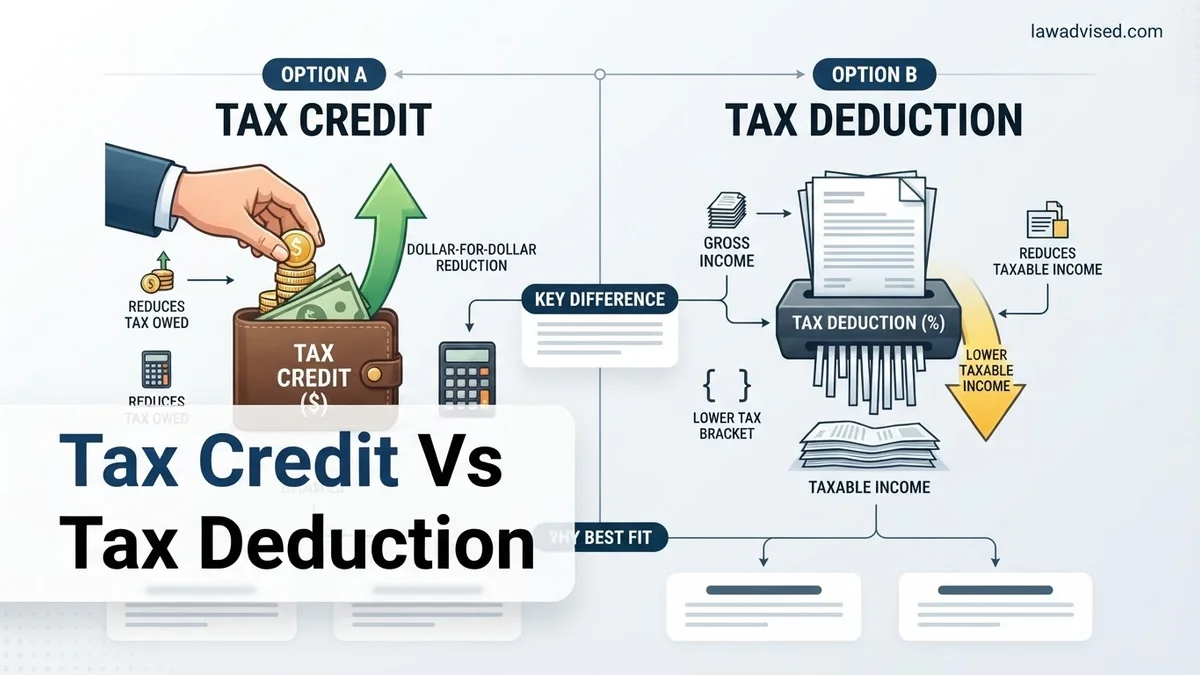
Understanding the difference between a tax credit vs tax deduction is essential for maximizing your tax savings. A tax credit reduces your tax bill dollar-for-dollar, while a tax deduction reduces the amount of income you pay taxes on.
A tax credit reduces your actual tax bill dollar-for-dollar, while a tax deduction simply lowers the amount of your income that is subject to taxes. Because of this fundamental mechanic, tax credits almost always save you significantly more money than tax deductions of the same nominal value.
Navigating your 2026 tax return requires you to master this exact difference. Mixing up these two terms means you cannot accurately forecast your tax liability, evaluate potential write-offs, or choose the right financial strategies to keep more of your hard-earned cash.
Key Takeaways
- Tax credits reduce your final tax liability directly on a dollar-for-dollar basis.
- Tax deductions reduce your taxable income, saving you money based on your tax bracket.
- Credits are generally more valuable than deductions of the exact same dollar amount.
- Refundable credits can result in a tax refund even if you owe zero tax.
- You can typically choose between taking the standard deduction or itemizing deductions.
What Causes Confusion Between Tax Credits and Tax Deductions
The Semantic Trap in Financial Marketing
Financial software, advertisements, and well-meaning friends often use terms like save, write-off, and slash interchangeably. When a brochure claims a green energy upgrade or educational program will save you money on your taxes, it rarely specifies whether that savings happens at the top of the tax funnel or the bottom. This ambiguity makes it easy to assume any tax break puts the exact same amount of cash back in your wallet.
Misunderstanding the Direction of the Math
Tax deductions work in reverse, starting from your gross income and moving downward. Tax credits enter the picture much later, applying directly to your final tax bill right before you pay. When you do not visualize the tax return as a multi-step downward funnel, it is easy to confuse a reduction in taxable income with a direct discount on your ultimate tax liability.
Step-by-Step Guide to Calculating Credits Versus Deductions
The 24 Percent Bracket Mathematical Showdown
To see why credits win, consider a straightforward mathematical comparison for 2026. Imagine you qualify for either a $1,000 tax deduction or a $1,000 tax credit, and your taxable income places you firmly in the 24 percent federal tax bracket.
- The Deduction Impact: A $1,000 deduction shields $1,000 of your income from the 24 percent tax rate. You multiply that $1,000 by 0.24, resulting in a modest $240 cash savings on your final tax bill.
- The Credit Impact: A $1,000 credit applies directly to your bottom line. Your final tax bill drops by the full $1,000, leaving you with $760 more in savings than the deduction provided.
Evaluating Your Real-World Financial Impact
When you evaluate any financial incentive or expense write-off in 2026, always check its classification first. A large deduction sounds impressive, but high-bracket earners benefit more from deductions than low-bracket earners. Conversely, a tax credit delivers the exact same flat-rate financial benefit to you regardless of whether you make $40,000 or $140,000 a year.
How to Fix Your Filing Strategy to Maximize Savings
Optimizing your tax outcome for 2026 requires moving beyond guesswork and implementing a structured filing strategy. Because credits and deductions interact differently with your adjusted gross income, sequencing your moves matters significantly. According to tax strategy analyses by the American Institute of CPAs (AICPA), taxpayers who plan their deductions before applying credits retain a higher percentage of their earned income.
Step-by-Step Optimization Sequence
- Calculate your Adjusted Gross Income (AGI): Total your gross income and subtract above-the-line deductions like educator expenses or student loan interest to lower your baseline.
- Choose your deduction path: Compare the 2026 standard deduction amounts against your itemized expenses. If your itemized total exceeds the threshold, use Schedule A.
- Apply non-refundable credits: Subtract non-refundable credits like the Child and Dependent Care Credit to drive your tax liability down to zero, ensuring you do not waste credit value.
- Claim refundable credits: Finally, factor in refundable credits like the Earned Income Tax Credit to trigger a direct cash refund from the IRS if your liability is already cleared.
What If Your Tax Reductions Still Result in a Bill
Even with careful utilization of credits and deductions, certain life events or structural tax bracket shifts can leave you with an unexpected balance due for the 2026 tax year. When standard reduction strategies fail to eliminate your liability, systematic troubleshooting is required to prevent penalties and interest.
Fallback Steps for Unpaid Tax Liabilities
- Verify the IRS calculation: Check your math against the 2026 tax tables or your software output to ensure no eligible credits or deductions were accidentally omitted.
- Apply for an IRS payment plan: If you cannot pay in full, request a short-term payment extension (up to 180 days) or set up an installment agreement directly through the IRS online portal.
- Evaluate an Offer in Compromise (OIC): If financial hardship prevents full payment, determine your qualification using the IRS OIC pre-qualifier tool to settle your tax debt for a lower amount.
- Engage professional representation: Hire a Certified Public Accountant (CPA) or an Enrolled Agent (EA) if your tax debt exceeds 5,000 dollars or involves complex audits. Professional fees for basic representation typically range from 300 to 1,000 dollars depending on complexity.
Conclusion
Navigating the distinct mechanics of tax credits and tax deductions transforms a stressful April filing deadline into an opportunity for substantial financial retention. While deductions reduce your overall taxable income, credits deliver a dollar-for-dollar reduction of your actual tax liability, making credits statistically more powerful for the average filer. According to verified research and expert sources from leading financial institutions, strategic stacking of both mechanisms yields the lowest possible lifetime tax burden. Your actionable next step for the 2026 tax season is to audit your anticipated income today and align your withholding or quarterly estimates to leverage these dual savings vehicles effectively.
❓ Frequently Asked Questions
What is the exact mathematical difference between a tax credit and a tax deduction?
If you are in the 24% tax bracket, a $1,000 deduction saves you $240 (24% of $1,000), while a $1,000 credit saves you the full $1,000 regardless of your bracket.
What are the most common examples of tax credits?
Popular tax credits include the Child Tax Credit, the Earned Income Tax Credit (EITC), and various energy-efficient home improvement credits.
What are the most common examples of tax deductions?
Common deductions include the standard deduction, student loan interest deduction, and deductions for traditional IRA contributions.
What is the difference between refundable and non-refundable credits?
Non-refundable credits can only reduce your tax liability to zero, while refundable credits send any remaining unused balance directly to you as a refund check.
Should I take the standard deduction or itemize my deductions?
You should choose whichever option results in the largest reduction of your taxable income. For most taxpayers, the standard deduction is higher and simpler to claim.
Do business expenses count as tax credits or deductions?
Ordinary and necessary business expenses generally function as tax deductions, lowering the net taxable income of your business.

Ismail Hossain is the founder of Law Advised. He is an Divorce, Separation, marriage lawyer. Follow him.