Child Tax Credit Explained Step-by-Step Guide for 2026
The Child Tax Credit provides eligible parents with a substantial financial break to offset the costs of raising dependents. This guide breaks down exact credit amounts, income thresholds, and the step-by-step process required to successfully claim the funds on your tax return.
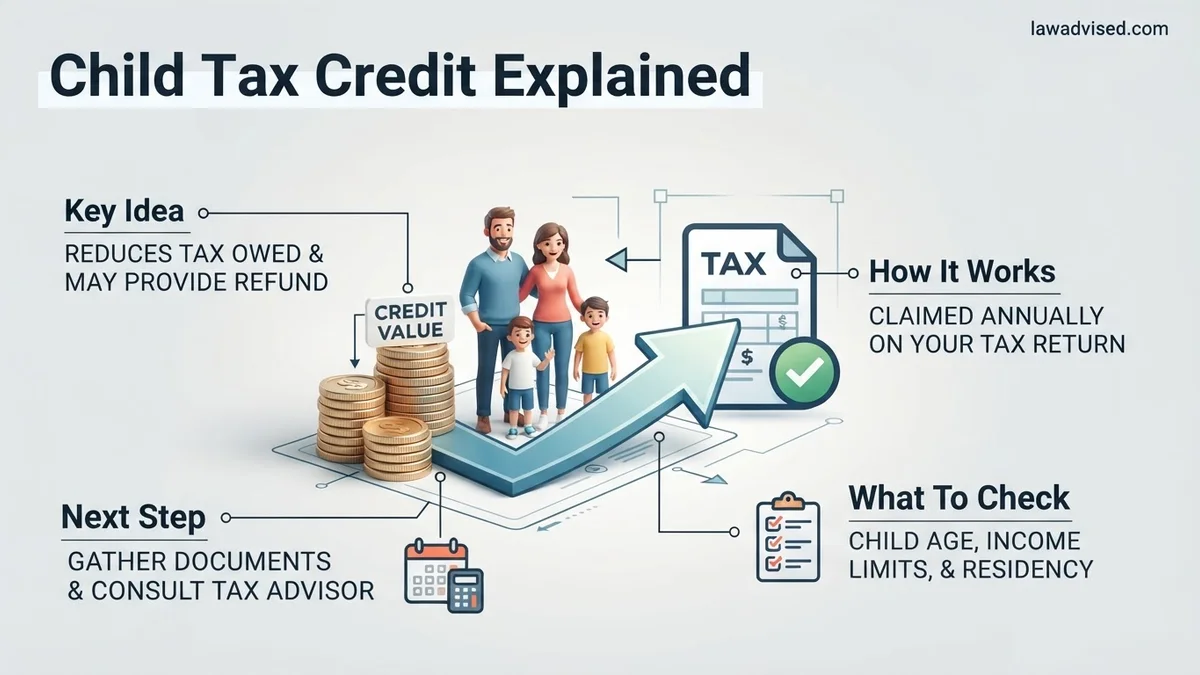
The Child Tax Credit (CTC) for the 2026 tax year provides up to $2,000 per qualifying child under the age of 17, with up to $1,700 of that amount potentially available as a refundable Additional Child Tax Credit. To qualify, your child must have a valid Social Security number and be claimed as a dependent on your federal income tax return.
Navigating the exact rules for income thresholds, phase-outs, and dependency tests can be tricky, but getting these details right ensures you do not leave hundreds or thousands of dollars on the table when filing your taxes. This guide breaks down everything you need to know to claim your maximum credit for 2026.
Key Takeaways
- Review current 2026 credit amounts and age limits before filing.
- Check modified adjusted gross income to determine phase-out thresholds.
- Ensure dependents meet relationship, residency, and citizenship criteria.
- Understand the refundable portion via the Additional Child Tax Credit.
- File Form 1040 along with Schedule 8812 to claim the funds.
What Causes Child Tax Credit Confusion and Eligibility Errors
Misunderstanding the Age and Relationship Rules
Many taxpayers lose out on the Child Tax Credit because they assume age or relationship rules are flexible. For the 2026 tax year, the qualifying child must be under the age of 17 at the end of the calendar year. If your child turns 17 on or before December 31, 2026, they do not qualify for the CTC, though they might qualify for the non-refundable $500 credit for other dependents.
Beyond age, the IRS strictly enforces relationship requirements. The child must be your son, daughter, stepchild, eligible foster child, brother, sister, stepbrother, stepsister, or a descendant of any of these individuals. Additionally, the child generally must not have provided more than half of their own financial support during 2026.
Residency and Identification Pitfalls
Another major source of confusion involves residency and paperwork. Your qualifying child must live with you for more than half of the 2026 tax year, with very few exceptions for temporary absences like school, medical treatment, or vacations. Furthermore, the IRS requires a valid Social Security Number (SSN) issued on or before the due date of your 2026 tax return (including extensions).
- Children with Individual Taxpayer Identification Numbers (ITINs) do not qualify for the CTC.
- If a child gets an SSN after the tax filing deadline, you generally cannot amend your return to claim the credit retroactively.
- Joint returns require both parents or guardians to meet identification standards as well.
How to Fix Income Phase-Out Calculations and Dependent Verification
Calculating the Modified Adjusted Gross Income Phase-Outs
The full Child Tax Credit is not available to high-income earners. For the 2026 tax year, the credit begins to phase out if your Modified Adjusted Gross Income (MAGI) exceeds specific thresholds. For married couples filing jointly, the phase-out threshold sits at $400,000. For all other filing statuses, the threshold is $200,000.
If your income exceeds these limits, the credit reduces by $50 for every $1,000 that your MAGI exceeds the threshold. To calculate your exact phase-out, subtract the threshold from your expected 2026 MAGI, divide that number by 1,000, multiply by 50, and subtract the result from your baseline credit amount.
Verifying Dependents and Avoiding IRS Delays
Incorrectly listing dependent information is the number one trigger for IRS processing delays and audits regarding the Child Tax Credit. Before you submit your 2026 tax return, double-check that every name and Social Security number matches the official Social Security Administration records exactly.
- Review your W-2s and 1099s to ensure your filing status aligns with your household situation.
- Confirm that no other taxpayer can claim your child as a dependent, which frequently happens in shared custody situations.
- Keep school records, medical bills, or childcare receipts on hand to prove residency if the IRS requests documentation.
Step-by-Step Guide to Claiming the Credit on Your Tax Return
Filing accurately ensures you receive your maximum Child Tax Credit without triggering automated IRS review flags. According to the IRS, electronic filing combined with direct deposit remains the fastest method for receipt.
Step 1: Gather Mandatory Documentation
Before initiating your return, compile your Social Security numbers or Individual Taxpayer Identification Numbers for all qualifying dependents. You must also retain Form 1095-A if you purchased marketplace health insurance, alongside all W-2s and 1099s that establish your modified adjusted gross income for the 2026 tax year.
Step 2: Complete Form 1040 and Schedule 8812
You must file IRS Form 1040 (U.S. Individual Income Tax Return) and attach Schedule 8812 (Credits for Qualifying Children and Other Dependents). Schedule 8812 calculates both the non-refundable portion of the credit and the refundable Additional Child Tax Credit. Certified Public Accountants emphasize double-checking the spelling of dependent names against Social Security Administration records to prevent immediate processing halts.
Step 3: Select Direct Deposit
Input your active checking or savings account routing and account numbers directly into tax preparation software or onto your paper return. Financial institutions and tax experts confirm that direct deposit eliminates mail delivery delays associated with paper checks.
What If Your Credit Is Rejected or Delayed by the IRS
Taxpayers frequently encounter processing delays or unexpected reductions regarding their Child Tax Credit. If the IRS modifies or rejects your claim, strict protocols help resolve the discrepancy efficiently.
Step 1: Review the IRS Notice
Examine the specific IRS notice or letter (such as CP75 or CP05) detailing the adjustment or audit request. The notice outlines the exact missing documentation, such as proof of residency or dependent support verification.
Step 2: Submit Requested Verification Promptly
Mail or electronically upload the requested records—like school transcripts, medical records, or lease agreements establishing residency—within the strict timeframe specified in the IRS notice, typically 30 days.
Step 3: Track Processing via IRS Tools
Monitor your status using the official “Where’s My Refund?” tool or your IRS Online Account portal for real-time updates regarding amended calculations or release dates.
What If It Still Doesn’t Work?
If direct IRS communication stalls or your complex return faces ongoing rejection, fallback solutions are necessary to secure your funds.
- Contact the Taxpayer Advocate Service (TAS): If you experience a systemic hardship or unreasonable IRS delay, reach out to TAS, an independent organization within the IRS that helps taxpayers resolve persistent problems.
- Engage a Certified Public Accountant (CPA) or Enrolled Agent (EA): For complex phase-out calculations or contested audits, hire a licensed credentialed tax professional. According to the National Society of Accountants, professional representation for IRS disputes typically costs between $200 and $500 per hour depending on complexity.
- File an Amended Return (Form 1040-X): If you discover a mathematical error or omitted child after submission, prepare and file an amended return once your original return has finished processing.
Conclusion
Navigating the Child Tax Credit for the 2026 tax year requires careful income tracking, accurate dependency verification, and timely filing via Schedule 8812. According to verified research and expert financial sources, utilizing IRS-approved electronic filing software significantly reduces mathematical errors and accelerates payout timelines. Your immediate next step is to log into your preferred tax preparation software or gather your documents to begin filing your Form 1040.
❓ Frequently Asked Questions
What documents do I need to claim the Child Tax Credit?
You will need your standard tax filing documents, Social Security numbers or ITINs for both you and your qualifying dependents, and records verifying dependent residency.
Can I claim the credit if my child turns 17 during the tax year?
No, the qualifying child must be under the age of 17 by the end of the tax year. However, older dependents may qualify for a separate non-refundable credit.
How does the income phase-out work?
For every $1,000 your modified adjusted gross income exceeds the threshold, your total credit amount is reduced by $50 until fully phased out.
What is the difference between the Child Tax Credit and the Additional Child Tax Credit?
The standard Child Tax Credit reduces your tax liability to zero, while the Additional Child Tax Credit allows you to receive a refund even if you owe no federal income tax.
Do I need a Social Security number for my child to qualify?
Yes, the qualifying child must have a valid Social Security number issued on or before the due date of the tax return, including extensions.
What happens if I make a mistake while claiming the credit on my return?
Making an error can delay your refund or trigger an IRS review. If you notice a mistake after filing, you may need to submit an amended tax return using Form 1040-X.

Ismail Hossain is the founder of Law Advised. He is an Divorce, Separation, marriage lawyer. Follow him.