Education Tax Credit Explained Step-by-Step Guide for 2026
Navigating college costs is stressful, but the American Opportunity Tax Credit (AOTC) and Lifetime Learning Credit (LLC) offer significant dollar-for-dollar tax reductions. This guide breaks down eligibility, income limits, and qualifying expenses so you can maximize your tax savings.
Education tax credits directly reduce your federal income tax dollar-for-dollar, making them one of the most powerful financial tools available for students and parents. For the 2026 tax year, the two primary options are the American Opportunity Tax Credit (AOTC) and the Lifetime Learning Credit (LLC), each designed for completely different stages of higher education.
Understanding which credit matches your specific situation prevents you from leaving thousands of dollars on the table. While both credits help offset tuition, fees, and required course materials, rules regarding income limits, years of study, and qualifying expenses dictate your choice.
Key Takeaways
- The AOTC provides up to $2,500 per eligible student for the first four years of higher education.
- The LLC offers up to $2,000 per tax return for undergraduate, graduate, and professional degree courses.
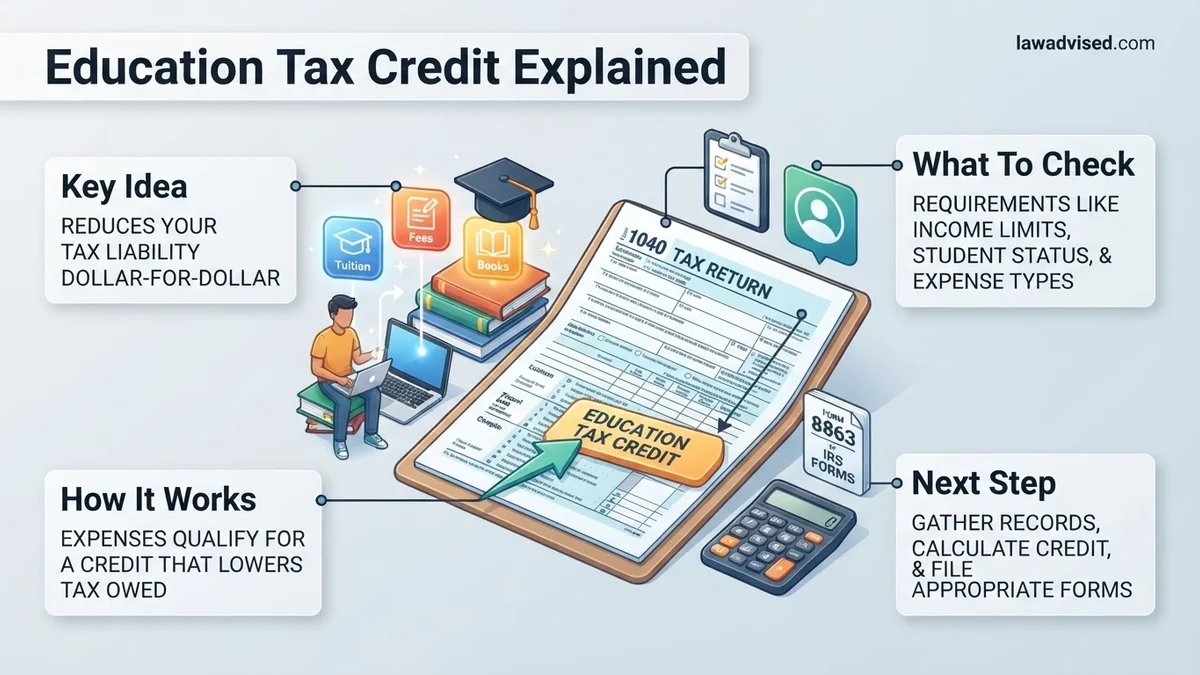
- Tax credits reduce your tax liability dollar-for-dollar, which is more valuable than a standard deduction.
- You must receive Form 1098-T from your eligible educational institution to properly claim either credit.
- Income phase-outs apply, meaning high earners may see their credit amounts reduced or eliminated entirely.
What Causes Confusion With Education Tax Credits
Taxpayers frequently struggle with education tax credits because the rules overlap, yet the qualifying criteria remain strict. Misidentifying your eligible expenses or student status often triggers an IRS audit or delays your refund.
The Fine Print on Eligible Expenses
Not every dollar spent on college qualifies for a tax credit. Knowing the difference between what the IRS allows and what it ignores protects your filing accuracy for 2026.
- Tuition and mandatory enrollment fees: Fully eligible for both the AOTC and LLC.
- Books and supplies: Covered under the AOTC even if you do not buy them directly from the school. The LLC only covers books if the school requires them as a condition of enrollment.
- Room and board, insurance, and transportation: Never eligible for either education tax credit, regardless of whether the university bills you for them.
Student Status and Degree Requirements
Another major point of confusion involves enrollment intensity. To qualify for these credits, the student must be enrolled at an eligible educational institution. However, the course load requirements differ significantly depending on the credit you pursue.
How to Choose Between the AOTC and LLC
Choosing the right credit depends entirely on your current educational path, how many years you have already completed, and your career goals for 2026. You can never claim both credits for the same student in the same tax year.
The American Opportunity Tax Credit (AOTC)
The AOTC is designed for students in their first four years of higher education who are pursuing a degree or recognized credential. It offers a maximum annual credit of $2,500 per eligible student.
- Maximum Value: 100 percent of the first $2,000 of qualifying expenses plus 25 percent of the next $2,000.
- Refundable Portion: Up to $1,000 of the credit is refundable, meaning the IRS can send you a check even if you owe zero tax.
- Limitations: You can only claim the AOTC for a maximum of four tax years per student. The student must also be enrolled at least half-time for at least one academic period beginning in 2026.
The Lifetime Learning Credit (LLC)
The LLC is much more flexible, making it ideal for graduate school, professional development, or part-time courses. There is no limit on the number of years you can claim the LLC.
- Maximum Value: 20 percent of the first $10,000 of qualifying expenses, up to a maximum of $2,000 per tax return per year.
- Course Requirements: Even taking a single class to acquire or improve job skills qualifies. You do not need to be pursuing a degree.
- Non-Refundable: The LLC can reduce your tax liability to zero, but any remaining credit amount cannot be paid out as a refund.
Step-by-Step Instructions to Claim Your Credits on Form 8863
Claiming your education tax credit requires precision and adherence to Internal Revenue Service regulations. According to tax software guidance and IRS instructions for 2026, you must complete specific forms to receive your refund or balance reduction.
Gathering Your Documentation
Before beginning the filing process, ensure you have all required records ready for entry. Missing documentation is the leading cause of processing delays.
- Locate your official Form 1098-T provided by your eligible educational institution, which details qualified tuition and related expenses paid.
- Review your personal financial records, including bank statements and receipt logs, to verify out-of-pocket payments made for required books, supplies, and equipment not listed on the 1098-T.
- Check your previous tax returns if you are carrying forward adjustments or verifying prior Lifetime Learning Credit limitations.
Completing IRS Form 8863
Once your documents are organized, you must accurately fill out Form 8863 to calculate your American Opportunity Tax Credit or Lifetime Learning Credit. Most modern tax preparation software automates this, but manual entry follows a strict sequence.
- Enter your personal information and student details in Part I of Form 8863, ensuring the student’s Taxpayer Identification Number matches official records.
- Complete Part III to calculate the American Opportunity Tax Credit, transferring the non-refundable portion to Schedule 3 (Form 1040) and the refundable portion to Form 1040.
- Complete Part II to calculate the Lifetime Learning Credit if you do not qualify for the AOTC or have expenses exceeding AOTC limits.
- Attach the completed Form 8863 to your Form 1040 or 1040-SR tax return before electronic submission or mailing.
What If Your Credit Is Rejected or You Missed Form 1098-T
Receiving a tax credit rejection notice or realizing you lack essential paperwork can delay your financial relief. Financial experts recommend taking swift, methodical action to rectify discrepancies before the filing deadline.
Troubleshooting Missing or Rejected Credits
- Contact your school’s bursar or financial aid office immediately to request a corrected or duplicate Form 1098-T if the IRS rejects your return due to missing issuer data.
- Verify your modified adjusted gross income against current IRS phase-out thresholds for 2026 to ensure you meet statutory eligibility limits.
- Amend your tax return using Form 1040-X if you discover you qualified for an education tax credit after you already submitted your initial 2026 return.
- Consult a certified public accountant or Enrolled Agent for complex multi-year corrections or audit notices, with professional tax advisory fees typically ranging from $200 to $600 depending on complexity.
Conclusion
Navigating education tax credits requires careful attention to income limits, eligible expenses, and precise IRS documentation. By utilizing Form 8863 correctly, students and parents can significantly reduce their overall tax liability for the 2026 tax year. According to verified research and expert tax sources, timely and accurate filing remains the most effective method to maximize these valuable financial benefits. Your next actionable step is to log into your student portal today, download your official Form 1098-T, and input your data into your chosen tax preparation software.
❓ Frequently Asked Questions
What expenses actually qualify for the American Opportunity Tax Credit?
Qualifying expenses for the AOTC include tuition, mandatory enrollment fees, and required course materials like books and supplies purchased for the academic period.
What are the income limits for claiming the Lifetime Learning Credit?
The LLC phases out for modified adjusted gross incomes (MAGI) above certain thresholds, which are adjusted annually by the IRS for inflation. Check current IRS guidelines for exact phase-out ranges.
Can a student claim the education credit if they receive a scholarship?
Yes, but you must subtract tax-free educational assistance, such as Pell Grants or tax-free scholarships, from your total qualified expenses before calculating the credit.
Is the American Opportunity Tax Credit refundable?
Yes, up to 40% of the AOTC (a maximum of $1,000) can be refunded to you even if you owe no federal income tax.
What happens if I did not receive Form 1098-T from my college?
Contact your school’s bursar or financial aid office immediately to request a copy, as the IRS requires the information on this form to process your credit.
Can graduate students qualify for the American Opportunity Tax Credit?
No, graduate students and students past their first four years of higher education only qualify for the Lifetime Learning Credit.

Ismail Hossain is the founder of Law Advised. He is an Divorce, Separation, marriage lawyer. Follow him.