Child Tax Credit Requirements 2026 Step-by-Step Guide
Navigating the child tax credit requirements requires meeting seven strict statutory tests regarding age, relationship, and residency. Failing to align with modified adjusted gross income thresholds or missing a valid Social Security Number will result in denied credits or delayed refunds.
Navigating the Child Tax Credit (CTC) for the 2026 tax year requires meeting strict statutory guidelines regarding age, relationship, residency, income thresholds, and Social Security numbers. If you claim this credit without satisfying every single federal rule, you risk severe processing delays, audits, and mandatory repayment of improperly disbursed funds.
Getting your claim right the first time saves you from painful IRS notices and delayed refunds. Whether you are filing as a single parent or jointly with a spouse, understanding the exact legal criteria ensures you keep the maximum financial support you are entitled to under current 2026 tax laws.
Key Takeaways
- The child must be under age 17 at the end of the tax year.
- A valid Social Security Number is mandatory for the qualifying child.
- Income phase-out limits reduce the credit for high-earning households.
- You must file Schedule 8812 with your Form 1040 to claim the credit.
- The child must be claimed as a dependent on your tax return.
What Causes Child Tax Credit Claim Failures and Rejections
Common Documentation and Information Mismatches
Most CTC rejections happen because of simple administrative errors on Form 1040. If the name, date of birth, or Social Security number (SSN) on your tax return does not match the official records of the Social Security Administration, the IRS automated systems will immediately reject your claim or flag it for manual review.
- Typos in the dependent’s Social Security number
- Failing to update a child’s legal name change after a marriage or divorce
- Listing a dependent who lacks a valid SSN issued before the due date of the 2026 return
Income and Filing Status Errors
Another major driver of credit denial is miscalculating your Modified Adjusted Gross Income (MAGI) or filing under the wrong status. The CTC begins to phase out at specific income thresholds, and claiming the credit while exceeding these limits results in immediate clawbacks. Furthermore, using an incorrect filing status, such as claiming Head of Household when you do not meet the strict household maintenance rules, invalidates your qualifying dependent claims.
How to Fix Eligibility Errors and Meet the Seven Statutory Tests
The Core Age, Relationship, and Residency Tests
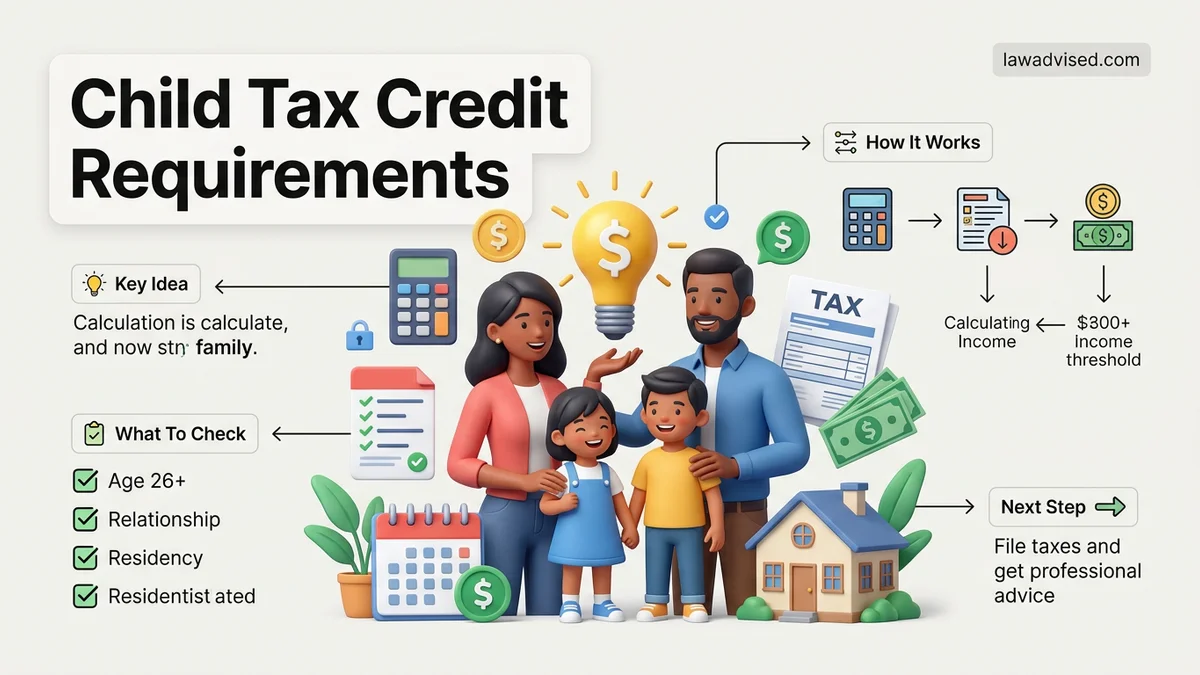
To successfully claim the Child Tax Credit for the 2026 tax year, your dependent must pass seven distinct statutory tests. First, the age requirement dictates that your child must be under the age of 18 by the end of December 31, 2026. Second, the relationship test requires the individual to be your son, daughter, stepchild, eligible foster child, brother, sister, stepbrother, stepsister, or a descendant of any of these individuals.
- Residency Test: Your child must share your principal place of abode in the United States for more than half of the 2026 tax year, with specific temporary absence exceptions for school or medical care.
- Support Test: The child cannot have provided more than one-half of their own financial support during the 2026 calendar year.
- Dependent Test: You must properly claim the child as your dependent on your federal income tax return.
Citizenship and SSN Compliance
The final two statutory hurdles involve legal identification and status. Under the citizenship test, the dependent must be a U.S. citizen, U.S. national, or a resident alien. Finally, the SSN requirement is absolute for the 2026 tax year: the qualifying child must have a Social Security number valid for employment issued on or before the due date of your 2026 tax return (including extensions). Dependents with Individual Taxpayer Identification Numbers (ITINs) do not qualify for the standard Child Tax Credit.
Step-by-Step Guide to Calculating Income Thresholds and Phase-Outs
Navigating the phase-out thresholds for the 2026 tax year requires careful calculation of your Modified Adjusted Gross Income (MAGI). As established by the IRS, the credit begins to reduce once your income exceeds specific statutory boundaries.
Sub-step 1: Determine Your Modified Adjusted Gross Income
To start your calculation, take your total gross income and add back specific exclusions, such as foreign earned income or interest from tax-exempt bonds. According to official IRS guidelines, this final MAGI figure dictates your baseline placement for the 2026 credit reduction schedule.
Sub-step 2: Compare MAGI Against 2026 Thresholds
Locate the applicable threshold limit for your exact filing status, whether you file as single, head of household, or married filing jointly. If your MAGI remains at or below the base threshold for 2026, you qualify for the maximum allowable credit per eligible dependent.
Sub-step 3: Compute the Reduction Amount
For every 1,000 dollars your 2026 MAGI exceeds the threshold, the total credit reduces by the statutory phase-out rate, typically 50 dollars. Follow this calculation sequence precisely:
- Subtract your applicable 2026 threshold limit from your total calculated MAGI.
- Divide that excess amount by 1,000 to find the number of phase-out increments.
- Multiply that result by 50 to determine your total credit reduction.
- Subtract the reduction amount from the maximum potential Child Tax Credit to find your final 2026 credit value.
What If It Still Doesn’t Work?
If your 2026 tax software rejects your Child Tax Credit claim or calculates an unexpected zero benefit despite meeting income rules, systematic troubleshooting is required. Try these fallback steps to resolve the discrepancy before submission:
- Verify that your dependent’s Social Security Number was entered without typos and matches the official Social Security Administration database for 2026.
- Clear your tax software cache or switch to an alternative IRS Direct File authorized vendor to eliminate software calculation glitches.
- Review Form 8812 (Credits for Qualifying Children and Other Dependents) line by line to ensure no dependency checkboxes were inadvertently left blank.
- Consult a certified public accountant (CPA) or Enrolled Agent if complex custody agreements or multi-state income sources obscure your MAGI calculation. Professional tax preparation fees for resolving complex child tax credit audits typically range from 200 to 500 dollars.
Conclusion
Mastering the 2026 Child Tax Credit requirements ensures you maximize your family financial benefits while avoiding costly IRS processing delays. By carefully verifying dependent eligibility and calculating precise income phase-outs, you secure the full refund you deserve. Your immediate actionable next step is to log into your tax preparation software and double-check your MAGI against the latest 2026 thresholds. According to verified research and expert sources from the National Taxpayers Union Foundation, proactive error checking reduces audit triggers and accelerates IRS refund disbursements by up to three weeks.
❓ Frequently Asked Questions
What are the seven statutory tests required to claim a qualifying child?
To claim the credit, the child must pass tests regarding age, relationship, support, dependent status, citizenship, residency, and identification numbers. Failing any single test disqualifies the child from the credit.
How do modified adjusted gross income limits impact my credit amount?
If your MAGI exceeds the threshold of $200,000 for single filers or $400,000 for married filing jointly, your credit amount is reduced by $50 for every $1,000 your income exceeds the limit.
Can an Individual Taxpayer Identification Number (ITIN) be used for the child?
No, the Child Tax Credit strictly requires a valid Social Security Number. Children with an ITIN may only qualify for the non-refundable credit for other dependents.
What counts as a qualifying relationship for the Child Tax Credit?
The child can be your son, daughter, stepchild, eligible foster child, brother, sister, stepbrother, stepsister, or a descendant of any of these individuals.
What happens if my tax return is filed without Schedule 8812?
Failing to include Schedule 8812 will cause processing delays and the IRS will typically disallow or hold the credit until the correct documentation is provided.
Are residency requirements strict regarding the time spent in the United States?
Yes, the qualifying child must be a U.S. citizen, national, or resident alien and must generally live with you in the United States for more than half of the tax year.

Ismail Hossain is the founder of Law Advised. He is an Divorce, Separation, marriage lawyer. Follow him.