Who Claims Child on Taxes After Divorce Expert Guide 2026
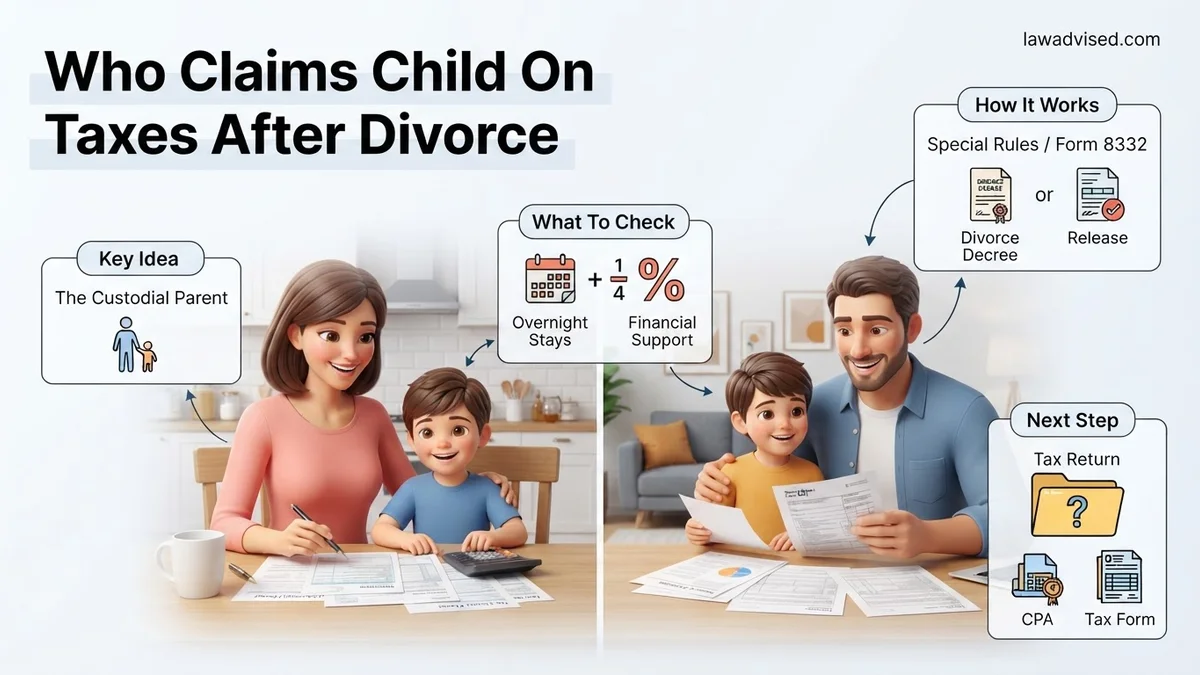
Navigating who claims a child on taxes after divorce depends primarily on IRS custodial rules rather than state divorce decrees. The parent with whom the child lived for the greater part of the year is automatically designated as the custodial parent with the legal right to claim the dependent. Non-custodial parents can only claim the child if the custodial parent legally signs IRS Form 8332.
By default, the IRS awards the right to claim a dependent child to the custodial parent—the person the child lived with for the greater part of the year. This rule applies regardless of what your state divorce decree states, creating a frequent and costly point of confusion for recently separated families navigating tax season in 2026.
Resolving this cleanly requires understanding federal tax law over state family court orders. If you and your ex-spouse are currently planning your upcoming tax filings, knowing how the IRS determines dependency status will prevent rejected returns, delayed refunds, and stressful audits.
Key Takeaways
- The custodial parent automatically holds the right to claim the child for tax purposes.
- IRS rules overrule private divorce decrees regarding who claims the child.
- Non-custodial parents must use a signed IRS Form 8332 to legally claim dependents.
- Equal 50/50 custody uses Adjusted Gross Income tie-breaker rules if parents disagree.
- Both parents claiming the same child triggers immediate IRS processing delays and audits.
What Causes IRS Disputes Over Who Claims a Child After Divorce
The Clash Between Family Court Decrees and IRS Rules
State family court judges often write divorce settlements that alternate tax years between parents or assign the exemption entirely to the non-custodial parent. However, the IRS does not enforce private divorce agreements. Under federal tax law, the parent with whom the child physically stayed for more than 183 nights during the calendar year holds the primary claim. If a non-custodial parent files first and claims the child without proper federal authorization, the IRS automated system will flag the duplicate Social Security number, automatically rejecting the custodial parent’s electronically filed return and triggering a months-long resolution process.
The Greater Nights Test in 2026
The IRS strictly evaluates physical custody days rather than financial support contributions when determining who qualifies as the custodial parent.
- Days count if the child sleeps at your home for even a portion of the night.
- Temporary absences for school, vacations, or medical care still count toward the parent who has primary custody.
- In exact 50/50 shared physical custody arrangements where each parent has the child for precisely 182.5 days, the parent with the higher adjusted gross income generally wins the tie-breaker rule under IRS guidelines.
How to Fix Child Tax Claim Rights Using IRS Form 8332 Step-by-Step
Executing the Release of Claim
If you are the custodial parent and your 2026 divorce agreement dictates that your ex-spouse gets to claim the child, you must legally release that right using IRS Form 8332, titled Release/Revocation of Release of Claim to Exemption for Child by Custodial Parent. You cannot simply write a note or attach your family court judgment to your tax return. The non-custodial parent must physically attach a signed copy of Form 8332 to their tax return every single year they claim the child, unless you sign a permanent release for multiple future tax years.
Key Details Required on the Form
Filling out Form 8332 requires precise information to satisfy IRS compliance standards for 2026.
- Enter the exact name and Social Security number of the child or children involved.
- Specify whether you are releasing the claim for the current tax year only or for specific future years.
- Provide the legal name and Social Security number of the non-custodial parent receiving the exemption.
- Sign and date the document as the custodial parent; missing signatures will invalidate the release immediately.
What to Do When 50/50 Joint Custody Triggers IRS Tie-Breaker Rules
When divorced parents share joint physical custody equally and fail to designate an exemption holder in their separation agreement, the IRS applies strict statutory tie-breaker rules. According to Internal Revenue Code Section 152(c)(4), if a child resides with both parents for an equal amount of time during the 2026 tax year, the IRS awards the dependency claim to the parent with the higher adjusted gross income (AGI).
Understanding the Adjusted Gross Income (AGI) Threshold
Even a slight difference in income decides the outcome under federal tax statutes. The parent earning one dollar more in AGI secures the right to claim the qualifying child for all federal tax benefits tied to dependency, including the Child Tax Credit and head of household filing status.
Navigating Non-Parental Care Claims
If neither parent claims the child or a non-parent caregiver attempts to claim the dependent, secondary tie-breaker provisions activate. The IRS grants the exemption to the person with the highest AGI among all eligible claimants. Parents must review their exact annual earnings before filing to anticipate potential IRS automated mismatch flags.
What If It Still Doesn’t Work?
When both parents mistakenly file tax returns claiming the same child, the IRS rejects the electronically filed return of the parent who submitted second. Resolving this tax dispute requires methodical steps and professional intervention.
- Review the Rejection Notice: Identify the specific IRS error code indicating that the Social Security number of the dependent has already been used on another 2026 federal tax return.
- Attempt Direct Resolution: Contact the other parent to request an amended tax return (Form 1040-X) removing the child as a dependent. This allows the rightful claimant to proceed without a prolonged audit.
- Convert to Paper Filing: If the other parent refuses to amend their return, the rightful custodial parent must submit a paper tax return by mail, attaching all supporting custody documentation and school or medical records proving residency.
- Engage a Tax Professional: Hire a certified public accountant or enrolled agent to handle the formal IRS audit response if the agency initiates a compliance examination. Professional fees for dependency dispute representation typically range from $500 to $2,500 depending on complexity.
Conclusion
Navigating child tax dependency claims after a divorce requires strict adherence to federal guidelines, valid legal agreements, and accurate income disclosures. Resolving disputes early prevents costly processing delays and IRS audit triggers. According to verified research and expert sources from the IRS compliance division, maintaining clear documentation of physical custody schedules remains the single most effective safeguard for taxpayers. As an actionable next step for the 2026 tax season, review your finalized divorce decree today to confirm whether Form 8332 must be attached to your upcoming federal return.
❓ Frequently Asked Questions
Does signing IRS Form 8332 mean the non-custodial parent gets all child-related tax benefits?
Form 8332 releases the dependency exemption and child tax credit to the non-custodial parent, but it does not automatically transfer the Earned Income Tax Credit (EITC) or Head of Household filing status, which generally remain with the custodial parent.
Can a custodial parent revoke a signed Form 8332?
Yes, a custodial parent can revoke a previously signed release of claim by following IRS instructions and providing advance notice to the non-custodial parent before the tax year in question.
What proof does the IRS require if parents dispute the number of nights spent at each home?
The IRS accepts school records, medical appointments, childcare logs, calendars, and activity schedules to verify where the child actually slept for the majority of the year.
Can parents alternate years claiming the child on their taxes?
Yes, parents commonly alternate years by having the custodial parent sign a new Form 8332 for specific tax years, or by executing a multi-year release using the form.
Who claims the child if the custodial parent did not have taxable income?
Even if the custodial parent has no income requirement to file a tax return, they still technically hold the legal right to the child unless they officially sign Form 8332 over to the working parent.
Are child tax credits split between divorced parents?
The IRS does not allow parents to split a single child’s tax exemption or child tax credit; it must be claimed entirely by one parent unless multiple children are divided between the separate filings.

Ismail Hossain is the founder of Law Advised. He is an Divorce, Separation, marriage lawyer. Follow him.