Dependent Child Tax Rules 2026 Expert Guide to IRS Rules
Navigating dependent child tax rules requires strict adherence to IRS dependency tests, including relationship, age, residency, and financial support. Meeting these criteria unlocks valuable tax benefits like the Child Tax Credit, directly lowering your taxable liability. Understanding these regulations prevents costly filing errors and ensures you claim every dollar you deserve.
Claiming a dependent child on your 2026 tax return requires meeting strict IRS tests including relationship, age, residency, support, and joint return rules. Getting these qualifications right unlocks major tax benefits like the Child Tax Credit and Head of Household filing status, while mistakes trigger immediate return rejections and audits.
Navigating the rules doesn’t have to be overwhelming. This guide breaks down exactly what the IRS looks for in 2026, why claims get rejected, and the exact steps you need to take to claim your child correctly and maximize your refund.
Key Takeaways
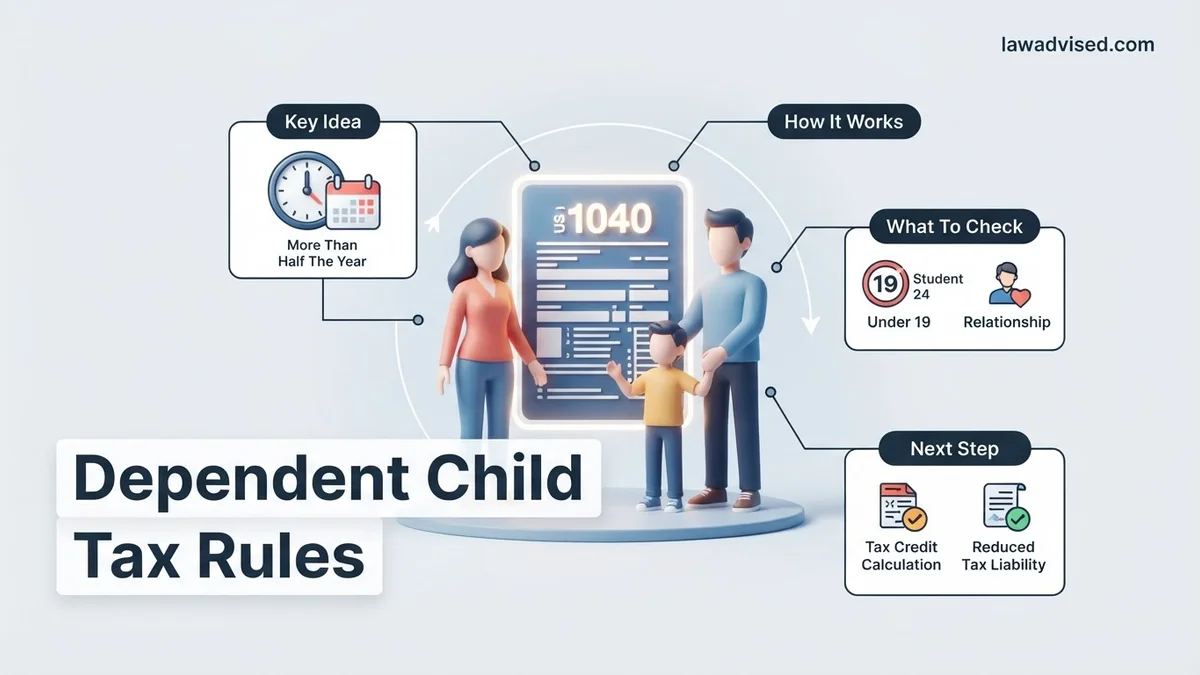
- A qualifying child must generally be under age 19 at the end of 2026.
- Students under age 24 qualify if they are enrolled full-time for at least five months.
- The child must live with you for more than half of the tax year.
- You must provide more than 50% of the child’s total financial support.
- A Social Security Number is mandatory to claim the Child Tax Credit.
What Causes IRS Dependent Disallowance and Rejection
The Support and Residency Trap
The number one reason the IRS disallows a dependent child claim is the residency and support test failure. For the 2026 tax year, your child must live with you for more than half of the year. Temporary absences for school, medical care, or vacations still count as time lived in your home, but extended stays with another relative can ruin your claim.
Furthermore, the child cannot have provided more than half of their own financial support during 2026. If your working teenager pays for most of their own car payments, insurance, and personal expenses, you might lose the ability to claim them.
Conflicting Claims and Custodial Rules
Another major trigger for IRS rejection happens when two taxpayers—usually separated or divorced parents—try to claim the same child. The IRS uses strict tie-breaker rules if parents do not file jointly:
- The parent with whom the child lived for the longer period during 2026 wins the claim.
- If the child lived with both parents for an equal amount of time, the parent with the higher Adjusted Gross Income (AGI) wins.
- Form 8332 must be properly executed and attached if the custodial parent is releasing the claim to the non-custodial parent.
How to Fix Your Filing Status and Claim Qualifying Children Step-by-Step
Verifying the Five Core Tests
Before you submit your 2026 tax return, run your child through the IRS five-part qualifying child test. Taking these steps systematically prevents costly processing delays:
- Relationship: The child must be your son, daughter, stepchild, foster child, brother, sister, half-brother, half-sister, stepbrother, stepsister, or a descendant of any of them.
- Age: The child must be under age 19 at the end of 2026, or under age 24 if a full-time student for at least five months of the year. Permanently and totally disabled children have no age limit.
- Residency: They must share your principal place of abode for more than half of 2026.
- Support: They must not have provided more than half of their own support for the calendar year.
- Joint Return: They cannot file a joint return for 2026, unless they are filing solely to claim a refund of withheld income tax.
Updating Your Filing Status Correctly
Once your dependent child passes the tests, check if you qualify for Head of Household status. This status offers a higher standard deduction and lower tax brackets than filing as Single. To qualify in 2026, you must pay more than half the cost of keeping up your home, and your qualifying child must live with you for more than half the year. Double-check your Social Security numbers and spelling against official cards to ensure the IRS processing system accepts your dependent on the first electronic submission.
What to Do If Your Dependent Claim Is Still Rejected by the IRS
Receiving an IRS rejection notice after filing your 2026 tax return can be stressful, but systematic resolution is possible. According to data from the National Taxpayer Advocate, processing paper returns or amended filings related to dependent disputes can take anywhere from 90 to 120 days. You must act quickly to protect your tax credits.
Step-by-Step Resolution Process
- Review the Rejection Code: Examine the specific reject code provided by your e-file software or the IRS notice (such as Reject Code IND-507-01, indicating a dependent’s Social Security Number was already claimed).
- Verify Support and Residency Records: Gather concrete documentation proving the child lived with you for more than half of 2026 and that you provided over 50 percent of their financial support.
- Coordinate with the Other Filer: If another individual legally or mistakenly claimed the child, communicate directly to resolve the duplicate filing before escalating to the IRS.
- File an Amended Return if Necessary: If you must remove or add a dependent, submit Form 1040-X once your original return has fully processed.
What If It Still Doesn’t Work?
If informal resolution fails and the IRS issues conflicting assessments or prolonged holds on your dependent-related refunds, specific escalation steps are required. According to IRS operational guidelines, taxpayers facing persistent duplicate claim freezes should take the following actions:
- Respond to IRS Letter 12C or CP75: Submit requested school records, medical bills, or lease agreements within the strict 30-day window provided in the notice.
- Request an IRS Account Transcript: Pull your official 2026 transcript via the IRS online portal to track the exact status of your audit or examination status.
- Engage a Qualified Tax Professional: Hire an Enrolled Agent (EA) or Certified Public Accountant (CPA) specializing in IRS dispute resolution. Professional representation typically costs between $300 and $1,000 depending on the complexity of the audit.
- Contact the Taxpayer Advocate Service (TAS): If you experience severe financial hardship due to a delayed dependent refund, apply for assistance through TAS using Form 911.
Conclusion
Navigating dependent child tax rules in 2026 requires strict adherence to IRS residency, support, and relationship guidelines to prevent costly processing delays and rejections. Resolving discrepancies swiftly through documentation or professional intervention protects your eligible child tax credits. According to verified research and expert sources from the IRS and national tax authorities, proactive record-keeping remains the single most effective defense against audit flags. Your immediate next step is to log into your secure IRS online account to verify that your 2026 dependent data matches official Social Security Administration records before filing.
❓ Frequently Asked Questions
What specific IRS tests must a child pass to be claimed as a dependent?
To claim a child, they must meet the relationship, age, residency, support, and joint return tests. Failing any single one of these criteria means the child cannot be claimed as a qualifying child on your return.
How does the residency test work if my child is away at college?
Temporary absences for special circumstances, such as attending college, are counted as time lived with you. As long as the college student maintains a permanent home with you, the residency test is usually satisfied.
What counts as financial support when calculating the 50% rule?
Financial support includes food, lodging, clothing, education, medical care, recreation, and transportation. You must prove that you paid for more than half of these total expenses for the calendar year.
Can I claim a child who has a taxpayer identification number instead of a Social Security Number?
To claim the lucrative Child Tax Credit, the child must have a valid Social Security Number issued on or before the due date of the return. An ITIN will not qualify you for the main Child Tax Credit.
What should I do if my former spouse and I both claim the same dependent child?
The IRS applies tie-breaker rules when two taxpayers claim the same child. Generally, the parent with whom the child lived the longest during the year wins the claim, followed by the parent with the highest adjusted gross income.
How do changing custody arrangements impact who gets the Child Tax Credit?
The custodial parent normally claims the Child Tax Credit, but the noncustodial parent can claim it if the custodial parent signs Form 8332 releasing the claim. However, the noncustodial parent still cannot claim head of household status or the Earned Income Tax Credit based on that child.

Ismail Hossain is the founder of Law Advised. He is an Divorce, Separation, marriage lawyer. Follow him.