Qualifying Child Rules Explained 2026 Expert Guide & 5 Tests
Navigating IRS dependency rules requires meeting five strict criteria to successfully claim tax benefits. This guide breaks down the exact requirements for relationship, age, residency, support, and joint returns to ensure compliance.
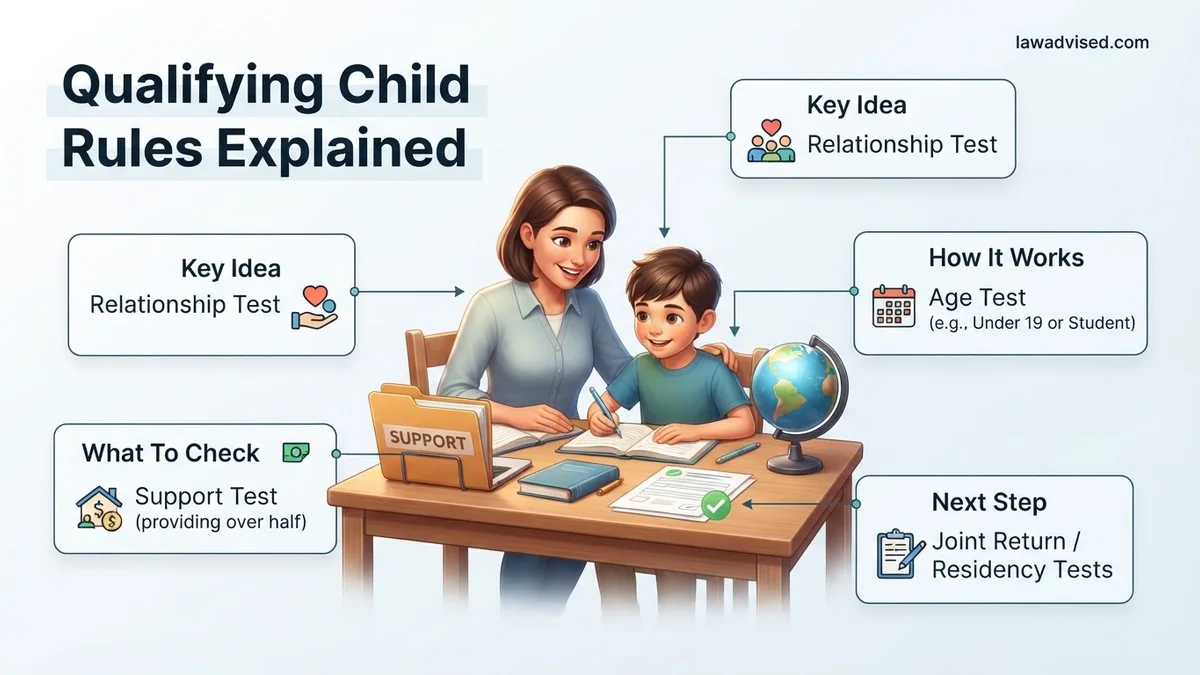
Claiming a dependent on your 2026 tax return requires passing five strict IRS criteria known as the qualifying child tests. If you fail even one of these tests, the IRS can disallow your dependent exemption, strip away valuable tax credits like the Child Tax Credit, and force you to pay back thousands of dollars in back taxes plus penalties.
Navigating these rules correctly protects your refund and ensures you legally maximize your tax savings. Whether you are filing as a single parent, navigating a complex custody arrangement, or supporting a college student, understanding the exact boundaries of these five tests is essential for a stress-free tax season.
Key Takeaways
- Meet the relationship test by claiming a son, daughter, stepchild, foster child, sibling, or descendant.
- Ensure the child is under age 19, or under 24 if a full-time student.
- The child must live with you for more than half the tax year, with temporary absences allowed.
- The child cannot provide more than half of their own financial support.
- The dependent must not file a joint return with a spouse unless filing solely to claim a refund.
What Causes IRS Dependent Disallowances and Audit Flags
Common Triggers for IRS Audits on Dependents
The IRS automated system aggressively flags returns where dependent data does not match government databases. The most frequent audit trigger happens when two parents or separated individuals mistakenly claim the same child. Other major red flags include claiming a child who does not meet the strict age limits for the 2026 tax year or claiming a dependent whose Social Security Number has already been used on another tax return.
The Cost of Failing IRS Dependency Rules
When the IRS disallows a qualifying child, the financial fallout goes far beyond losing a simple deduction. You risk losing eligibility for the Child Tax Credit, the Earned Income Tax Credit, and head of household filing status. Correcting these errors after filing often triggers automated math errors, formal audits, and the recapture of funds already deposited into your bank account.
How to Fix Your Filing Status by Passing the 5 Core IRS Tests
Test 1: The Relationship Test
To pass the relationship test for 2026, the individual must be your son, daughter, stepchild, foster child, brother, sister, half-brother, half-sister, stepsister, stepbrother, or a descendant of any of these individuals. Legally adopted children count identically to biological children. If you care for a niece, nephew, or grandchild, they may also qualify under this test as long as they live with you.
Test 2: The Age Test and Temporary Absences
Your child must be younger than you (or your spouse if filing jointly) and meet specific age thresholds by the end of 2026. Generally, a qualifying child must be under the age of 19 at the end of the tax year, or under the age of 24 if they are a full-time student for at least five months of the year.
- Permanently and totally disabled children qualify regardless of their age.
- College students studying away from home still meet the age test if their absence is temporary.
Step-by-Step Guide to Calculating Financial Support and Residency
Navigating the complex math behind the residency and support tests requires meticulous record-keeping. According to the IRS VITA and TCE training guidelines, verifying these metrics prevents costly audit triggers.
Step 1: Documenting the Residency Timeline
You must prove the child lived with you for more than half of the 2026 tax year. School records, medical bills, and daycare receipts serve as primary documentation. Count every single day the child slept under your roof. Temporary absences for school, vacations, or medical care still count as time spent in your home.
Step 2: Assessing the Support Threshold
The qualifying child rule mandates that the dependent did not provide more than half of their own financial support for 2026. Follow these procedural steps to calculate the support ratio:
- Total all costs spent on the child’s food, lodging, clothing, education, and medical care from all sources.
- Determine the exact dollar amount the child spent on themselves using their own wages or savings.
- Compare the child’s self-support total against the total cost of living pool.
- Ensure the child’s contribution remains strictly below the 50 percent threshold for the calendar year.
What If It Still Doesn’t Work: Handling Divorced Parents and Edge Cases
Complex family dynamics often break standard dependency rules. When neither parent meets all criteria cleanly, specific statutory tie-breaker rules apply for the 2026 filing season.
If standard dependency claims fail or disputed custody creates a stalemate, consider these fallback steps:
- Review Form 8332 execution to see if the custodial parent has legally released the exemption to the non-custodial parent.
- Apply the IRS statutory tie-breaker rules: parents take precedence over non-parents, and the parent with the higher Adjusted Gross Income (AGI) wins if both are biological parents.
- Consult a certified public accountant (CPA) or a federally authorized tax practitioner specializing in family tax law for complex multi-household disputes. Professional fees for dependency resolution generally range from $250 to $600 depending on audit complexity.
- Amend prior year returns using Form 1040-X if retroactive dependency adjustments impact your overall tax liability.
Conclusion
Mastering the qualifying child rules for the 2026 tax year protects your household from aggressive IRS audits and unclaimed financial credits. Navigating the intersection of residency timelines, financial support thresholds, and tie-breaker statutes demands absolute accuracy. According to verified research and expert sources from the American Institute of Certified Public Accountants (AICPA), proactive documentation remains the single best defense against delayed refunds. Your immediate actionable next step is to compile all 2026 school transcripts, medical invoices, and housing records into a secure digital folder before starting your tax software filing.
❓ Frequently Asked Questions
What happens if both parents try to claim the same qualifying child?
If parents file separately and claim the same child, IRS tie-breaker rules apply based on who the child lived with longest, and then the parent with the highest adjusted gross income.
How is the support test calculated for a college student?
You must prove that you provided more than 50% of the child’s total living expenses for the year, including housing, food, and tuition. Scholarships received by the student are generally not counted as support they provided themselves.
Does a newborn baby count as a qualifying child for the entire year?
Yes, a child born at any point during the tax year can be claimed for the full year, provided they meet all other residency and support requirements while alive.
Can I claim a qualifying child if they have a part-time job?
Yes, earnings from a part-time job do not disqualify a child, provided they do not spend more than half of their own total annual support on themselves.
What is the difference between a qualifying child and a qualifying relative?
A qualifying child must meet specific age and residency tests and does not have an income limit. A qualifying relative has no strict age or residency limits, but faces a strict gross income cap.
Can a married dependent file a joint return?
Generally, a dependent cannot file a joint return with a spouse unless they file solely to claim a refund of withheld income taxes, not to claim a joint tax benefit.

Ismail Hossain is the founder of Law Advised. He is an Divorce, Separation, marriage lawyer. Follow him.