Tax Rules for Shared Custody 2026 Expert Step-by-Step Guide
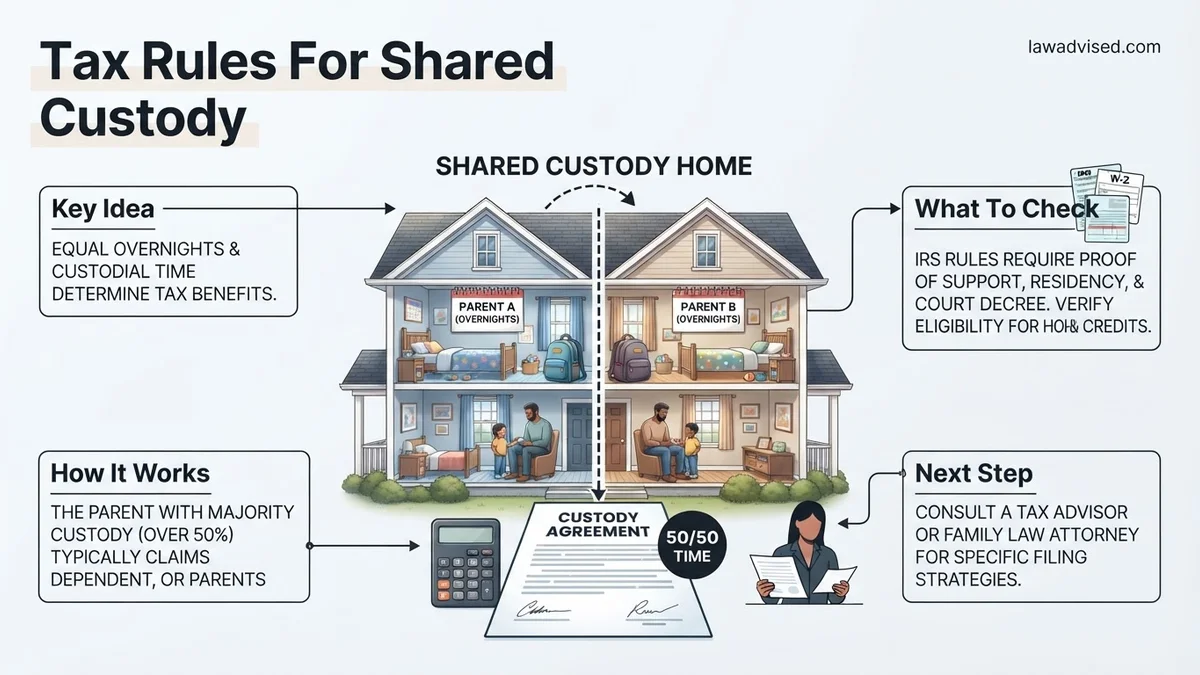
Navigating tax rules for shared custody can be challenging, but the IRS determines benefits based on which parent has the child for the greater number of nights. Custodial parents automatically hold the primary right to claim dependents and related tax credits, though parents can legally agree to alternate these benefits. Understanding these federal guidelines prevents costly filing errors and audit flags.
When you share custody of your children, only one parent can claim the child as a dependent for the 2026 tax year. The Internal Revenue Service resolves this by default through a strict “night-count” rule, granting the primary tax benefits to the parent with whom the child spent the greater number of nights.
Navigating these rules correctly prevents IRS audits, rejected electronic returns, and lost financial relief. Understanding how the federal tax code evaluates your 2026 custody schedule ensures you maximize your eligible credits without stepping on your co-parent’s toes.
Key Takeaways
- The custodial parent is strictly defined as the parent with whom the child spent more nights.
- Only the custodial parent can legally claim Head of Household filing status.
- IRS Form 8332 allows custodial parents to release their right to claim the Child Tax Credit.
- Parents cannot both claim the same child for the exact same tax benefits in one year.
- Exact 50/50 split schedules rely on Adjusted Gross Income tie-breaker rules if parents disagree.
What Causes Tax Disputes in Shared Custody
The 50/50 Schedule Dilemma and Leap Year Math
Equal parenting time creates immediate friction during tax season. When a court orders an exact 50/50 split, the IRS does not care about your balanced calendar. Because 2026 is not a leap year, it contains 365 days. One parent will mathematically have the child for 183 nights, while the other gets 182.
- The parent with 183 nights is legally the custodial parent for tax purposes.
- That parent automatically holds the default right to claim the child.
- The 182-night parent gets zero dependency-related benefits by default, despite equal caregiving.
Conflicting E-Filing Rejections
Disputes frequently erupt when both parents attempt to claim the child on their respective 2026 returns. Because the IRS electronic filing system only allows a Social Security Number to be claimed once, the second parent to file will have their return rejected automatically.
- The rejecting parent must then file a paper return to dispute the claim.
- This triggers an IRS audit process called a tie-breaker rule review.
- Processing delays can hold up your tax refunds for six to nine months while the agency investigates.
How to Fix Child Tax Benefit Allocations Using Form 8332
Releasing the Claim as the Custodial Parent
You can legally bypass the default night-count rule if you are the custodial parent and want to let your co-parent take the dependency exemption. The IRS requires a very specific document to make this arrangement official without amending your court-ordered custody agreement.
- The custodial parent must sign IRS Form 8332 (Release/Revocation of Release of Claim to Exemption for Child by Custodial Parent).
- The non-custodial parent must attach this signed form to their 2026 tax return.
- This form can release the claim for a single tax year, multiple specific years, or all future years.
Splitting Child Tax Credits versus Head of Household Status
Cooperating parents often misunderstand what Form 8332 actually transfers. Signing this document is an all-or-nothing proposition for certain credits, but leaves other valuable tax statuses strictly tied to physical custody.
- Form 8332 allows the non-custodial parent to claim the Child Tax Credit and the Additional Child Tax Credit.
- The form never transfers the Head of Household filing status or the Earned Income Tax Credit.
- The custodial parent always retains Head of Household eligibility as long as the child lived with them for over half the year and they paid more than half of household upkeep costs.
Step-by-Step Guide to Claiming Head of Household and Credits
Filing taxes under a shared custody arrangement in 2026 requires precise adherence to IRS rules. To successfully claim the Head of Household filing status and associated tax benefits, follow this procedural sequence.
Filing Your 2026 Return
- Verify that your child lived with you for more than 50% of the 2026 tax year. This physical presence test is absolute for the Head of Household status.
- Calculate your household maintenance costs. According to IRS guidelines, you must pay more than half of the total cost of keeping up your home for the year, including rent, mortgage interest, utilities, and grocery expenses.
- Ensure the custodial parent executes IRS Form 8332 if you intend to claim the Child Tax Credit as the non-custodial parent. Attach this signed form to your annual tax return.
- Input your qualifying dependent details into your tax software or provide documentation directly to your certified public accountant. Cross-reference Social Security numbers to prevent processing rejections.
What If Shared Custody Schedule Tie-Breakers Apply
When parents have exact 50-50 custody splits and cannot agree on who claims the child, IRS tie-breaker rules automatically override private parenting agreements. Understanding these statutory protocols prevents costly duplicate filings.
Resolving Custody Claims
- Determine the adjusted gross income (AGI) of both parents. The IRS tie-breaker rule dictates that the parent with the higher AGI has the primary right to claim the child for tax purposes.
- Review the specific AGI thresholds outlined in current tax code updates to ensure accurate calculation of your taxable income relative to the co-parent.
- Consult with a certified family law attorney or a certified public accountant if the higher-income parent wishes to waive their claim in writing via Form 8332 for the lower-income parent.
What If It Still Doesn’t Work?
If automated filing rejections occur or the co-parent violates a court-ordered tax agreement, immediate escalation is necessary. Try these fallback steps to resolve the dispute:
- File your return using paper forms by mail. The IRS electronic filing system automatically rejects duplicate Social Security numbers, but paper filing triggers a formal IRS audit review process.
- Gather all supporting documentation, including school records, medical logs, and custody calendars, to prove physical custody timelines for the 2026 tax year.
- File a motion for contempt in family court if the co-parent violated a binding divorce decree regarding tax benefit allocations.
- Retain a specialized tax professional or a certified tax resolution specialist. Professional advisory fees typically range from $250 to $600 per hour depending on the complexity of the audit representation.
Conclusion
Navigating shared custody tax rules in 2026 requires strict adherence to physical custody percentages, precise AGI calculations, and proper execution of IRS Form 8332. Failure to follow these federal guidelines can result in delayed refunds and costly IRS audits. According to verified research and tax enforcement data from authoritative financial sources, proactive communication and legally binding agreements remain the most effective defense against duplicate claims. Your actionable next step is to review your 2026 custody calendar today and confirm Form 8332 execution with your co-parent before filing.
❓ Frequently Asked Questions
How does the IRS determine who the custodial parent is during a tax year?
The IRS counts the actual number of nights the child slept at each parent’s home throughout the calendar year. The parent with the higher night count is designated the custodial parent, regardless of what a legal custody agreement states.
Can a non-custodial parent claim the Child Tax Credit without Form 8332?
No, the non-custodial parent must attach a signed copy of IRS Form 8332 to their tax return to legally claim the Child Tax Credit or Additional Child Tax Credit.
Does a signed Form 8332 give the non-custodial parent the right to Head of Household status?
No, Form 8332 only transfers the dependency exemption and Child Tax Credit. It does not transfer Head of Household filing status, the Earned Income Tax Credit, or child care credits.
What happens if both parents claim the same child on their tax returns?
The IRS automated system will flag the duplicate Social Security Number, leading to processing delays and potential audits. The IRS will require documentation to prove which parent is legally entitled to the claim based on the night-count rule.
Can parents alternate claiming the child every other year?
Yes, parents commonly alternate claiming the child. To do this legally, the custodial parent can either sign a single-year release on Form 8332 or execute a permanent release that specifies multiple tax years.
How does shared custody impact the Earned Income Tax Credit (EITC)?
The EITC can only be claimed by the custodial parent who meets the residency test for more than half the year. This specific tax credit cannot be transferred to a non-custodial parent via Form 8332.

Ismail Hossain is the founder of Law Advised. He is an Divorce, Separation, marriage lawyer. Follow him.