Dependent Filing Requirements for 2026 Expert Guide
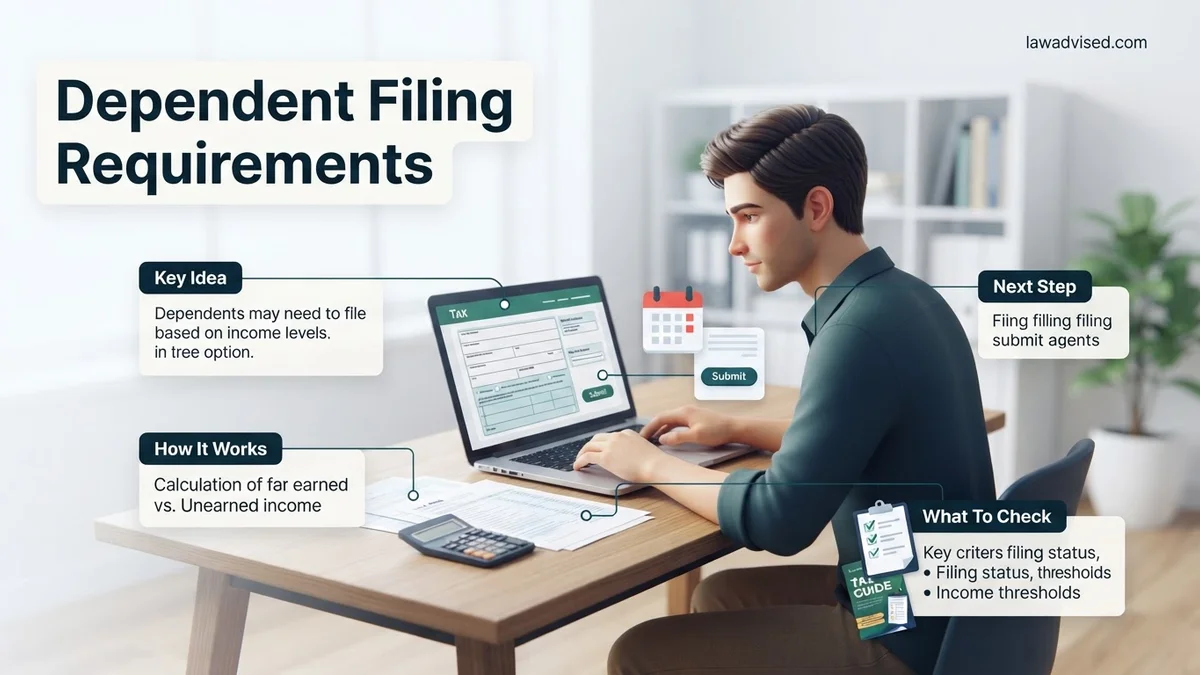
Determining dependent filing requirements depends heavily on whether the dependent earns income from a job or unearned income from investments. Even if a dependent is claimed on your tax return, they may still need to file their own return if their gross income crosses specific IRS thresholds.
Whether your dependent needs to file a 2026 tax return depends entirely on their age, filing status, and whether their income comes from a job or from investments. If your dependent earned income from a W-2 job, they generally do not need to file unless their total earnings exceed the standard deduction amount for that tax year. However, if they have unearned income like interest, dividends, or capital gains from custodial accounts, the rules change drastically and trigger much lower thresholds.
Navigating these IRS guidelines prevents unnecessary paperwork while keeping your dependent compliant with federal laws. Knowing these exact thresholds also helps you determine if your teen or college student is leaving a refund on the table by failing to file when federal income tax was mistakenly withheld from their paycheck.
Key Takeaways
- Dependents with only earned income must file if it exceeds the standard deduction.
- Unearned income limits are much lower, triggering filing requirements sooner.
- Always file a return to claim a refund of withheld income taxes.
- Check both federal and state income tax thresholds for accuracy.
- Keep accurate records of W-2s and 1099s to calculate gross income.
What Causes Dependent Tax Filing Obligations Under IRS Rules
Earned Income Triggers for W-2 Workers
For the 2026 tax year, a dependent with only earned income—such as wages, tips, or salaries from a part-time job—must file a federal income tax return if their total earned income exceeds the standard deduction for dependents. While final inflation adjustments for 2026 continue to track closely with recent trends, the dependent standard deduction generally equals their earned income plus a small statutory buffer (typically around $450 to $500), up to the maximum standard deduction for single filers.
- If your dependent only works a summer job and earns less than the standard deduction limit, they face no filing requirement.
- Surpassing that specific threshold means they must file, even if they owe zero actual tax liability.
Unearned Income Triggers from Investments
Unearned income subjects dependents to much stricter reporting requirements under IRS rules. If your child has investment income from trust funds, stocks, or bank interest, the threshold drops significantly. A dependent must file a 2026 return if their unearned income exceeds the minimum unearned income threshold (historically starting around $1,300), or if their total income exceeds the standard deduction. Furthermore, if their unearned income crosses higher thresholds, you might need to report it on your own return using Form 8814 or file a separate Form 8615 for the dependent.
How to Calculate Earned Versus Unearned Income Thresholds for 2026
Step-by-Step Income Categorization
Calculating your dependent’s filing requirement starts by separating their money into two distinct categories: earned income and unearned income. Mixing these amounts together will lead to calculation errors because the IRS applies entirely different formulas to each type of revenue. Grab their W-2 forms, 1099-INT statements, and brokerage reports to tally the exact gross amounts received throughout the 2026 calendar year.
- Earned Income: Money received for services performed, including W-2 wages, tips, and taxable scholarship grants reported on a W-2.
- Unearned Income: Money generated from assets, including taxable interest, ordinary dividends, capital gain distributions, and unemployment compensation.
Applying the Combined Income Formula
When a dependent has both earned and unearned income in 2026, the calculation becomes slightly more complex. You must add their earned income to $450 (or the exact indexed statutory amount for 2026), and then compare that total to the standard deduction. Alternatively, you can simply add their earned and unearned income together and compare the gross total to the standard deduction for single filers.
If your dependent earned $5,000 from a grocery store job and generated $800 in stock dividends, their total gross income of $5,800 falls well below the single filing threshold. Conversely, if that same dependent earned $2,000 from work but pulled in $3,500 from a trust fund, their unearned income pushes past the strict investment thresholds, triggering an absolute requirement to file a 2026 federal tax return.
Step-by-Step Guide to Determine If Your Dependent Must File
Navigating the IRS rules for 2026 can feel overwhelming. Following a structured approach ensures total tax compliance. According to guidelines from the IRS and certified tax professionals, you should execute a systematic evaluation of your dependent’s finances.
Step 1: Calculate Earned and Unearned Income Separately
You must total all revenue streams accurately before applying thresholds. Group wages from W-2 jobs into earned income. Group dividends, interest, and capital gains into unearned income.
Step 2: Compare Against the 2026 Thresholds
Review the exact numbers calculated in the previous step against official IRS thresholds for the 2026 tax year. Remember that unearned income thresholds start much lower, often around the $1,300 mark adjusted for inflation. Earned income thresholds generally match the full standard deduction of $15,000.
Step 3: Check for Self-Employment Net Earnings
Determine if the dependent earned more than $400 from independent contracting, gig work, or freelance jobs. Even if their total income is well below the standard deduction, net self-employment earnings above $400 trigger a mandatory filing requirement for Schedule SE.
What If Your Dependent Had Taxes Withheld But Falls Below the Income Limit
Many dependents take on part-time summer jobs and see federal or state income taxes withheld from their paychecks. Even if your dependent falls well below the 2026 filing thresholds, filing a federal tax return remains necessary to claim that money back.
Reclaiming Money Through a Return
The government does not automatically refund withheld income tax. According to the IRS, a taxpayer must file a return to claim a refund of any withheld federal income tax. Leaving these funds unclaimed is essentially donating money to the Treasury.
Distinguishing Income Tax from FICA Taxes
Note that federal income tax withholding (Box 2 on Form W-2) can be refunded via a tax return. However, standard FICA withholdings for Social Security and Medicare cannot typically be recovered this way unless an employer made a direct payroll error.
What If It Still Doesn’t Work?
If complex investment distributions, multi-state earnings, or conflicting tax software outputs prevent you from determining dependent filing requirements for 2026, take immediate corrective action. Follow these troubleshooting steps to resolve the ambiguity:
- Run the official IRS Interactive Tax Assistant tool on the official government website to simulate filing scenarios based on real-time 2026 parameters.
- Review past tax return transcripts from the IRS portal to see how similar situations were handled in prior filing cycles.
- Consult a Certified Public Accountant (CPA) or Enrolled Agent (EA) to review complex trust distributions or unearned income thresholds. Professional tax advisory fees for a dependent return typically range from $150 to $350 depending on geographic location and form complexity.
- Utilize IRS Volunteer Income Tax Assistance (VITA) programs if your household income falls below the program limits, offering free expert preparation for qualifying families.
Conclusion
Determining dependent filing requirements for 2026 protects your family from unexpected IRS penalties and ensures your teen or college student reclaims every dollar of withheld income tax. By carefully separating earned and unearned income against updated inflation benchmarks, you can easily establish whether a return is legally required. According to verified research and expert tax advisory sources, taking a proactive stance on dependent compliance prevents costly filing errors down the road. Your actionable next step today is to gather all of your dependent’s W-2 and 1099 forms to calculate their exact gross income for the 2026 tax year.
❓ Frequently Asked Questions
What are the exact income thresholds for a dependent with earned income?
For tax year 2026, a dependent with earned income generally must file a return if their earned income is greater than the standard deduction amount set by the IRS for dependents.
How do unearned income rules differ for tax dependents?
Unearned income thresholds are significantly lower than earned income limits. If a dependent has unearned income above the minimum IRS threshold, they are required to file a return.
What happens if a dependent fails to file a required tax return?
Failing to file a required tax return can result in failure-to-file penalties, interest charges from the IRS, and potential notices regarding unreported income.
Do self-employed dependents have different filing requirements?
Yes, dependents with net earnings from self-employment of $400 or more must file a tax return to pay self-employment tax, even if their total income is below the standard deduction.
Does a dependent’s investment income trigger the Kiddie Tax?
If a dependent has substantial unearned income, it may be subject to the Kiddie Tax, which taxes certain unearned income at the parents’ tax rate.
Should a dependent file electronically or on paper?
Filing electronically using tax software is the fastest and most secure way for a dependent to submit their return and receive any owed refunds.

Ismail Hossain is the founder of Law Advised. He is an Divorce, Separation, marriage lawyer. Follow him.