Single vs Head of Household Taxes Best Step-by-Step 2026
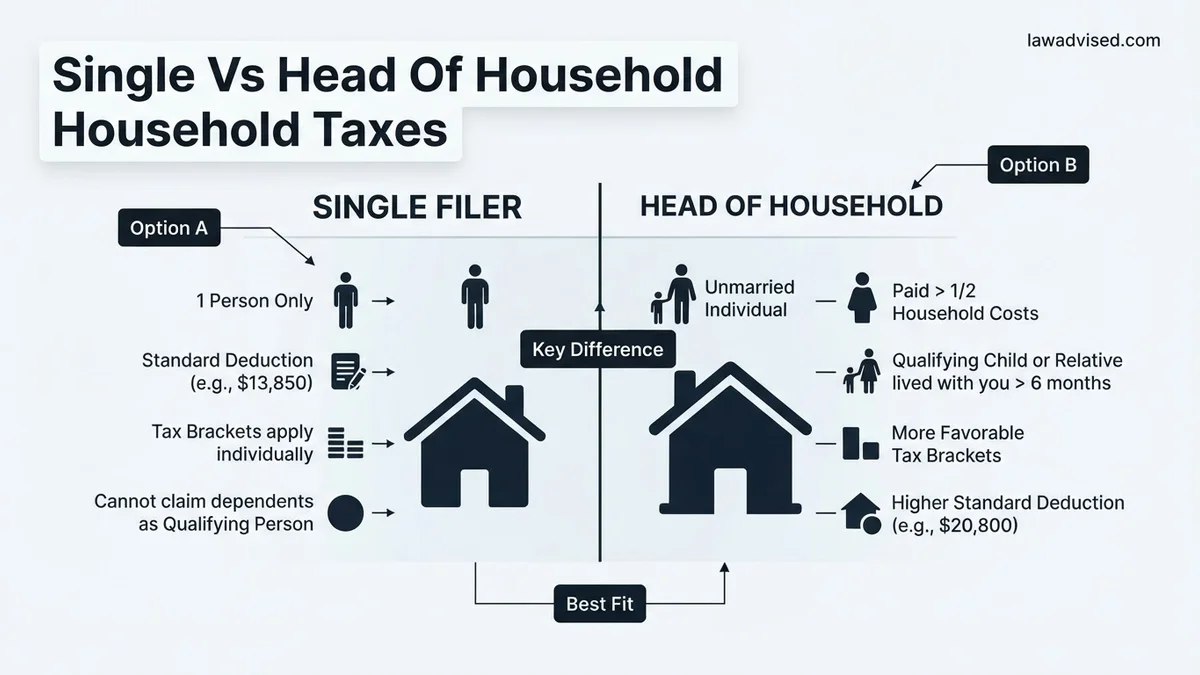
Filing as Head of Household instead of Single offers a significantly higher standard deduction and wider tax brackets, saving qualified taxpayers thousands. To qualify, you must be unmarried, pay more than half the cost of keeping up a home, and house a qualifying dependent. Missing these strict IRS criteria can result in costly filing errors and audits.
Filing as Head of Household instead of Single is one of the easiest ways to secure a significantly larger standard deduction and lower tax brackets, provided you meet strict IRS guidelines. If you are unmarried and pay more than half the cost of maintaining a home for a qualifying dependent, filing as Head of Household can save you thousands of dollars compared to the Single filing status for the 2026 tax year.
Choosing the correct filing status directly impacts your bottom line, changing both your taxable income baseline and your tax rates. Making a mistake here can trigger IRS audits or costly amended returns, making it essential to verify your eligibility before submitting your 2026 tax forms.
Key Takeaways
- Head of household offers a substantially higher standard deduction than single filing status.
- You must be legally unmarried or considered unmarried on the last day of the tax year.
- You must pay more than 50% of the home maintenance costs.
- A qualifying dependent, such as a child or qualifying parent, must live with you.
- Using the wrong status risks IRS penalties and requires filing an amended return.
What Causes Incorrect Filing Status Claims on Single vs Head of Household Taxes
Misunderstanding the Unmarried Requirement
Many taxpayers assume that simply not being married is enough to qualify as Head of Household, but the IRS applies strict residency and relationship tests. To file under this status for 2026, you must be considered unmarried on the last day of the tax year. This means you were never married, legally divorced, or legally separated under a decree of divorce or separate maintenance by December 31, 2026. If you lived with your spouse at any time during the last six months of the year, the IRS generally classifies you as married for tax purposes, forcing you to choose between Married Filing Jointly or Married Filing Separately.
Failing the Cost of Keeping Up a Home Test
Another frequent error involves miscalculating who actually pays for the household expenses. You must pay more than half of the total cost of keeping up your home for the entire year. Qualifying expenses include:
- Rent or mortgage interest
- Real estate taxes and homeowner insurance
- Utilities, such as electricity, gas, and water
- Repairs, maintenance, and groceries consumed on the premises
Utility bills paid out of government assistance programs or contributions from non-dependents living with you do not count toward your half of the financial burden.
How to Fix Your Filing Status and Qualify for Head of Household in 2026
Identifying a Qualifying Person
You cannot claim Head of Household without a qualifying person who lived with you for more than half of 2026. This is usually a child, stepchild, or foster child who meets the age and relationship tests. If your qualifying person is a dependent parent, they do not need to live with you, provided you paid more than half the cost of maintaining their separate primary residence, such as a nursing home or their own apartment. For other qualifying relatives, such as siblings or grandparents, they must live in your home for the entire year and be claimed as your economic dependent.
Correcting Your Status Before Submission
If you realize your tax software defaulted you to Single when you actually qualify for Head of Household, you must update your dependent and household support details immediately. Gather your 2026 utility bills, mortgage statements, and dependent records to prove you met the financial threshold. Switching from Single to Head of Household for the 2026 tax year dramatically increases your standard deduction to an estimated $22,600 (compared to $15,000 for Single filers), immediately shielding a much larger portion of your earned income from federal taxation.
Step-by-Step Instructions to Calculate Your 2026 Tax Savings
Calculating your potential 2026 tax savings between filing as Single versus Head of Household requires comparing your expected adjusted gross income against the updated IRS thresholds. According to tax planning guidelines from certified public accountants, running a dual calculation takes less than twenty minutes using certified tax software.
Follow these procedural steps to accurately estimate your 2026 tax difference:
- Gather 2026 Income Documents: Collect all projected W-2s, 1099s, and investment statements to establish your total estimated adjusted gross income for the 2026 tax year.
- Verify Qualifying Person Costs: Document that you paid more than 50 percent of the actual household upkeep costs for the entire calendar year, including rent, utilities, and groceries.
- Run Scenario A (Single Status): Input your financial data into tax preparation software selecting the Single filing status to view your projected federal tax liability.
- Run Scenario B (Head of Household Status): Switch the filing status to Head of Household, input your qualifying dependent details, and note the resulting tax liability.
- Calculate the Net Difference: Subtract the Head of Household liability from the Single liability to determine your exact dollar savings, keeping in mind the higher 2026 standard deduction of approximately $22,600.
What If Your Head of Household Claim is Rejected by the IRS
Filing errors or insufficient documentation can trigger an IRS audit or automated rejection of your Head of Household status. When the agency flags your return, immediate and precise corrective action is required to protect your tax refund.
If your claim is rejected, execute these fallback steps to resolve the issue:
- Review the IRS Notice: Examine the specific error code or discrepancy letter sent by the IRS, usually a CP2000 or audit inquiry, detailing why your qualifying person was disallowed.
- Gather Proof of Residency: Compile school records, medical bills, and lease agreements proving the qualifying dependent lived with you for more than half of 2026.
- Verify Financial Support Records: Collect bank statements, utility bills, and mortgage receipts showing you paid over half the household maintenance costs.
- Consult a Licensed Tax Professional: If the IRS maintains the rejection after you submit documentation, retain a CPA or Enrolled Agent. According to industry data, professional representation for tax status disputes typically costs between $300 and $1,000 depending on complexity.
Conclusion
Filing as Head of Household instead of Single provides substantial financial relief through a significantly higher standard deduction and more favorable tax brackets. Missing these criteria or failing to document household support properly can result in costly IRS audits and delayed refunds. According to verified research and expert tax sources, utilizing modern tax software alongside meticulous record-keeping ensures full compliance while maximizing legitimate deductions. Your actionable next step is to review your 2026 household expense logs today to confirm you meet the strict support test before submitting your return.
❓ Frequently Asked Questions
What are the exact IRS requirements to file as Head of Household?
You must be unmarried or considered unmarried on the last day of the year, pay more than half the cost of maintaining your home, and have a qualifying person live with you for more than half the year.
Can I file as Head of Household if my spouse moved out earlier this year?
Yes, if you lived apart from your spouse for the last six months of the tax year, paid over half the home expenses, and your home was the main home of your qualifying child dependent for more than half the year.
How do the tax brackets differ between Single and Head of Household?
Head of Household tax brackets are wider than Single brackets, meaning a larger portion of your income is taxed at lower marginal rates before jumping to higher brackets.
What expenses count toward keeping up a home?
Qualifying expenses include rent, mortgage interest, real estate taxes, home insurance, repairs, utilities, and groceries eaten in the home. Personal items, clothing, and life insurance do not count.
What happens if I mistakenly file as Head of Household when I qualify as Single?
The IRS may audit your return, disallow the status, and require you to pay back taxes plus interest and potential accuracy-related penalties.
Can I claim Head of Household if my dependent is away at college?
Yes, temporary absences for special circumstances like college education do not disqualify you, provided the home would have been their main residence for more than half the year.

Ismail Hossain is the founder of Law Advised. He is an Divorce, Separation, marriage lawyer. Follow him.