1099 DIV Explained for 2026 Step-by-Step Tax Guide
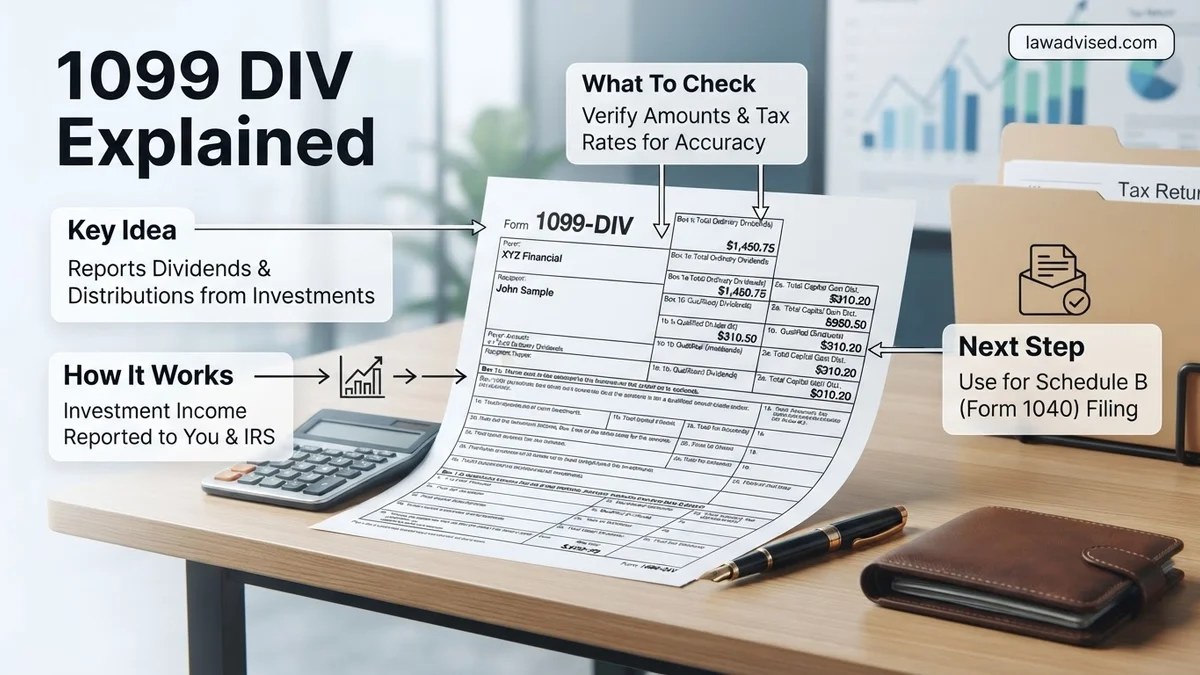
IRS Form 1099-DIV is a tax document sent to investors detailing dividends and capital gains distributed by mutual funds, stocks, or other investments during the tax year. You must report this income on your federal tax return even if you automatically reinvested your dividends. Financial institutions are required to issue this form if your total dividend distributions exceed $10.
IRS Form 1099-DIV is the tax document you receive when you earn more than ten dollars in dividends or other distributions from your stocks, mutual funds, or brokerage accounts during the tax year. This form details every dollar your investments paid out to you, categorizing those payouts so you and the IRS know how to tax them.
Failing to report this income or misinterpreting the specific boxes on your 1099-DIV can trigger automated matching notices from the IRS or cause you to overpay your taxes. For the 2026 tax season, understanding exactly how to read these numbers ensures you keep more of your investment returns while staying fully compliant with current tax laws.
Key Takeaways
- Issuers must send a 1099-DIV if total dividend distributions exceed $10 for the year.
- Box 1a lists ordinary dividends, which are taxed at standard income tax rates.
- Box 1b displays qualified dividends, which benefit from lower long-term capital gains tax rates.
- Box 2a details capital gain distributions, which must also be reported on your tax return.
- Reinvested dividends are still taxable income and must be included when filing Form 1040.
What Causes 1099-DIV Tax Confusion and Who Receives the Form
Who Gets a 1099-DIV and When
You will receive a 1099-DIV from any bank, brokerage firm, or mutual fund company if you received at least ten dollars in dividends, capital gain distributions, or exempt-interest dividends during the calendar year. Even if you automatically reinvested those dividends instead of taking cash, that money is still considered taxable income for 2026 and will appear on your form. Brokerages are legally required to mail or make these forms available electronically by mid-February.
Why the Form Confuses Many Investors
The primary source of confusion is that not all investment income is taxed at the same rate. Your 1099-DIV breaks a single lump sum of earnings into several different categories, such as ordinary dividends, qualified dividends, and capital gains. If you simply add up every number on the form and report it as standard income, you could easily pay a higher tax rate than necessary. Knowing how these categories interact with your overall 2026 tax bracket prevents costly filing mistakes.
How to Read and Interpret the Most Important Boxes on Form 1099-DIV
Box 1 and Box 2: Ordinary Versus Qualified Dividends
Box 1a displays your total ordinary dividends, which are payouts from a corporation’s earnings. A portion of these ordinary dividends may also appear in Box 1b as qualified dividends. Qualified dividends are taxed at much lower capital gains rates (ranging from zero to twenty percent depending on your 2026 income) as long as you held the underlying stock for more than sixty days during the specific holding period.
Box 2a and Beyond: Capital Gains and Foreign Taxes
Box 2a shows total capital gain distributions, which happen when a mutual fund or exchange-traded fund sells underlying assets at a profit. Here are the other key boxes you need to review:
- Box 5: Section 199A dividends, which may qualify for the lucrative twenty percent pass-through deduction for business income.
- Box 6: Investment expenses, though these are generally no longer deductible for individual investors under current tax rules.
- Box 7: Foreign tax paid, which you may be able to claim as a credit or deduction on your 2026 return to avoid double taxation.
Step-by-Step Instructions to Report 1099-DIV on Your Tax Return
Reporting your dividend income correctly prevents IRS mismatches and processing delays for the 2026 tax season. Whether you use tax preparation software or file manually, precise data entry is critical.
Filing via Tax Software
- Navigate to the investment income section in your software (such as TurboTax, H&R Block, or FreeTaxUSA).
- Select the option to import or manually enter Form 1099-DIV.
- Input the Payer’s Federal Identification Number (EIN) exactly as shown in Box 1.
- Transfer the exact dollar amounts from Box 1a, Box 1b, Box 2a, and any foreign tax paid in Box 7 into the corresponding software fields.
- Review the generated Schedule B if your ordinary dividends exceed $1,500, as required by IRS regulations.
Filing Manually
- Retrieve IRS Schedule B (Interest and Ordinary Dividends) if your total ordinary dividends exceed the $1,500 threshold.
- List the name of each payer and the ordinary dividend amount from Box 1a on Part II of Schedule B.
- Carry the total ordinary dividend amount over to Form 1040, Line 3b.
- Transfer qualified dividend amounts from Box 1b of all 1099-DIV forms to Form 1040, Line 3a.
- Attach Schedule B and your Form 1040 to your paper tax return before mailing it to the IRS.
What If It Still Doesn’t Work?
If you encounter missing data, conflicting financial statements, or rejected electronic filings related to your 1099-DIV, take these steps to resolve the issue before the 2026 tax deadline:
- Log into your brokerage or mutual fund online portal to check for corrected 1099-DIV forms, which issuers frequently issue through late February.
- Compare your year-end consolidated brokerage statement against the figures reported on the 1099-DIV to identify the exact source of discrepancy.
- Contact your brokerage firm’s customer service department to request an immediate re-issuance of a corrected form if an error is confirmed.
- Consult a certified public accountant (CPA) or enrolled agent if complex foreign tax credits or capital gain distributions stall your filing. According to the National Society of Accountants, professional tax preparation fees typically range from $220 to $525 depending on investment complexity.
Conclusion
Navigating Form 1099-DIV for the 2026 tax year requires careful attention to the distinction between ordinary and qualified dividends to optimize your tax liability. According to verified research and expert sources from the IRS and major financial institutions, proactive document review prevents costly processing delays and IRS automated underreporter notices. Your actionable next step is to log into your brokerage accounts today to confirm that all final 1099-DIV forms have been downloaded and reconciled.
❓ Frequently Asked Questions
What do the different boxes on Form 1099-DIV actually mean?
The form features multiple boxes breaking down income types. Box 1a shows total ordinary dividends, Box 1b displays qualified dividends eligible for lower tax rates, and Box 2a reports capital gain distributions from mutual funds.
Are dividends from foreign stocks reported differently on Form 1099-DIV?
Yes, Box 7 often reports foreign taxes paid, which you may be able to claim as a credit or deduction on your tax return using Form 1116.
What should I do if my 1099-DIV arrives with incorrect numbers?
Contact the brokerage firm or financial institution that issued the form immediately to request a corrected 1099-DIV before filing your taxes.
Why didn’t I receive a 1099-DIV for my brokerage account?
You typically will not receive a 1099-DIV if your total dividends and distributions for the entire calendar year fell below the IRS $10 reporting threshold.
Do tax-advantaged accounts like IRAs generate a 1099-DIV?
No, dividends earned inside qualified retirement accounts like traditional or Roth IRAs are tax-deferred or tax-free and do not trigger a 1099-DIV.
How are capital gain distributions in Box 2a taxed?
Capital gain distributions reported in Box 2a are generally taxed at long-term capital gains rates, regardless of how long you have held the specific fund shares.

Ismail Hossain is the founder of Law Advised. He is an Divorce, Separation, marriage lawyer. Follow him.