1099 G Explained 1099-G Explained Expert Guide to 2026
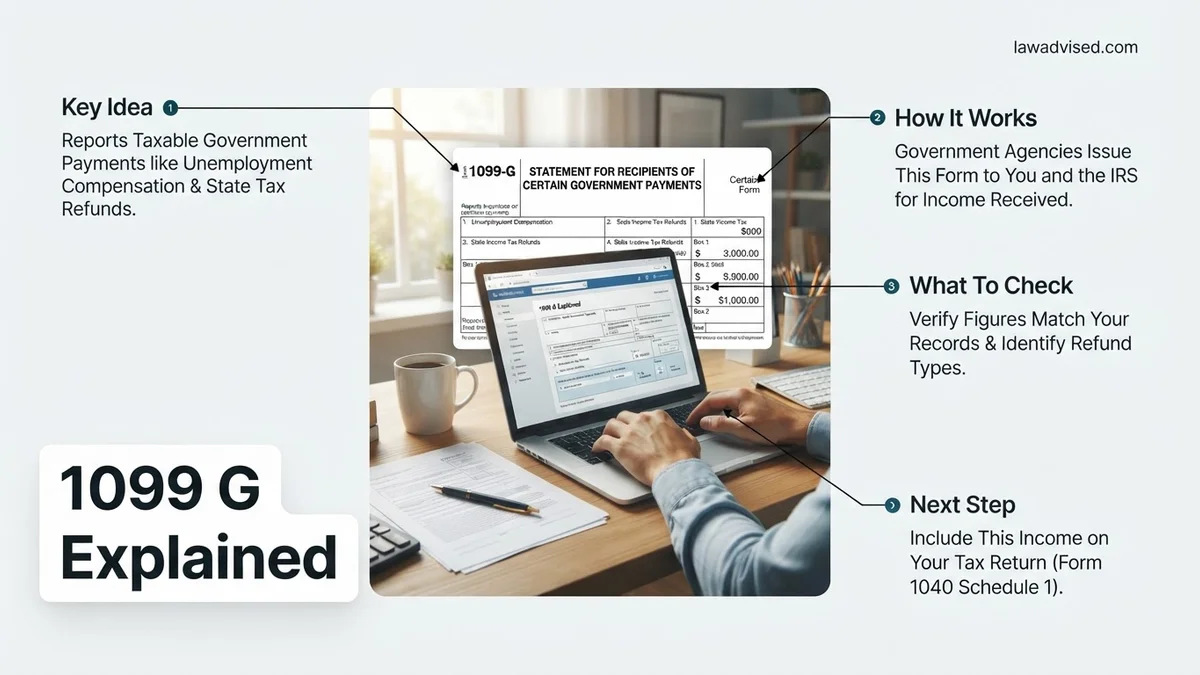
Form 1099-G reports certain government payments, such as unemployment compensation and state tax refunds, to taxpayers and the IRS. You must report this income on your tax return, though whether state refunds are taxable depends on your previous deductions.
Form 1099-G reports certain government payments, most commonly unemployment compensation or a state income tax refund. If you received money from a state or local government agency during the previous year, you can expect this tax form in your mailbox or online portal as part of the 2026 tax season.
The IRS requires you to report most of these payments on your federal income tax return. Missing or ignoring this form can trigger automated IRS notices, delayed refunds, or unwanted tax penalties.
Key Takeaways
- Box 1 reports taxable unemployment benefits that must be included on your tax return.
- Box 2 shows state tax refunds, which are only taxable if you itemized deductions previously.
- The IRS receives a copy of your 1099-G directly from the issuing government agency.
- Enter all 1099-G data accurately into your tax software to avoid processing delays.
- Contact the issuing agency immediately if you receive a fraudulent 1099-G.
What Causes Form 1099-G to Be Issued by State Agencies
State governments issue Form 1099-G, “Certain Government Payments,” to report funds disbursed to citizens throughout the year. The agency sending the form is typically your state’s Department of Labor or Department of Revenue.
Box 1: Unemployment Compensation
Box 1 is the most frequent reason taxpayers receive this form. It tracks every dollar you collected from state or federal unemployment programs, including standard benefits and supplemental pandemic-era or emergency extensions still managed by specific jurisdictions.
- Standard weekly unemployment benefit payouts
- Disaster unemployment assistance
- Paid family leave benefits treated as unemployment by your state
Box 2: State and Local Income Tax Refunds
Box 2 reports any refund, credit, or offset of state or local income taxes you received from a prior filing year. Whether this amount counts as taxable income depends entirely on how you filed your taxes in that previous year.
How to Report Unemployment and State Refunds Step-by-Step
Filing your taxes with a 1099-G requires careful attention to which box the money came from. Treating an untaxable refund as income means you pay too much tax, while omitting unemployment income guarantees an IRS notice.
Handling Unemployment Benefits on Your Return
Unemployment compensation listed in Box 1 is fully taxable at the federal level for the 2026 tax season. Your state may also tax these benefits depending on local laws.
- Locate Box 1 on your 1099-G form to find your total unemployment payout.
- Enter this exact figure onto Schedule 1 of your Form 1040 under taxable unemployment compensation.
- Verify if federal or state income tax was withheld, which is reported in Box 4.
Handling State Tax Refunds
Box 2 state tax refunds are only taxable if you itemized your deductions on your federal return for the year the refund is associated with. If you took the standard deduction, the refund is generally tax-free.
- Check your prior year tax return to confirm if you itemized using Schedule A.
- If you took the standard deduction, report the Box 2 refund as non-taxable income.
- If you itemized and benefited from deducting state and local taxes, report the refund amount as taxable income on your current Form 1040.
What to Do If Your 1099-G Amount Is Incorrect or Fraudulent
Receiving an inaccurate Form 1099-G or discovering identity theft requires immediate intervention before filing your 2026 tax return. According to the Internal Revenue Service and state labor departments, reporting errors quickly prevents processing delays and safeguards your credit profile.
Handling State Tax Refund Discrepancies
If the state income tax refund reported in Box 2 does not match your records, investigate the discrepancy first. State agencies occasionally report the gross refund amount before state-level offsets or processing fees were applied. Take the following steps to resolve a mathematical or reporting error:
- Log into your state department of revenue portal to review the exact disbursement history for the 2025 tax year.
- Contact the issuing state agency via their dedicated customer support phone line or secure messaging portal to request a corrected 1099-G form.
- Proceed with filing your tax return using the verified correct amount while keeping documented notes of your communication with the state agency.
Reporting Unemployment Fraud
A 1099-G reporting unemployment compensation you never claimed is a primary indicator of identity theft. According to federal cybersecurity guidelines, state systems experienced widespread fraudulent claims that continue to impact taxpayers. Take these immediate actions if you suspect fraud:
- Notify the state workforce agency that issued the fraudulent 1099-G immediately through their official fraud reporting web form.
- Request a corrected 1099-G showing zero dollars in taxable compensation, and retain the confirmation number for your records.
- File an identity theft report with the Federal Trade Commission at IdentityTheft.gov and consider placing a credit freeze on your files.
What If Your Tax Software Still Flags a 1099-G Discrepancy
Tax preparation platforms use automated validation checks that can halt filing when state reporting mismatches occur. If standard troubleshooting fails to resolve the software error, systematic fallback measures ensure compliance without risking an IRS audit.
According to certified public accountant standards, taxpayers facing persistent software blocks should execute the following fallback steps:
- Bypass the automated import tool by manually entering the payer Identification Number, Box 1, and Box 2 amounts exactly as printed on the physical form.
- Attach a digital explanation statement or PDF copy of the disputed form to your electronic return when the software prompts for supporting documentation.
- Submit a paper return by mail if electronic filing rejections persist, though processing times will extend from the standard 21 days up to six months.
- Consult a licensed tax professional or Enrolled Agent if the disputed amount exceeds five thousand dollars or involves complex multi-state employer withholding. Professional consultation fees typically range from $200 to $500 depending on the complexity of the resolution.
Conclusion
Navigating Form 1099-G requires careful verification of state tax refunds and unemployment benefits to prevent costly processing delays and tax liabilities. Resolving mathematical discrepancies or fraudulent reporting early ensures your federal and state returns process smoothly. According to verified research and expert financial sources, proactive communication with state agencies remains the most effective defense against unearned tax burdens. Your actionable next step is to log into your state revenue portal today to verify every dollar reported on your 2026 tax documents.
❓ Frequently Asked Questions
Why did I receive a 1099-G if I never applied for unemployment?
Receiving an unexpected 1099-G is often a red flag for identity theft, where someone else used your personal information to fraudulently collect unemployment benefits. You should contact the issuing state agency right away to report the fraud, file a police report if necessary, and check your credit reports.
Is Box 2 state tax refund income always taxable?
No. Box 2 state and local income tax refunds are only taxable if you chose to itemize your deductions on your federal income tax return for the year the tax was paid, and that deduction reduced your overall federal tax liability.
What happens if I forget to report income from my 1099-G?
Because the IRS receives an identical copy of your 1099-G from the state government, omitting it from your tax return will likely trigger an automated IRS notice. This can result in delayed refunds, recalculated tax bills, and potential interest or penalties.
Can I have federal taxes withheld from my unemployment benefits?
Yes, you can voluntarily request that the state withhold federal income tax from your unemployment payments by submitting IRS Form W-4V. This helps prevent a large, unexpected tax bill when you file your annual return.
What should I do if the dollar amount listed on my 1099-G is wrong?
If the numbers do not match your own records of payments received, contact the state department of labor or agency that issued the form immediately. Ask them to investigate the discrepancy and issue a corrected 1099-G form.
Do I need to attach the physical 1099-G form to my tax return?
If you are filing your taxes electronically, you generally do not need to attach or mail the paper form to the IRS. However, you should keep a copy of the form with your personal tax records for at least three years in case of an audit.

Ismail Hossain is the founder of Law Advised. He is an Divorce, Separation, marriage lawyer. Follow him.