USA Income Tax System Explained Step-by-Step Guide for 2026
Navigating the USA income tax system can feel overwhelming, but it boils down to a progressive bracket structure and your final taxable income. This step-by-step guide breaks down how marginal rates, deductions, and withholdings actually affect your paycheck.
The United States income tax system is a pay-as-you-go structure, meaning you pay tax as you earn income throughout the year rather than waiting until an annual deadline. For the 2026 tax year, understanding this mechanism is vital because your overall tax liability dictates your take-home pay, your budgeting accuracy, and your potential refund.
Most taxpayers feel overwhelmed by the jargon and the constant threat of audits. However, the system relies on a few fundamental concepts that strip away the complexity. Once you grasp how your earnings transition from gross pay to taxable income, the entire process becomes manageable and predictable.
Key Takeaways
- The US uses a progressive tax system with marginal brackets.
- Moving into a higher bracket only taxes your additional dollars at that higher rate.
- Deductions directly lower the amount of income subject to taxation.
- Tax credits reduce your actual tax liability dollar-for-dollar.
- Employers use W-4 forms to withhold taxes from your paycheck throughout the year.
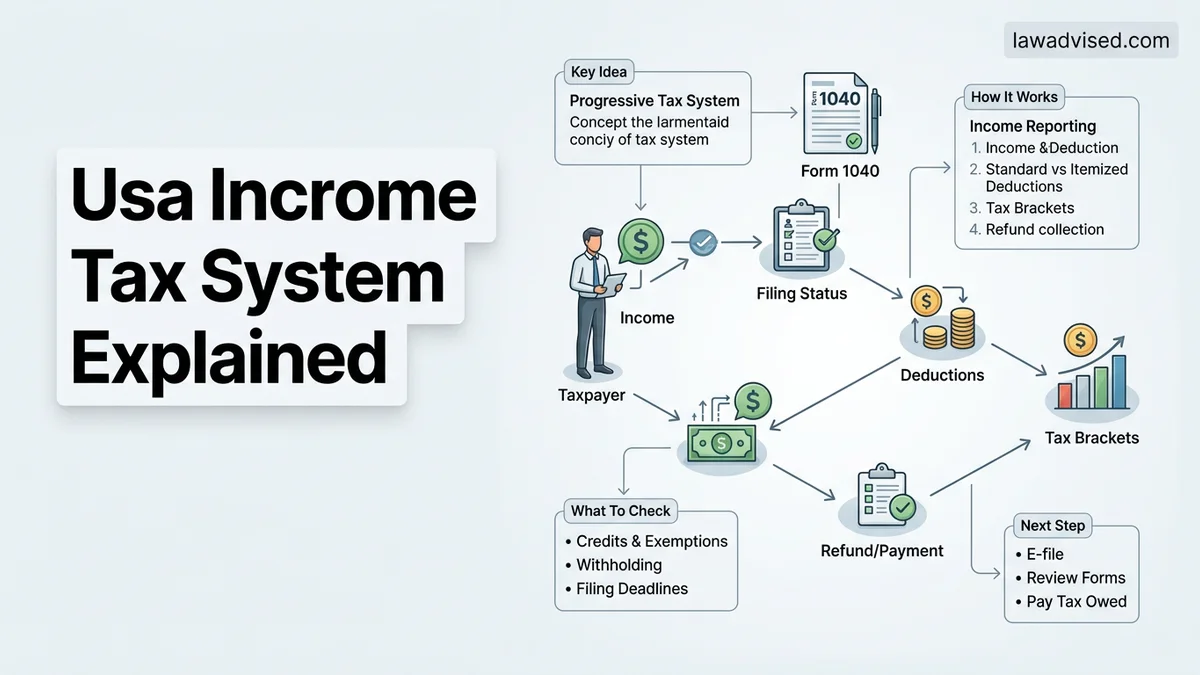
What Causes Confusion in the USA Income Tax System
The Myth of the Single Tax Rate
Many people believe that entering a higher tax bracket means every dollar they earn gets taxed at that higher rate. This misconception causes unnecessary panic during salary negotiations or when evaluating overtime opportunities. If you receive a raise that pushes you into a new bracket, only the money falling within that specific bracket gets taxed at the higher percentage. Your previous earnings remain taxed at their original, lower rates.
Filing Status and Deductions Layering
Confusion also stems from how the IRS calculates your final tax bill using multiple moving parts. Your filing status determines your standard deduction, which reduces the total amount of money the government can tax. People often mix up deductions, which lower your taxable income, with credits, which directly reduce your tax bill dollar-for-dollar. Without separating these concepts, the tax code looks like an arbitrary maze of numbers.
Step-by-Step Guide to How Marginal Tax Brackets Really Work
The Bucket System of Taxation
Think of the 2026 federal income tax brackets as a series of buckets filling up with water. As you earn money, the first bucket fills up to a certain dollar limit and gets taxed at a low rate, such as 10 percent. Once that bucket overflows, the next dollar spills into the second bucket, which carries a slightly higher rate, like 12 percent. This progressive design ensures that low and middle-income earners do not pay high rates on their foundational earnings.
A Practical 2026 Marginal Tax Example
Imagine a single filer in 2026 with a taxable income that spans across the 10 percent and 12 percent marginal brackets:
- First Bucket: The first $11,925 of taxable income is taxed at 10 percent.
- Second Bucket: Income earned between $11,926 and $48,475 is taxed at 12 percent.
- The Reality: If you earn $40,000, you do not pay 12 percent on all $40,000. You pay 10 percent on the first portion, and only the remaining amount above $11,925 faces the 12 percent rate.
How to Calculate Your Taxable Income Using Deductions and Credits
Calculating your final tax liability for 2026 requires moving from your gross income down to your actual taxable income. According to the Internal Revenue Service and financial experts, understanding the distinction between deductions and credits is essential for minimizing your tax burden.
Step 1: Determine Your Adjusted Gross Income (AGI)
You must first calculate your gross income from all sources, including wages, tips, and investment dividends. Subtract specific above-the-line adjustments, such as student loan interest, eligible retirement contributions, and health savings account deposits. This results in your Adjusted Gross Income (AGI).
Step 2: Apply the Standard or Itemized Deductions
Next, you lower your AGI by subtracting deductions to arrive at your taxable income. You can choose between two main options:
- The Standard Deduction: For the 2026 tax year, the IRS adjusts standard deduction amounts for inflation. Single filers and married filing separately typically receive a baseline deduction, while married couples filing jointly receive roughly double that amount.
- Itemized Deductions: You can list out specific expenses—such as mortgage interest, state and local taxes (SALT) up to statutory limits, and substantial medical costs—if they exceed the value of the standard deduction.
Step 3: Subtract Tax Credits Dollar-for-Dollar
Once you calculate your tentative tax based on tax brackets, you subtract tax credits. Unlike deductions that reduce taxable income, credits directly reduce your final tax liability dollar-for-dollar. Prominent examples include the Child Tax Credit and various energy-efficient home improvement credits available in 2026.
What If Your Withholding Fails and You Owe the IRS Money
Even with careful planning, unexpected life changes or investment gains can cause your employer withholding to fall short. If you file your 2026 tax return and discover you owe the IRS money, do not panic. Ignoring the balance will only trigger failure-to-pay penalties and compounding interest.
What If It Still Doesn’t Work?
If standard payment methods fail or your tax liability is too large to settle in a single lump sum, rely on these structured fallback steps:
- File on Time Anyway: Always submit your tax return by the April 2027 deadline, even if you cannot pay the full balance. The failure-to-file penalty is significantly higher than the failure-to-pay penalty.
- Request a Short-Term Payment Plan: The IRS often grants up to 180 days to pay your tax liability in full if you face temporary financial hardship.
- Set Up an Installment Agreement: For longer-term repayment needs, you can apply for an IRS Installment Agreement online to make monthly payments for up to 72 months. Setup fees typically range from $31 for direct debit agreements to $130 for standard agreements, though lower-income taxpayers may qualify for fee waivers.
- Consult a Licensed Tax Professional: If you face complex tax debt exceeding $10,000, hire a Certified Public Accountant (CPA) or Enrolled Agent (EA). Professional representation fees generally range from $300 to $1,000 depending on the complexity of your financial situation.
Conclusion
Navigating the USA income tax system requires a clear understanding of brackets, deductions, and accurate withholding adjustments. Failing to manage your tax strategy properly can result in unexpected liabilities and IRS penalties at filing time. According to verified research and tax experts, your immediate actionable next step is to review your most recent pay stub and submit an updated Form W-4 to your employer if your withholding appears misaligned for 2026.
❓ Frequently Asked Questions
How are federal income tax brackets determined each year?
The IRS adjusts federal income tax brackets annually to account for inflation, ensuring that cost-of-living adjustments do not push taxpayers into higher effective tax brackets simply due to rising prices.
Should I take the standard deduction or itemize my deductions?
You should choose whichever option results in the lower taxable income. For most taxpayers, taking the higher standard deduction is simpler and yields a larger tax break than itemizing individual expenses.
What happens if I cannot pay my taxes on time to the IRS?
If you cannot pay, you should still file your tax return on time to avoid failure-to-file penalties, and then contact the IRS to set up a short-term payment plan or an installment agreement.
Are state and local income taxes separate from federal income taxes?
Yes, federal income tax is paid to the federal government, but many states and some municipalities also levy their own separate income taxes, which require separate filings.
What is the difference between a refundable and a non-refundable tax credit?
A non-refundable credit can only reduce your tax liability down to zero, whereas a refundable credit will pay you the remaining balance as a refund if the credit exceeds what you owe.
Why do some people get a tax refund while others owe money?
A refund happens when more money was withheld from your paychecks throughout the year than you actually owed in total taxes, while owing money means your withholdings were too low.

Ismail Hossain is the founder of Law Advised. He is an Divorce, Separation, marriage lawyer. Follow him.