Self Employment Tax Explained 2026 A Step-by-Step Guide
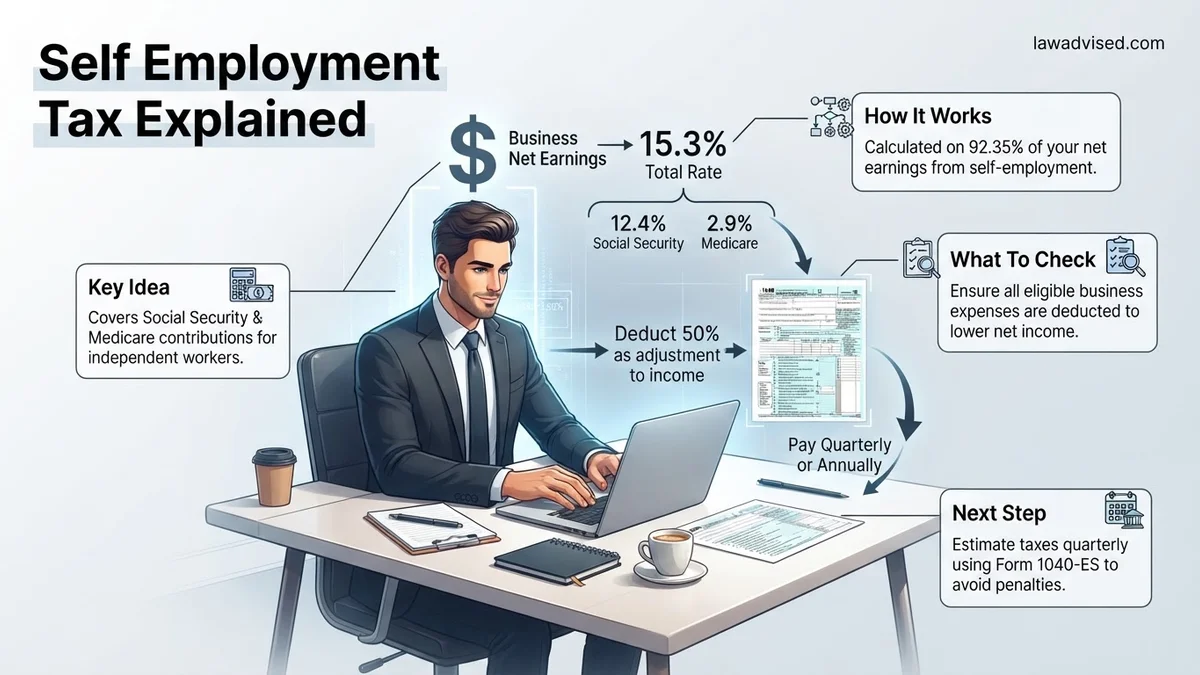
Self-employment tax is the Social Security and Medicare tax required for freelancers, independent contractors, and sole proprietors. Anyone with net earnings of $400 or more must pay a 15.3% total tax rate on their net self-employment income. Understanding how to calculate this liability correctly prevents surprise tax bills and ensures you claim eligible deductions.
Self-employment tax is the special tax you pay as a freelancer, independent contractor, or sole proprietor to cover your contributions to Social Security and Medicare. If you work a traditional W-2 job, your employer automatically deducts half of these Federal Insurance Contributions Act taxes from your paycheck and pays the other half. When you work for yourself, you are both the employee and the employer, meaning you must pay the entire 15.3% tax burden out of your own pocket.
Navigating these tax obligations for 2026 requires understanding how your net earnings trigger the requirement and how the math actually works. Missing these calculations can lead to surprise bills and underpayment penalties from the IRS when tax season arrives. Getting a firm grip on your liability keeps your freelance business profitable and compliant.
Key Takeaways
- Self-employment tax is a flat 15.3% rate covering Social Security and Medicare for independent workers.
- You must file and pay this tax if your net earnings equal or exceed $400.
- Calculate your tax base by multiplying net self-employment earnings by 92.35%.
- You can deduct half of your self-employment tax on your federal income tax return.
- Quarterly estimated tax payments prevent underpayment penalties throughout the year.
What Causes Self-Employment Tax Obligations and Who Must Pay
The IRS does not care if your freelance gig is a full-time career or a weekend side hustle. The moment you generate net earnings from self-employment above a specific threshold, your tax obligation is triggered. Knowing whether you cross this line is the first step in managing your business finances for 2026.
The $400 Net Earnings Threshold
You must file a Schedule SE and pay self-employment tax if your net earnings from self-employment are $400 or more for the year. Note that this rule applies to your net profit, not your gross revenue. If you bring in $5,000 in gross client payments but spend $4,700 on legitimate business expenses, your net earnings are $300. In this scenario, you owe zero self-employment tax because you stayed under the $400 limit. However, if your net profit hits $401, you owe the tax on the entire amount.
The 15.3% Rate Breakdown
The total self-employment tax rate is a flat 15.3% on your net self-employment earnings. This rate breaks down into two distinct federal programs:
- 12.4% for Social Security, which applies up to the annual wage base limit set for 2026.
- 2.9% for Medicare, which applies to all of your net earnings with no upper limit.
Master Self Employment Tax in 7 Simple Steps
Navigating the world of freelancing, contracting, or running your own small business brings incredible freedom, but it also introduces new financial responsibilities—chief among them being self-employment tax. Unlike traditional W-2 employees whose employers automatically withhold taxes, self-employed individuals must calculate and pay their own taxes directly to the government. This comprehensive guide breaks down the complexities of self-employment tax into clear, actionable phases, ensuring you understand your obligations, maximize your deductions, and avoid costly penalties with the IRS.
Step 1: Determine If You Actually Owe Self-Employment Tax
What you need: Your estimated annual net earnings, records of all freelance or business income, and basic knowledge of IRS filing thresholds.
Instructions: Before diving into tax calculations, you must verify whether your independent income meets the IRS requirement for filing. Generally, if you have net earnings from self-employment of $400 or more in a single tax year, you are legally required to file a tax return and pay self-employment tax, regardless of whether you also hold a traditional W-2 job. Calculate your gross income and subtract your ordinary and necessary business expenses to find your net earnings. If that final number crosses the $400 mark, you are officially in self-employment tax territory and must proceed with the following steps.
Pro Tip: Do not confuse gross revenue with net earnings. The $400 threshold applies strictly to your profit (revenue minus expenses), not the total amount clients paid you.
Step 2: Understand the 15.3% Tax Breakdown
What you need: A calculator and a basic understanding of Social Security and Medicare contribution limits.
Instructions: The self-employment tax rate is a flat 15.3% on your net earnings. This percentage is actually a combination of two distinct federal programs: 12.4% goes toward Social Security, and 2.9% goes toward Medicare. When you work a traditional job, your employer pays half of these taxes (7.65%) and you pay the other half. As a self-employed worker, you are legally considered both the employer and the employee, meaning you are responsible for paying the entire 15.3% yourself. Keep in mind that the 12.4% Social Security portion only applies up to a specific annual wage base limit set by the IRS, while the 2.9% Medicare tax applies to all of your net earnings.
Pro Tip: High earners should watch out for the Additional Medicare Tax, which tacks on an extra 0.9% once your net earnings exceed specific filing-status thresholds, such as $200,000 for single filers.
Step 3: Track and Categorize Every Legitimate Business Expense
What you need: Dedicated business bank accounts, bookkeeping software (like QuickBooks or Wave), and digital receipt scanners.
Instructions: The absolute best way to lower your self-employment tax bill is by aggressively tracking your business write-offs. Every dollar you spend on ordinary and necessary expenses to run your business reduces your net earnings, which in turn lowers the amount of self-employment tax you owe. Open a separate business bank account immediately to keep personal and professional transactions distinct. Meticulously categorize expenses such as software subscriptions, marketing costs, professional fees, home office usage, and business travel. Make it a weekly habit to reconcile your accounts and save digital copies of every single receipt to build an audit-proof paper trail.
Pro Tip: Never mix personal and business expenses on the same credit card or bank account, as this makes IRS auditing nightmares and causes you to miss valuable tax write-offs.
Step 4: Master the Half-Tax Deduction Rule
What you need: Your calculated net earnings and Form 1040 Schedule 1 details.
Instructions: One of the most common fears about self-employment tax is that paying the full 15.3% out of pocket is unbearably heavy. Fortunately, the IRS offers a helpful counterweight called the “deductible part of self-employment tax.” When filing your federal income tax return, you are legally permitted to deduct half (50%) of your total self-employment tax liability from your gross income before calculating your standard income tax. This adjustment to income is sometimes called an “above-the-line” deduction, meaning you can claim it even if you take the standard deduction instead of itemizing. This rule essentially levels the playing field between traditional employees and freelancers.
Pro Tip: This deduction only reduces your income tax liability—it does not reduce the actual amount of self-employment tax you calculate on Schedule SE.
Step 5: Calculate and File Schedule SE
What you need: Schedule C (Profit or Loss From Business) and IRS Form 1040.
Instructions: When tax season arrives, you cannot simply write a lump sum check to the government; you must file the proper paperwork. First, you will complete Schedule C to determine your net profit from your freelance work or business. Next, you will take that net profit figure and plug it into Schedule SE (Self-Employment Tax). Schedule SE guides you through a multi-step calculation that accounts for the 92.355% multiplier rule (a special calculation that mimics the employer-equivalent half deduction for tax computation purposes) and determines your final self-employment tax owed. Once computed, you transfer this final number over to your main Form 1040 tax return.
Pro Tip: Always double-check your Social Security number and net earnings transfer amounts between Schedule C, Schedule SE, and Form 1040 to prevent automated IRS processing delays.
Step 6: Set Up Quarterly Estimated Tax Payments
What you need: IRS Form 1040-ES, estimated income projections, and a calendar for quarterly deadlines.
Instructions: Because self-employment tax is not automatically withheld from client payments throughout the year, the IRS expects you to pay as you go using quarterly estimated taxes. If you expect to owe $1,000 or more in taxes when you file your return, you must make payments four times a year. The standard quarterly payment deadlines typically fall on April 15, June 15, September 15, and January 15 of the following year. Calculate your expected annual profit, estimate your total self-employment and income taxes, divide that amount by four, and submit payments online through the IRS Direct Pay system or by mailing Form 1040-ES vouchers.
Pro Tip: Missing quarterly estimated payments can trigger underpayment penalties and interest charges from the IRS, even if you pay the full balance by April.
Step 7: Explore S-Corporation Election Strategies
What you need: Consistent business revenue exceeding $70,000 to $80,000 annually, a CPA consultation, and Form 2553.
Instructions: As your freelance business grows and your net earnings climb higher, paying the full 15.3% self-employment tax on every single dollar of profit can become financially draining. Once your business hits a certain revenue threshold, you may want to talk to a tax professional about electing S-Corporation status with the IRS. By filing Form 2553, you can restructure how you are paid. Instead of taking all profits as self-employment income, you pay yourself a “reasonable salary” (subject to payroll taxes) and take the rest of your business income as distributions or dividends, which are exempt from self-employment tax.
Pro Tip: Do not rush into an S-Corporation election too early; the added administrative costs, payroll processing fees, and tax preparation expenses usually outweigh the tax savings until your net profit surpasses $80,000.
✅ Final Checklist
- Verified that annual net self-employment earnings equal or exceed the $400 IRS filing requirement.
- Separated business finances entirely from personal bank accounts and credit cards.
- Calculated net profit accurately on Schedule C by subtracting all legitimate business expenses.
- Completed IRS Schedule SE to compute the exact 15.3% self-employment tax obligation.
- Scheduled and submitted all four IRS quarterly estimated tax payments using Form 1040-ES.
Important Notes:
- Tax laws, deduction limits, and mileage rates change frequently; always consult the most current IRS guidelines or publication updates.
- Seek professional help from a Certified Public Accountant (CPA) or Enrolled Agent (EA) if your business structure changes or you face complex multi-state tax issues.
- Estimated time range for initial setup and organization: 3 to 5 hours. Estimated cost: Free using IRS free file tools, or $150–$500 annually for professional bookkeeping and tax software.
How to Calculate Self-Employment Tax Step by Step
Calculating your self-employment tax might look intimidating at first glance, but the formula follows a predictable sequence. The IRS allows you to deduct half of your self-employment tax when calculating your overall income tax, which slightly softens the blow. Here is how you run the numbers for 2026.
The Three-Step Calculation Formula
To find out exactly how much self-employment tax you owe, follow these three practical steps:
- Calculate your net self-employment earnings: Subtract your ordinary and necessary business expenses from your total gross self-employment income.
- Multiply by 92.35%: Multiply your net earnings figure by 0.9235. This step accounts for the employer-equivalent half of the tax that you are technically allowed to exclude, mirroring the deduction W-2 workers get.
- Apply the 15.3% tax rate: Multiply the resulting adjusted figure by 15.3% (or 0.153) to find your total self-employment tax liability.
A Concrete Calculation Example
Imagine your freelance graphic design business generates $60,000 in gross revenue for 2026, and you rack up $10,000 in deductible business expenses (software subscriptions, equipment, home office deduction).
- Your net earnings equal $50,000 ($60,000 minus $10,000).
- Multiply $50,000 by 92.35% to get your taxable self-employment earnings of $46,175.
- Multiply $46,175 by 15.3% to find your total self-employment tax of $7,064.78.
You can then take half of that tax amount ($3,532.39) as an above-the-line deduction on your Form 1040, lowering your overall income tax liability.
Step-by-Step Guide to Claiming Deductions and Reducing Liability
Minimizing your self-employment tax burden in 2026 requires a disciplined approach to tracking business write-offs. According to IRS guidelines and tax experts, deducting ordinary and necessary business expenses directly lowers your net earnings, which reduces both your income tax and the 15.3% self-employment tax. Follow this structured process to maximize your legal deductions.
1. Identify and Track All Ordinary Expenses
- Compile receipts and digital records for software subscriptions, home office space, and specialized equipment purchased for your trade.
- Separate personal banking from business accounts to maintain a clean audit trail that satisfies IRS documentation standards.
- Calculate vehicle mileage using the standard IRS mileage rate for 2026 to deduct business-related travel accurately.
2. Calculate the Above-the-Line Deduction
- Determine your total net self-employment earnings from Schedule C.
- Multiply your net earnings by the 2026 deduction factor of 0.9235 to find the baseline for tax calculations.
- Claim the deduction for half of your self-employment tax on Schedule 1 of Form 1040, which lowers your adjusted gross income immediately.
What If Your Income Changes or You Miss Estimated Payments
Fluctuating freelance or business income creates unique challenges for quarterly tax planning. Missing an IRS estimated tax deadline or experiencing a sudden drop in revenue can trigger penalties. Certified Public Accountants recommend specific adjustments to handle income volatility without facing steep underpayment interest.
1. Adjust Quarterly Payments Upward or Downward
- Recalculate your projected annual earnings at the start of each quarter using current year-to-date financial data.
- Submit a higher estimated payment in subsequent quarters if your income spiked unexpectedly to compensate for earlier shortfalls.
- Use the annualized income installment method on IRS Form 2210 if your earnings were heavily weighted toward the end of 2026, which can eliminate or reduce late-payment penalties.
What If It Still Doesn’t Work?
If self-employment tax calculations still feel overwhelming or you face complex multi-state tax issues in 2026, standard DIY software may fall short. Consider these fallback steps:
- Schedule a consultation with a Certified Public Accountant or an Enrolled Agent who specializes in freelance and small business taxation. Professional advisory fees typically range from $300 to $600 for a comprehensive tax review.
- Contact the IRS directly through their dedicated business and self-employed tax center or visit a local Taxpayer Assistance Center for guidance on payment plans.
- Utilize IRS Free File or professional tax resolution services if you have already incurred penalties and need to request a first-time penalty abatement.
Conclusion
Navigating self-employment taxes in 2026 requires understanding the 15.3% rate, making accurate quarterly estimated payments, and leveraging deductions to protect your bottom line. According to verified research and tax experts, proactive record-keeping and strategic write-offs remain the most effective methods for reducing overall tax liability. Your immediate next step is to log into your accounting software today, tally your current quarterly earnings, and schedule your upcoming estimated tax payment before the next IRS deadline.
❓ Frequently Asked Questions
What expenses can I deduct to lower my self-employment tax?
You can deduct ordinary and necessary business expenses directly related to your trade or profession, such as home office use, software subscriptions, travel, and supplies. These deductions lower your net earnings, which in turn reduces your overall self-employment tax.
Is self-employment tax in addition to income tax?
Yes, self-employment tax is separate from federal, state, and local income taxes. Freelancers and independent contractors typically pay both self-employment tax and standard income tax on their business earnings.
How does the Social Security wage cap affect self-employment tax?
The 12.4% Social Security portion of the self-employment tax applies only up to an annual wage limit established by the IRS. Earnings above this threshold are exempt from the Social Security portion, but the 2.9% Medicare tax continues to apply regardless of income.
Do I owe self-employment tax if my business operated at a loss?
No, if your business expenses exceeded your gross income, you have a net loss and do not owe self-employment tax for that year. You may be able to carry forward that net operating loss to offset future business income.
How do single-member LLCs handle self-employment tax?
For tax purposes, a single-member LLC is typically treated as a disregarded entity or sole proprietorship by default. This means all net business profits flow directly to the owner’s personal tax return and are subject to self-employment tax.
What happens if I miss a quarterly estimated tax payment?
Missing quarterly payments or underpaying your estimated taxes can result in IRS penalties and interest charges when you file your annual return. You can use Form 2210 to calculate penalties or request a waiver if you meet specific exception criteria.

Ismail Hossain is the founder of Law Advised. He is an Divorce, Separation, marriage lawyer. Follow him.