How Self Employment Taxes Work Step-by-Step Guide 2026
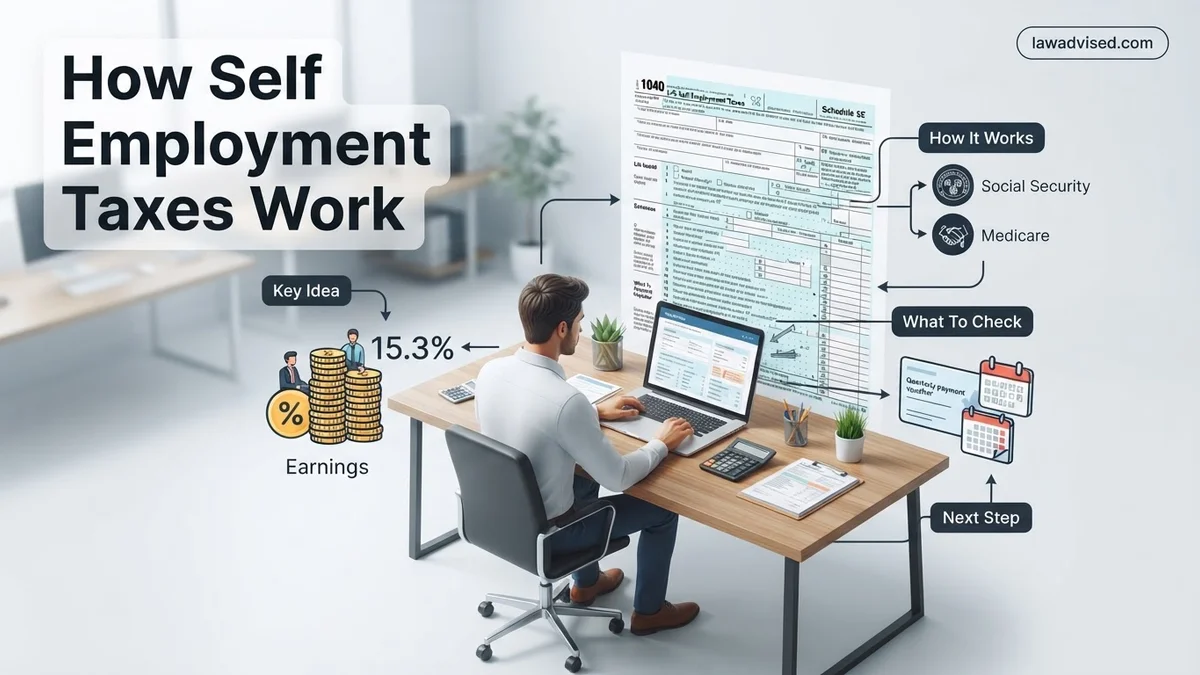
Self-employment taxes fund your Social Security and Medicare benefits when you work for yourself. The standard self-employment tax rate is 15.3%, applied to your net earnings from self-employment. Freelancers and independent contractors must calculate this tax and pay it quarterly to avoid IRS penalties.
If you are working for yourself in 2026, you are responsible for paying your own self-employment taxes, which total 15.3% of your net earnings. When you worked a traditional W-2 job, your employer paid half of your Social Security and Medicare taxes, but as a freelancer, independent contractor, or sole proprietor, you must cover both the employee and employer portions yourself.
Managing these taxes without a payroll department means you need to calculate your liability and pay quarterly estimated taxes to the IRS. Skipping these steps or miscalculating your obligations can result in unexpected underpayment penalties when you file your annual return.
Key Takeaways
- Pay self-employment tax if your net earnings are $400 or more in a year.
- The tax rate is 15.3%, split into 12.4% for Social Security and 2.9% for Medicare.
- Calculate your taxable base by multiplying your net earnings by 92.35%.
- Deduct half of your self-employment tax from your adjusted gross income.
- Submit quarterly estimated tax payments using IRS Form 1040-ES.
What Causes High Self-Employment Tax Burdens and Who Must Pay
Who is Subject to Self-Employment Tax
You must pay self-employment tax if you net $400 or more from freelance work, independent contracting, or running a single-member business in 2026. This rule applies whether your self-employment income is full-time or just a side hustle alongside a traditional job.
Why the Burden Feels Heavy
The primary reason your self-employment tax bill feels so high is the flat 15.3% rate applied directly to your net business earnings. Unlike income tax brackets that scale up gradually, this tax applies heavily right from your first dollar of profit. Furthermore, you do not get taxes automatically withheld from client payments, which leaves you responsible for saving and submitting large lump sums throughout the year.
- Your total tax combines a 12.4% Social Security component and a 2.9% Medicare component.
- High earners may owe an additional 0.9% Medicare tax on net earnings above specific statutory thresholds.
- Failing to account for this 15.3% slice of your revenue throughout the year creates severe cash flow crunches in April.
2026 Self-Employment Taxes Made Easy: Your Essential Action Plan
Navigating taxes as an independent worker, freelancer, or small business owner can feel overwhelming, but understanding how self-employment taxes work is the key to keeping your business legal and profitable. This comprehensive guide walks you through calculating your earnings, understanding the dual role of employee and employer, making quarterly payments, and maximizing your deductions. By following this action plan, you will avoid IRS penalties and keep more of your hard-earned money.
Step 1: Determine Your Self-Employment Status
What you need: 1099-NEC forms, bank statements, and accounting software or spreadsheets recording all business income for the tax year.
Instructions: Before calculating taxes, you must confirm that the IRS classifies you as self-employed rather than a W-2 employee. You are considered self-employed if you operate a trade or business as a sole proprietor, independent contractor, member of a partnership, or freelance worker. Tally up all gross income earned from your business activities. If your net earnings from self-employment are $400 or more for the year, you are legally required to file a federal income tax return and pay self-employment tax, regardless of whether you received formal 1099 forms from your clients.
Pro Tip: Do not wait until tax season to add up your income. Reconcile your business bank accounts monthly to catch discrepancies early.
Step 2: Understand the 15.3% Self-Employment Tax Rate
What you need: Schedule SE (Form 1040) and a basic calculator.
Instructions: Traditional W-2 employees split their payroll taxes with their employers, each paying 7.65% for Social Security and Medicare (totaling 15.3%). As a self-employed individual, you are both the employee and the employer, meaning you must pay the entire 15.3% tax yourself. This rate is broken down into 12.4% for Social Security (up to the annual wage base limit set by the IRS) and 2.9% for Medicare. Note that this 15.3% is separate from your standard federal and state income taxes; it is specifically designed to fund your future social security and medicare benefits.
Pro Tip: High earners should watch the Social Security wage cap, as earnings above that threshold are exempt from the 12.4% Social Security portion, though an additional 0.9% Medicare tax may apply to very high incomes.
Step 3: Calculate Your Net Earnings From Self-Employment
What you need: Schedule C (Profit or Loss From Business) and records of all legitimate business expenses.
Instructions: You do not pay self-employment tax on your gross revenue; you pay it on your net earnings. Fill out Schedule C to subtract all ordinary and necessary business expenses—such as software subscriptions, advertising, professional fees, and equipment—from your gross business income. Once you have your net profit, multiply that figure by 92.35% (0.9235). The IRS allows you to deduct half of your self-employment tax equivalent from your net earnings, which is why you apply this 92.35% multiplier before calculating the actual 15.3% tax.
Pro Tip: Keep every single business receipt digitalized. If audited, the burden of proof rests entirely on you to show that your deductions were valid business expenses.
Step 4: Claim the Above-the-Line Deduction for Half of SE Tax
What you need: Completed Schedule SE calculations and Form 1040 (Schedule 1).
Instructions: Because paying the full 15.3% self-employment tax is a heavy burden, the tax code provides a silver lining: you can deduct 50% of your calculated self-employment tax from your gross income when figuring out your adjusted gross income (AGI). This is known as an “above-the-line” deduction, meaning you do not need to itemize your personal deductions to take advantage of it. Transfer the deductible half of your self-employment tax from Schedule SE onto Schedule 1 of Form 1040, which directly lowers the total income upon which your federal income tax is calculated.
Pro Tip: This deduction only lowers your income tax liability, not your self-employment tax liability. Make sure you apply it in the correct order on your tax forms.
Step 5: Master Estimated Quarterly Tax Payments
What you need: Form 1040-ES (Estimated Tax for Individuals), estimated income projections, and IRS Direct Pay or EFTPS account.
Instructions: The United States operates on a “pay-as-you-earn” tax system. Since no employer is withholding taxes from your freelance paychecks, you are required to make estimated quarterly tax payments if you expect to owe $1,000 or more in taxes for the year. The year is divided into four payment periods with strict deadlines: April 15, June 15, September 15, and January 15 of the following year. Calculate what you expect to owe based on the previous year’s liability or current-year projections, and pay equal installments four times a year to avoid underpayment penalties.
Pro Tip: Set up an automatic calendar alert 5 days before every quarterly deadline. Missing these dates triggers compounding IRS interest and late-payment penalties.
Step 6: Incorporate State and Local Self-Employment Obligations
What you need: State Department of Revenue website, local city or county tax guidelines.
Instructions: Federal taxes are only part of the equation. Depending on where you live and operate your business, you may also owe state income taxes, local business privilege taxes, or state-level self-employment assessments. Research your specific state’s requirements, as some states do not have a personal income tax, while others require their own version of quarterly estimated payments. Check with your city or county clerk’s office to see if you need to pay a local business license fee or gross receipts tax to legally operate within your municipality.
Pro Tip: Never assume state tax rules mirror federal rules. For example, some states have different definitions for what qualifies as a deductible business expense.
Step 7: Automate Your Tax Savings Strategy
What you need: A dedicated business savings account and automated transfer rules set up through your bank.
Instructions: The biggest pitfall for new self-employed individuals is spending gross revenue and having nothing left when tax day arrives. Protect yourself by opening a separate, high-yield business savings account. As a general rule of thumb, immediately transfer 25% to 30% of every client payment you receive straight into this dedicated tax bucket. This percentage covers both your self-employment tax (15.3%) and your estimated federal/state income tax brackets. When your quarterly payments are due, the money will already be sitting safely in your account, eliminating cash flow crunches.
Pro Tip: Treat your tax savings account like a vault. Never dip into those funds for everyday business expenses, vacations, or personal cash flow emergencies.
✅ Final Checklist
- Verified that net self-employment earnings meet or exceed the $400 filing threshold
- Completed Schedule C and accurately deducted all eligible business expenses
- Calculated the 15.3% self-employment tax using Schedule SE
- Scheduled or submitted estimated quarterly payments (Form 1040-ES) for all four deadlines
- Transferred 25-30% of current income into a dedicated tax savings account
Important Notes:
- Failing to make quarterly estimated payments can result in IRS underpayment penalties and interest charges.
- Seek professional help from a Certified Public Accountant (CPA) or Enrolled Agent (EA) if your business structure changes (e.g., electing S-Corp status) or if your annual income exceeds $100,000.
- Estimated time: 2 to 4 hours per quarter for record-keeping and payments; cost range: Free if filing manually, or $30–$300 annually for tax preparation software and professional consultation.
How to Calculate Your Self-Employment Taxes Step-by-Step
The 92.35% Net Earnings Rule
You do not pay self-employment tax on 100% of your gross business revenue or even your gross profit. The IRS allows you to deduct the employer-equivalent portion of your self-employment tax, which simplifies mathematically to multiplying your net self-employment earnings by 92.35% before applying the 15.3% tax rate.
Step-by-Step Calculation Example
Assume your freelance graphic design business generates $100,000 in gross revenue for 2026, and you have $20,000 in legitimate business deductions, leaving you with $80,000 in net earnings.
- Take your net earnings of $80,000 and multiply by 92.35%, which equals $73,880.
- Multiply that adjusted figure of $73,880 by the total 15.3% self-employment tax rate.
- Your total self-employment tax liability comes out to $11,303.64.
Once you calculate this amount, remember that federal tax law allows you to deduct half of your self-employment tax liability from your gross income when calculating your standard income taxes for 2026, which softens the overall blow.
How to Fix and Submit Your Quarterly Estimated Tax Payments
Filing quarterly estimated taxes prevents large penalties at the end of the year. The IRS requires freelancers and independent contractors to make these payments if they expect to owe at least $1,000 in taxes for 2026. Setting up a reliable submission routine protects your business cash flow and keeps you compliant with federal guidelines.
Step-by-Step Submission Process
- Calculate your net earnings: Use your 2026 Schedule C to estimate your annual gross income minus deductible business expenses.
- Determine your tax liability: Multiply your projected net earnings by 15.3% for self-employment tax, then add your projected income tax bracket.
- Divide by four: Split your total estimated annual tax liability into four equal installments for the year.
- Submit via IRS Direct Pay: Log into the official IRS website to make secure, direct electronic transfers from your checking or savings account for free.
- Mark the 2026 deadlines: Ensure your payments are submitted by April 15, June 15, September 15, and January 15, 2027.
What If Your Income Fluctuates or You Still Owe Penalties?
Freelance income rarely arrives in equal monthly installments. If your 2026 earnings fluctuate wildly throughout the year, calculating fixed quarterly payments becomes challenging. According to tax compliance experts at the IRS, utilizing the annualized income installment method allows you to pay taxes based on what you actually earned during each specific quarter.
Handling Penalties and Volatile Income
- Use Form 2210: If your income spiked late in the year, file IRS Form 2210 to calculate lower underpayment penalties using the annualized income method.
- Adjust future payments: Recalculate your remaining quarterly estimates immediately after a major financial quarter to avoid compounding shortfalls.
- Set aside a percentage buffer: Financial advisors recommend automatically transferring 25 to 30 percent of every client invoice into a dedicated tax savings account.
- Request penalty abatement: First-time penalty offenders with a strong compliance history can request a penalty waiver from the IRS under specific administrative relief guidelines.
What If It Still Doesn’t Work?
Navigating complex self-employment tax structures can sometimes overwhelm standard software tools or DIY methods. If your calculations remain unclear or you receive an IRS notice, actionable fallback steps ensure resolution:
- Consult a Certified Public Accountant (CPA): Partnering with a licensed tax professional ensures complex deductions and multi-state compliance are handled accurately. Professional CPA fees for self-employed returns typically range from $300 to $800 annually.
- Utilize an Enrolled Agent (EA): Eased federally licensed tax practitioners specialize in IRS dispute resolution and tax planning for small business owners.
- Set up an IRS payment plan: If you cannot pay a tax liability in full, apply for a short-term payment plan or an installment agreement directly through the IRS online portal.
Conclusion
Mastering self-employment taxes in 2026 requires understanding the 15.3% tax rate, tracking deductions, and submitting accurate quarterly payments on time. According to verified research and expert sources from the IRS and the National Association of Tax Professionals, proactive tracking prevents costly year-end penalties. Your actionable next step for today is to open a dedicated digital savings account and set up an automatic transfer of 25 percent from your next client payment.
❓ Frequently Asked Questions
How is the 15.3% self-employment tax broken down?
The rate consists of 12.4% for Social Security and 2.9% for Medicare. The Social Security portion only applies up to the annual wage limit set by the IRS.
Do I have to pay self-employment tax if I also have a W-2 job?
Yes, if you earn income from freelance work or side hustles exceeding $400 net. However, your W-2 job wages count toward the annual Social Security wage cap.
What happens if I miss a quarterly estimated tax payment?
Missing quarterly deadlines can result in underpayment penalties and interest charges from the IRS when you file your annual return.
How do I calculate my net earnings for Schedule SE?
You start with your gross self-employment income and subtract all ordinary and necessary business expenses to find your net profit, then multiply by 92.35%.
Is self-employment tax different from regular income tax?
Yes, self-employment tax replaces the FICA taxes normally split between an employee and employer. Regular income tax is separate and calculated on your total taxable income.
What is Form 1040-ES used for?
Form 1040-ES contains the payment vouchers and instructions you use to calculate and mail your quarterly estimated tax payments to the IRS.

Ismail Hossain is the founder of Law Advised. He is an Divorce, Separation, marriage lawyer. Follow him.