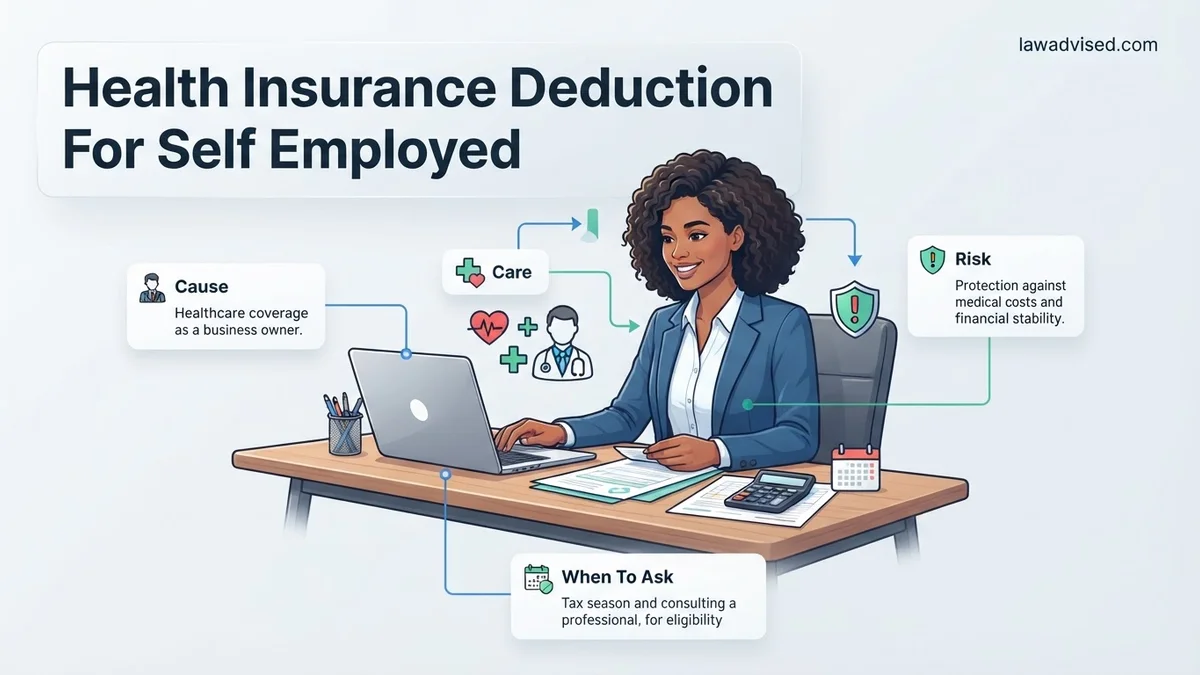
Health Insurance Deduction for Self Employed A 2026
The health insurance deduction for self employed allows you to write off 100% of your medical, dental, and qualifying long-term care insurance premiums. You can claim this as an above-the-line deduction without needing to itemize your personal tax returns, provided you meet specific net income and employer-coverage rules.
You can write off 100 percent of your health, dental, and long-term care insurance premiums as an above-the-line deduction if you operate as a self-employed individual. This deduction directly lowers your adjusted gross income for the 2026 tax year without requiring you to itemize your deductions on Schedule A.
Maximizing this tax break requires strict adherence to IRS rules regarding net earnings and alternative coverage options. Understanding these qualifications prevents costly auditing errors and ensures you claim every dollar you earned through your business.
Key Takeaways
- Deduct up to 100% of health, dental, and vision insurance premiums paid out of pocket.
- Your deduction cannot exceed your net earnings from your self-employment business.
- You cannot qualify if you are eligible for an employer-subsidized plan through a spouse or job.
- Report the write-off directly on Schedule 1 (Part II) of IRS Form 1040.
- This is an above-the-line deduction, meaning it lowers your adjusted gross income without itemizing.
What Causes Ineligibility for the Self-Employed Health Insurance Deduction
The IRS enforces strict disqualifiers for this tax write-off. Violating these primary rules means you must shift your premiums to Schedule A as a medical expense instead of taking the above-the-line deduction.
The Employer-Subsidized Plan Rule
You cannot claim this deduction if you were eligible to participate in any subsidized health plan maintained by your employer. This restriction applies even if you chose not to enroll in that workplace coverage.
- Spousal Plans: If your spouse has a job that offers family health insurance coverage, and you are eligible to join that plan, you lose your self-employed deduction.
- Secondary Jobs: Even a part-time W-2 job with health benefits can disqualify your entire freelance business from taking the write-off.
Net Income Limitations
Your deduction is capped by your business profits. If your business operates at a net loss for 2026, you cannot take the self-employed health insurance deduction at all. You need positive net earnings from the specific business that established the plan to qualify.
2024 Self-Employed Health Insurance Deduction Expert Practical Guide
Navigating tax deductions as a freelancer or small business owner can feel overwhelming, but mastering the self-employed health insurance deduction is one of the best ways to lower your taxable income. This guide walks you through the exact process to correctly calculate, document, and claim your medical, dental, and qualifying vision insurance premiums on your federal tax return, ensuring you keep more of your hard-earned money.
Step 1: Determine Your Eligibility
What you need: Your Schedule C net profit figures, W-2 forms from any secondary jobs, and proof of your current health insurance policy.
Instructions: Before calculating any numbers, verify that you qualify for the deduction. To be eligible, your business must show a net profit for the year. Furthermore, you cannot be eligible to participate in a health plan subsidized by an employer, such as a spouse’s group plan or a plan from a W-2 job you hold concurrently. Review your income streams carefully to confirm you meet IRS guidelines for self-employed status.
Pro Tip: Many freelancers miss out because they check eligibility only at year-end; check your status monthly if your employment situation fluctuates.
Step 2: Calculate Your Net Business Income
What you need: Completed business income and expense records, accounting software reports, or bookkeeping spreadsheets.
Instructions: Total all your freelance or business revenue and subtract your ordinary and necessary business expenses to find your net profit. This number is crucial because the health insurance deduction is limited to your net self-employment earnings. If you operate multiple businesses, you can generally combine your net earnings from those ventures to establish your total business income ceiling for the deduction.
Pro Tip: Remember that this deduction is taken “above-the-line” on Schedule 1, meaning it reduces your Adjusted Gross Income without requiring you to itemize deductions.
Step 3: Gather Premium Payment Documentation
What you need: Monthly bank statements, credit card statements, and official payment receipts or year-end statements from your insurance provider.
Instructions: Compile every single receipt and statement showing out-of-pocket premium payments made for medical, dental, and qualified long-term care insurance. The policy must be established under your business name or in your personal name as a self-employed individual. Total these annual payments meticulously, ensuring you only count months where you were actually actively self-employed and ineligible for an employer-sponsored plan.
Pro Tip: Keep these records organized in a dedicated digital folder for at least three years in case the IRS requests verification during an audit.
Step 4: Include Eligible Dependents and Family Members
What you need: Family member Social Security numbers, dates of coverage, and dependent verification documents.
Instructions: Add up the premiums paid not just for yourself, but also for your spouse and your dependents. The IRS allows you to deduct coverage for children under the age of 27 at the end of the tax year, even if they are not claimed as tax dependents, provided they were covered under your self-employed health plan. Ensure you separate out any portions of the premiums that were reimbursed or paid through other pre-tax mechanisms.
Pro Tip: Do not include out-of-pocket medical costs like copays, prescriptions, or hospital visits here; those belong on Schedule A under itemized medical expenses.
Step 5: Apply the Net Earnings Limitation Rule
What you need: Your preliminary Schedule C net profit and your total annual health insurance premium calculations.
Instructions: Compare your total annual health insurance premiums against your net self-employment income from that specific business. Your deduction cannot exceed your net profit from the business under which the plan was established. For instance, if your net profit is $8,000 and your total health insurance premiums equal $10,000, your deduction is capped at $8,000. Any excess premiums cannot be deducted here, though a portion might be eligible for itemization.
Pro Tip: Do not factor in your self-employment tax deduction when calculating this limit; use your net profit before that specific adjustment.
Step 6: Fill Out Schedule 1 (Form 1040)
What you need: IRS Form 1040, Schedule 1, and your final calculated premium and net income totals.
Instructions: Navigate to Part II of Schedule 1 (“Adjustments to Income”) on your federal tax return. Locate the specific line designated for the self-employed health insurance deduction (typically Line 17). Enter your final calculated allowable premium amount in this field. This figure will directly transfer over to your main Form 1040, reducing your overall taxable income before standard or itemized deductions are applied.
Pro Tip: Double-check that you are not claiming these same premiums as a medical expense deduction on Schedule A, as “double dipping” is strictly prohibited.
Step 7: Factor in State Tax Implications
What you need: State income tax software or local state tax forms (Schedule CA, Schedule OD, etc.).
Instructions: Review your specific state’s tax laws regarding self-employed health insurance deductions. While the federal government generally allows the deduction, some states have unique rules. A few states do not conform to federal adjustments, requiring you to add the amount back on your state return or handle it via a separate state-level medical expense calculation. Adjust your state software inputs accordingly to avoid unexpected tax bills.
Pro Tip: State tax treatment varies wildly, so consult state-specific tax instructions if you operate in high-tax jurisdictions like California or New Jersey.
✅ Final Checklist
- Verified net profit exists on Schedule C before claiming the deduction
- Confirmed zero eligibility for an employer-sponsored health plan (including a spouse’s plan)
- Checked that total deductions do not exceed net business earnings
- Maintained accurate monthly bank statements and insurance receipts for proof of payment
- Successfully entered the final calculated amount on Schedule 1, Part II of Form 1040
Important Notes:
- Never claim health insurance premiums as both a business expense on Schedule C and as an above-the-line deduction on Schedule 1.
- Seek professional CPA or tax preparer assistance if you have complex multi-state businesses, partnership structures, or major mid-year shifts in employment status.
- Estimated time to complete: 1 to 2 hours. Cost range: Free if filing yourself using standard software, or $150–$400 if hiring a tax professional.
How to Calculate Your Maximum Allowable Premium Write-Off
Calculating your allowable deduction involves a specific sequence because your self-employment tax deduction and your health insurance deduction interact mathematically. You must figure out your net earnings from self-employment before finalizing the health insurance amount.
The Calculation Sequence
You cannot simply add up your monthly premium statements and write that total on your tax forms. You must run your numbers through the IRS self-employment tax worksheet first.
- Step 1: Calculate your net profit from Schedule C.
- Step 2: Subtract half of your self-employment tax to find your adjusted net self-employment earnings.
- Step 3: Total all qualified medical, dental, and eligible long-term care insurance premiums paid during 2026.
Applying the Net Income Cap
Your maximum deduction cannot exceed your net income from the business under which the insurance plan was established. For example, if your net freelance profit for 2026 is 8,000 dollars, but your annual health insurance premiums total 10,000 dollars, your deduction is capped strictly at 8,000 dollars. You cannot carry the remaining 2,000 dollars over to the next tax year or use it to offset other household income.
Step-by-Step Guide to Claiming the Deduction on IRS Form 1040 Schedule 1
Claiming this valuable tax break requires reporting it correctly on your annual federal income tax return. Because this is an above-the-line deduction, you do not need to itemize your deductions to benefit from it. According to IRS instructions, you calculate and report the deduction using specific forms before transferring the total to your main tax return.
Step-by-Step Reporting Procedure
- Calculate your net self-employment earnings: Complete Schedule C (Profit or Loss From Business) to determine your net profit before taking the health insurance deduction.
- Complete Schedule 1 (Form 1040): Locate Part II, titled “Adjustments to Income.” Find the specific line designated for self-employed health insurance deduction, which is typically Line 17 for the 2026 tax year.
- Enter the allowable amount: Transfer the calculated premium amount from your worksheet to Schedule 1, ensuring you do not exceed your net business income limit.
- Transfer to Form 1040: Move the final total from Schedule 1 directly to your main Form 1040, where it reduces your total adjusted gross income.
Tax experts recommend keeping all monthly premium payment receipts, annual statements from your insurance marketplace or private carrier, and your Schedule C calculations readily available. The IRS requires proper documentation to substantiate above-the-line deductions during an audit.
What If Your Net Self-Employment Income Is Too Low to Cover Premiums
A common hurdle for new business owners is experiencing a low-profit or loss year where net self-employment income cannot fully cover the cost of health insurance premiums. The IRS explicitly caps the deduction at your net earned income from the specific business under which the plan is established. If your business operates at a loss, your deduction limit through Schedule 1 drops to zero for that tax year.
Alternative Options for Excess Premiums
- Itemize medical deductions: Any health insurance premiums that exceed your net self-employment income—or premiums paid if you cannot use the above-the-line deduction—can be moved to Schedule A as standard medical expenses.
- Meet the AGI threshold: Remember that itemized medical expenses are only deductible to the extent they exceed 7.5 percent of your adjusted gross income for the 2026 tax year.
- Explore premium tax credits: If you purchase coverage through the Health Insurance Marketplace and your income drops significantly, you may qualify for advance premium tax credits that lower your monthly costs directly.
Financial planners note that strategic income timing can help maximize tax efficiency during fluctuating business cycles, ensuring you make the most of available healthcare subsidies.
What If It Still Doesn’t Work?
If calculating your self-employment health insurance deduction still results in errors, rejected returns, or confusion, you should utilize structured fallback strategies to resolve the issue before the tax filing deadline.
- Review your business structure: If you operate an S-Corporation, the rules differ significantly; corporate-paid premiums must be reported correctly on W-2 forms rather than Schedule 1.
- Consult a licensed CPA or Enrolled Agent: Complex multi-state operations or mixed-income households require specialized guidance. Professional tax preparation fees typically range from $300 to $800 depending on business complexity.
- Utilize IRS Publication 535: Review official IRS guidelines on business expenses for exact definitions of eligible medical and dental plans for self-employed individuals.
- Amortize or adjust previous filings: If you discovered missed deductions from prior tax years, work with a professional to file an amended return (Form 1040-X) within the standard three-year statute of limitations.
Conclusion
Navigating the self-employment health insurance deduction for the 2026 tax year requires careful coordination between your net business income, premium totals, and proper Schedule 1 reporting. By utilizing above-the-line adjustments correctly, you can substantially lower your adjusted gross income without needing to itemize. According to verified research and tax authority guidelines, maintaining accurate monthly records and verifying net earnings prevents costly reporting errors. As an actionable next step, gather your 2026 premium statements and Schedule C net profit calculations today to determine your exact allowable deduction before filing your annual return.
❓ Frequently Asked Questions
Can I claim the self-employed health insurance deduction if I take the standard deduction?
Yes, because this is classified as an above-the-line deduction (an adjustment to income), you can claim it even if you take the standard deduction instead of itemizing.
How does an S-corporation shareholder handle health insurance deductions?
S-corp shareholder-employees owning more than 2% of the company must follow specific payroll reporting rules where the health premiums are included in gross wages and deducted on Form 1040.
What happens to the portion of premiums I cannot deduct due to low net income?
Any premium amounts that exceed your net self-employment income cannot be deducted as a business write-off, but you may be able to include them as medical expenses on Schedule A if you itemize.
Does this deduction reduce my self-employment tax (Schedule SE)?
No, the health insurance deduction is an income tax deduction only. It does not reduce your net earnings from self-employment for calculating Social Security and Medicare taxes.
Can I deduct health insurance premiums for my children?
Yes, you can deduct premiums paid for yourself, your spouse, and your dependents, including children who are under age 27 at the end of the tax year.
Are marketplace plans purchased through Healthcare.gov eligible for this deduction?
Yes, health insurance plans purchased through the official Health Insurance Marketplace qualify for the deduction, provided you reduce your write-off amount by any Premium Tax Credit you received.

Ismail Hossain is the founder of Law Advised. He is an Divorce, Separation, marriage lawyer. Follow him.