Standard Deduction for Single Filers 2026 Proven Guide
Navigating tax season requires knowing the exact IRS thresholds to lower your taxable income. The standard deduction for single filers determines how much of your earned income is shielded from federal income taxes before you even begin calculating what you owe.
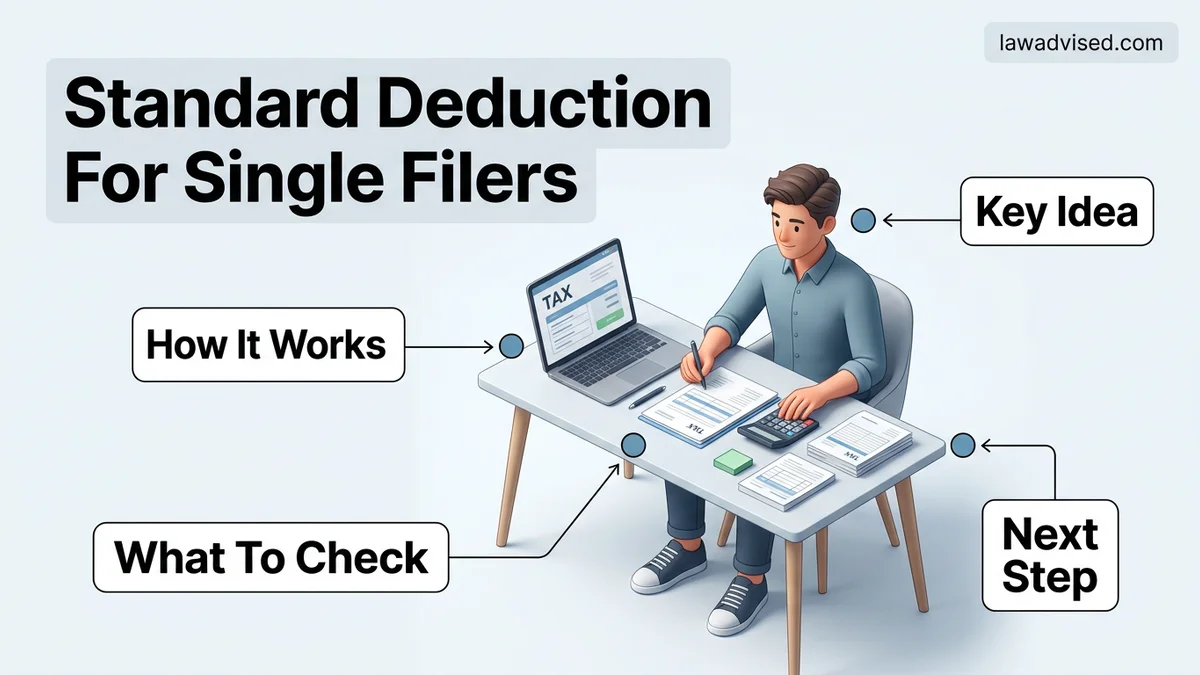
For the 2026 tax year, the IRS standard deduction for single filers is $15,000. If you file your federal income taxes as an unmarried individual, this is the baseline portion of your income that is completely shielded from federal income tax without needing to itemize a single receipt.
Knowing this exact figure matters practically because it sets the financial threshold where you decide whether to take the flat deduction or itemize. If your total deductible expenses—like mortgage interest, state and local taxes, and charitable donations—do not exceed $15,000 in 2026, taking the standard deduction is the faster, smarter choice that maximizes your take-home pay.
Key Takeaways
- The standard deduction for single filers reduces your overall taxable income significantly.
- Check IRS updates annually to ensure you apply the correct dollar threshold.
- Seniors aged 65 or older qualify for an additional standard deduction amount.
- Blind single filers are eligible for an extra tax break on their return.
- Compare itemized deductions against the standard amount to maximize your savings.
What Causes Confusion With the Standard Deduction for Single Filers
Annual Inflation Adjustments and Indexing
Many taxpayers run into trouble because they rely on outdated tax figures from previous years. The IRS adjusts the standard deduction annually to account for inflation through a process called indexing. What applied in 2024 or 2025 does not automatically apply to your 2026 return. Always check the official IRS inflation adjustments for the exact tax year you are filing to avoid underreporting or overcalculating your taxable income.
Filing Status Misclassifications
Another major source of confusion is mixing up filing statuses. You might consider yourself single in everyday life, but the IRS has strict definitions. For tax purposes, single filers are unmarried, divorced, or legally separated according to state law on the last day of the tax year, and do not qualify for head of household status. Using the wrong filing status will apply the incorrect standard deduction amount and trigger automatic IRS processing delays.
How to Calculate Your Taxable Income Using the Standard Deduction
Step-by-Step Subtraction From Gross Income
Calculating your taxable income using the 2026 single standard deduction is a straightforward mathematical process. You do not need to be a certified accountant to figure out your baseline numbers.
- Start with your total gross income (W-2 wages, freelance earnings, interest, and other taxable sources).
- Subtract any above-the-line adjustments to income, such as traditional IRA contributions or student loan interest deductions, to find your Adjusted Gross Income (AGI).
- Subtract the 2026 single standard deduction amount of $15,000 directly from your AGI.
- The resulting figure is your final taxable income, which determines the tax brackets applied to your return.
A Practical Calculation Example
Imagine your total gross income for 2026 is $65,000, and you have no above-the-line deductions. Your AGI remains $65,000. You subtract the $15,000 standard deduction for single filers. Your final taxable income drops to $50,000. The federal government will only calculate your income tax based on that $50,000 amount, saving you thousands of dollars compared to being taxed on your full earnings.
Step-by-Step Guide to Claiming Additional Deductions for Seniors and the Blind
Filing as a single taxpayer with specific visual or age-related criteria in 2026 unlocks extra tax savings. According to Internal Revenue Service inflation adjustments, single filers who are at least age 65 or legally blind by the final day of the tax year receive an increased standard deduction amount. If you meet both criteria, you can stack these additional amounts for maximum tax relief.
How to Apply Additional Standard Deductions
- Verify your eligibility status: Confirm your birthdate falls on or before January 1, 1962, to qualify for the 2026 senior deduction. For blindness, secure an official statement from your ophthalmologist or optometrist confirming central visual acuity of 20/200 or less in your better eye with corrective lenses.
- Locate the correct calculation worksheet: Open your Form 1040 instructions booklet for the 2026 tax year and navigate directly to the Standard Deduction Worksheet for Dependents or Standard Deduction Chart for People Age 65 or Older and Blind.
- Enter your baseline single amount: Input the standard baseline single filer amount into the first line of the designated calculation sheet.
- Add the appropriate increments: Enter the specific statutory additional amount for each qualifying condition (age and/or blindness) and add them together to establish your total 2026 standard deduction.
What If Your Itemized Deductions Are Higher Than the Standard Amount
Choosing between the standard deduction and itemizing deductions requires a direct mathematical comparison. According to tax economics research from the Tax Foundation, the vast majority of single filers utilize the standard deduction because it surpasses their cumulative itemized expenses. However, if your total deductible expenses exceed the 2026 single threshold, itemizing saves you more money.
Evaluating Itemized Expenses
- Compile your schedule A categories: Gather receipts and annual statements for state and local taxes (SALT) capped at $10,000, home mortgage interest on loans up to $750,000, charitable donations, and unreimbursed medical expenses exceeding 7.5 percent of your adjusted gross income.
- Compare against the 2026 threshold: Sum your itemized expenses. If this aggregate total is higher than the single standard deduction amount, you should itemize your deductions on Schedule A.
- Maintain comprehensive documentation: Store all receipts, appraisal records, and bank statements securely for at least three years in case the Internal Revenue Service audits your itemized returns.
What If It Still Doesn’t Work?
If you encounter complex financial situations, conflicting tax software messages, or unpredictable filing errors regarding your 2026 single standard deduction, strict fallback protocols are necessary. Do not guess on your tax return, as miscalculations trigger automated notices and potential penalties.
- Consult an enrolled agent or certified public accountant: Professional tax practitioners offer specialized expertise for complicated single-filer scenarios involving investment income, multiple jobs, or life changes. Certified public accountant and enrolled agent service fees typically range from $250 to $600 for standard individual federal and state returns.
- Utilize Internal Revenue Service Free File programs: If your 2026 adjusted gross income falls below the IRS threshold, access guided electronic filing software through the official IRS portal at no cost to ensure accurate deduction calculations.
- Submit Form 4868 for an extension: If you need additional time to resolve discrepancies or gather documentation for senior or blind adjustments, file for an automatic six-month tax extension before the April deadline.
Conclusion
Navigating the standard deduction for single filers in 2026 requires understanding baseline inflation adjustments, additional senior and blindness increments, and the mathematical tipping point for itemization. Applying these strategic guidelines prevents overpayment and ensures complete compliance with current tax regulations. According to verified research and expert sources from leading financial authorities, utilizing the correct deduction strategy remains the single most effective way to lower your annual tax liability. Review your specific financial documents and tax software calculations today to secure your maximum entitled deduction before the filing deadline.
❓ Frequently Asked Questions
How does the standard deduction for single filers work?
The standard deduction lowers your overall taxable income by a flat, predetermined amount established by the IRS. This reduces the total amount of income subject to federal income tax without requiring you to list individual expenses.
What happens if my income is below the standard deduction limit?
If your total gross income is less than the standard deduction for single filers, you generally are not required to file a federal income tax return, though you may still want to file to claim certain refundable credits or get a refund of withheld taxes.
Are there extra deductions for single filers over 65?
Yes, single filers who are age 65 or older by the end of the tax year are entitled to an additional standard deduction amount added on top of the base single deduction.
Can a blind single filer claim extra tax relief?
Single filers who are legally blind at the end of the tax year qualify for an additional standard deduction, similar to the senior tax provision.
Should I take the standard deduction or itemize?
You should choose whichever option gives you the highest deduction and lowest tax liability. If your total deductible expenses like mortgage interest and state taxes exceed the single filer standard deduction, itemizing may be better.
Can nonresident aliens use the standard deduction?
Nonresident alien individuals generally cannot take the standard deduction and must itemize their allowable deductions instead, with a few specific exceptions.

Ismail Hossain is the founder of Law Advised. He is an Divorce, Separation, marriage lawyer. Follow him.