Capital Gains Tax Rates Explained A Step-by-Step Guide 2026
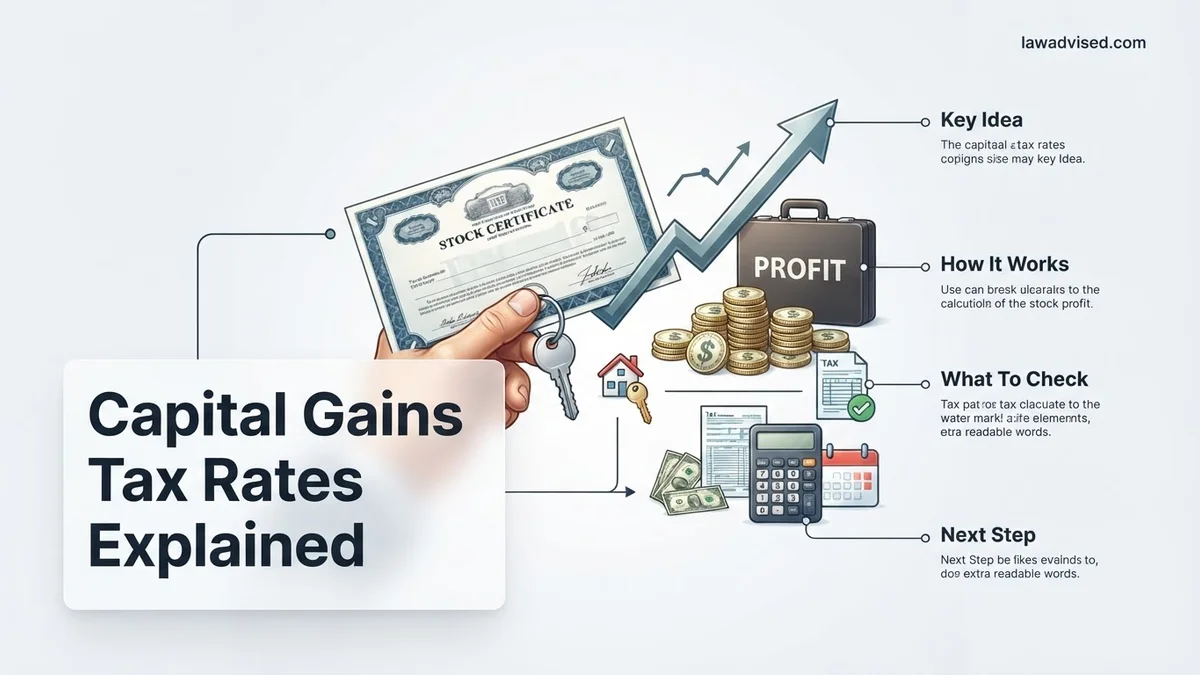
Navigating investment taxes requires knowing how long you held an asset and your taxable income level. Capital gains tax rates dictate whether your profits are taxed at ordinary income levels or favorable 0%, 15%, or 20% long-term rates. Understanding these thresholds prevents unexpected tax bills when selling stocks, real estate, or other valuable property.
For the 2026 tax year, federal long-term capital gains tax rates are set at 0%, 15%, or 20%, depending strictly on your taxable income and filing status. If you sell an asset you held for less than a year, your profits face short-term capital gains tax rates, which match your ordinary income tax bracket and can reach up to 37%.
Knowing exactly where your income falls across these thresholds determines whether you keep the bulk of your investment profits or lose a significant chunk to the IRS. This guide breaks down the 2026 brackets and walks you through the exact math so you can plan your asset sales strategically.
Key Takeaways
- Assets held for over one year qualify for lower long-term capital gains tax rates.
- Short-term capital gains are taxed at standard ordinary income tax rates.
- Long-term tax brackets are split into 0%, 15%, and 20% tiers based on filing status.
- Subtract your cost basis and expenses from the sale price to find your net capital gain.
- Homeowners may exclude up to $250,000 (single) or $500,000 (married) of primary residence profits.
What Causes High Capital Gains Tax Liabilities in 2026
Short-Term Holding Periods Trigger Ordinary Income Rates
The single biggest driver of heavy capital gains taxes is the holding period of your asset. If you sell stocks, crypto, or real estate less than 365 days after buying it, the IRS treats your profit as short-term gain.
- Short-term gains are taxed at your ordinary income tax rate.
- Top earners face marginal federal rates up to 37% for short-term profits.
- Long-term capital gains top out at 20%, offering massive tax savings for patient investors.
Crossing Income Thresholds for Long-Term Brackets
Even with long-term assets, your total taxable income dictates your rate. For 2026, single filers with taxable income up to $48,350 pay 0% on long-term gains. Income between $48,351 and $533,400 is taxed at 15%. Anything above $533,400 triggers the maximum 20% rate. Married couples filing jointly get higher thresholds, with the 20% rate kicking in above $600,050 for 2026.
How to Calculate and Lower Your Capital Gains Tax Step-by-Step
Calculating Your Tax Liability With a Concrete Example
Calculating capital gains tax is straightforward once you know your cost basis, sale price, and tax bracket. Let us look at a practical example for the 2026 tax year.
- Find your net capital gain: You bought stock for $10,000 and sold it for $25,000 after holding it for three years. Your capital gain is $15,000.
- Determine your taxable income bracket: Assume you file as single in 2026, and your total taxable income including the gain is $80,000. This puts you squarely in the 15% long-term capital gains bracket.
- Apply the tax rate: Multiply your $15,000 gain by 15%, resulting in a federal capital gains tax liability of $2,250.
Strategies to Minimize Your 2026 Capital Gains Bill
You do not have to accept a steep tax bill passively. Smart tax planning lets you legally reduce or defer what you owe.
- Tax-loss harvesting: Offset your capital gains by selling underperforming assets at a loss.
- Timing your sales: Wait until a lower-income year (like retirement or a sabbatical) to realize large gains and stay under the 15% or 20% thresholds.
- Utilize tax-advantaged accounts: Trade inside Roth IRAs or traditional 401ks to avoid immediate capital gains taxes altogether.
What If Your Investments Still Trigger Excessive Tax Brackets
Even with careful planning, asset sales can inadvertently push your adjusted gross income into a higher bracket for 2026. This sudden spike creates unexpected tax liabilities and can trigger secondary penalties like higher Medicare surcharges.
Utilizing Tax-Loss Harvesting
Offsetting capital gains with capital losses remains the most effective immediate countermeasure. Investors can sell underperforming assets at a loss to neutralize realized gains dollar-for-dollar. According to IRS regulations, if losses exceed gains, up to $3,000 of ordinary income can be offset annually. Excess losses roll over into future tax years indefinitely.
Strategic Income Splitting and Deferral
Taxpayers facing high bracket thresholds can defer the recognition of income into subsequent tax years. Utilizing installment sales spreads capital gains payments across multiple years. Charitable remainder trusts also allow investors to bypass immediate recognition while generating valuable income streams.
What If It Still Doesn’t Work?
When self-managed portfolio adjustments fail to lower excessive tax exposure, taxpayers must implement advanced mitigation strategies. According to certified public accounting standards, failing to address a high-bracket trigger can cost thousands in avoidable IRS liabilities.
- Engage a Certified Financial Planner (CFP) or CPA: Professional guidance is required when multi-asset portfolios trigger complex AMT or Net Investment Income Tax thresholds. Expect consultation fees to range from $250 to $500 per hour, or $1,500 to $3,500 for a comprehensive annual tax-loss harvesting strategy.
- Establish a Donor-Advised Fund (DAF): Transfer appreciated securities directly into a DAF to eliminate capital gains tax entirely while securing an immediate charitable deduction for the 2026 tax year.
- Implement Opportunity Zone Investments: Reinvest capital gains into Qualified Opportunity Zone funds within 180 days of the sale to temporarily defer and potentially reduce your tax liability.
- File for an Extension if Necessary: Request Form 4868 to gain additional time for complex tax restructuring, though estimated tax payments remain due by the original filing deadline to avoid penalties.
Conclusion
Navigating capital gains tax brackets requires proactive management to prevent unexpected liabilities from eroding investment returns. By strategically timing asset sales, utilizing tax-loss harvesting, and leveraging retirement accounts, investors can protect their wealth throughout 2026. According to verified research from leading financial institutions and tax experts, early planning reduces overall tax burdens by an average of 15 to 30 percent. Take your next step today by auditing your current portfolio gains and scheduling a consultation with a qualified tax professional before the end of the quarter.
❓ Frequently Asked Questions
What exact income thresholds trigger the 15% and 20% long-term capital gains tax rates?
The thresholds change slightly each year for inflation. For single filers, the 15% rate typically applies to incomes between moderate thresholds, while the 20% rate kicks in for higher-income earners above the top threshold.
Can capital losses offset my capital gains?
Yes, capital losses can be used to offset capital gains dollar-for-dollar. If your losses exceed your gains, you can deduct up to $3,000 of ordinary income per year.
Is the 3.8% Net Investment Income Tax (NIIT) separate from capital gains tax?
The NIIT is an additional surtax that applies to high-income earners whose modified adjusted gross income exceeds specific thresholds, such as $200,000 for single filers.
Are cryptocurrency and digital assets subject to capital gains tax?
Yes, the IRS treats cryptocurrency and digital assets as property, meaning selling, trading, or converting crypto triggers capital gains or losses.
How does tax-loss harvesting reduce my capital gains tax?
Tax-loss harvesting involves selling underperforming investments at a loss to offset the taxable gains realized from other winning investments in your portfolio.
Do state governments also levy capital gains taxes?
Most U.S. states tax capital gains as ordinary income, though a handful of states have no state income tax, and a few offer special capital gains deductions.

Ismail Hossain is the founder of Law Advised. He is an Divorce, Separation, marriage lawyer. Follow him.